Intent-Based Crypto Development
Introduction to Blockchain
Blocks in a Chain
At its heart, a blockchain is a special kind of database, a digital ledger. Think of it like a shared notebook that's passed among a group of people. Every time someone wants to add a new entry, they write it on a new page. Once the page is full, it gets added to the notebook.
In a blockchain, these "pages" are called blocks, and the "notebook" is the chain.
Each block contains a batch of transactions. But what makes it a chain is how the blocks are linked. Each new block contains a unique digital fingerprint, called a hash, of the block that came before it. This creates a cryptographic link, chaining them together in chronological order. If someone tried to alter an old block, its hash would change. This would break the link to the next block, and the discrepancy would be obvious to everyone on the network. This structure makes the entire chain incredibly secure and tamper-proof.
The Power of Decentralization
Traditional ledgers, like the ones your bank uses, are centralized. One organization owns and controls the data. If their server goes down or their records are compromised, you have a big problem. A blockchain, however, is typically decentralized.
This means that instead of one central copy, the ledger is distributed across a network of computers around the world. Every participant, or node, on the network has their own copy of the entire chain. There's no single person or company in charge.
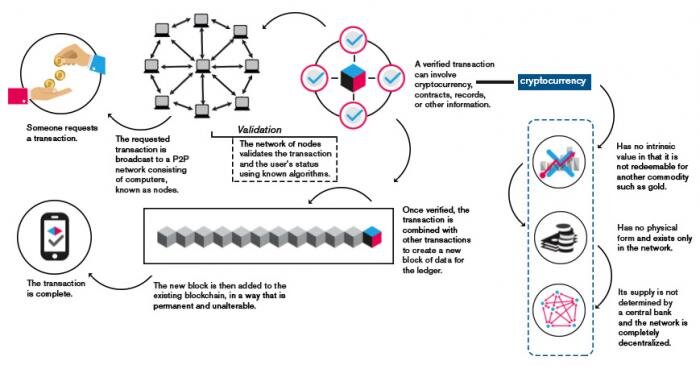
This setup has powerful implications. First, it's incredibly resilient. To take the network down, you'd have to attack thousands of computers simultaneously. Second, it promotes transparency. Since many people have a copy of the ledger, everyone can verify the transactions for themselves. It's very difficult for any single party to cheat the system or censor transactions they don't like.
Reaching an Agreement
If everyone has a copy of the ledger, how does the network agree on which new transactions are valid and should be added to the chain? This is solved using a consensus mechanism. It's a set of rules that allows the decentralized network to reach an agreement, or consensus, without a central authority.
There are many different types, but two are the most common.
Consensus
noun
A general agreement among the participants in a distributed network about the current state of the ledger.
Proof of Work (PoW) is the original consensus mechanism, used by Bitcoin. In this system, participants called "miners" compete to solve a complex mathematical puzzle. The first one to solve it gets to propose the next block and is rewarded with cryptocurrency. This process requires significant computational power, which helps secure the network.
Proof of Stake (PoS) is a newer, more energy-efficient alternative. Instead of miners, you have "validators." To get a chance to create a new block, validators lock up, or "stake," a certain amount of their own cryptocurrency as collateral. The network then chooses a validator to create the next block, often based on the size of their stake. If they act dishonestly, they can lose their staked coins.
| Feature | Proof of Work (PoW) | Proof of Stake (PoS) |
|---|---|---|
| Participants | Miners | Validators |
| How blocks are added | Solving a computational puzzle | Staking crypto as collateral |
| Energy Use | High | Low |
These core ideas—the linked blocks, the decentralized network, and the consensus mechanism—are the foundation of blockchain technology. They work together to create a secure, transparent, and resilient way to record and verify information.
Ready to check your understanding? Let's see what you've learned.
What is the primary function of a cryptographic hash in a blockchain?
In a decentralized blockchain network, the ledger is stored on a single, central server for maximum security and control.
Understanding these foundational concepts is the first step to grasping how cryptocurrencies and the applications built on them actually work.