Intelligent Agent Development
Introduction to Agents
What Is an AI Agent?
At its core, an artificial intelligence (AI) agent is a system that can observe its environment, make decisions, and take actions to achieve a specific goal. Think of it as an autonomous entity that acts on your behalf. It could be a software program that books a flight for you, a robot navigating a warehouse, or a smart thermostat adjusting your home's temperature.
An agent perceives its environment through sensors and acts upon that environment through actuators.
This definition is broad, but it captures the essence of what makes an agent special. It's not just a passive tool; it's an active participant in a process. The "sensors" might be a camera, a microphone, or data feeds from the internet. The "actuators" could be robotic arms, a synthesized voice, or commands sent to another software application.
Agent
noun
An entity that perceives its environment and takes actions to achieve specific goals.
The Agent Through Time
The concept of agents isn't new. It has roots in the early days of AI research, dating back to the 1950s. Early AI focused on logic and reasoning, creating systems that could solve well-defined problems like playing chess. These were some of the first, albeit simple, agents. They perceived the board state (environment) and chose a move (action) to achieve a goal (checkmate).
As computing power grew, so did the complexity of agents. In the 1970s and 80s, the idea of "distributed AI" emerged, where multiple agents would work together to solve a problem that was too large for any single agent. This laid the groundwork for today's multi-agent systems, where teams of bots might collaborate to manage a power grid or coordinate self-driving cars in traffic.
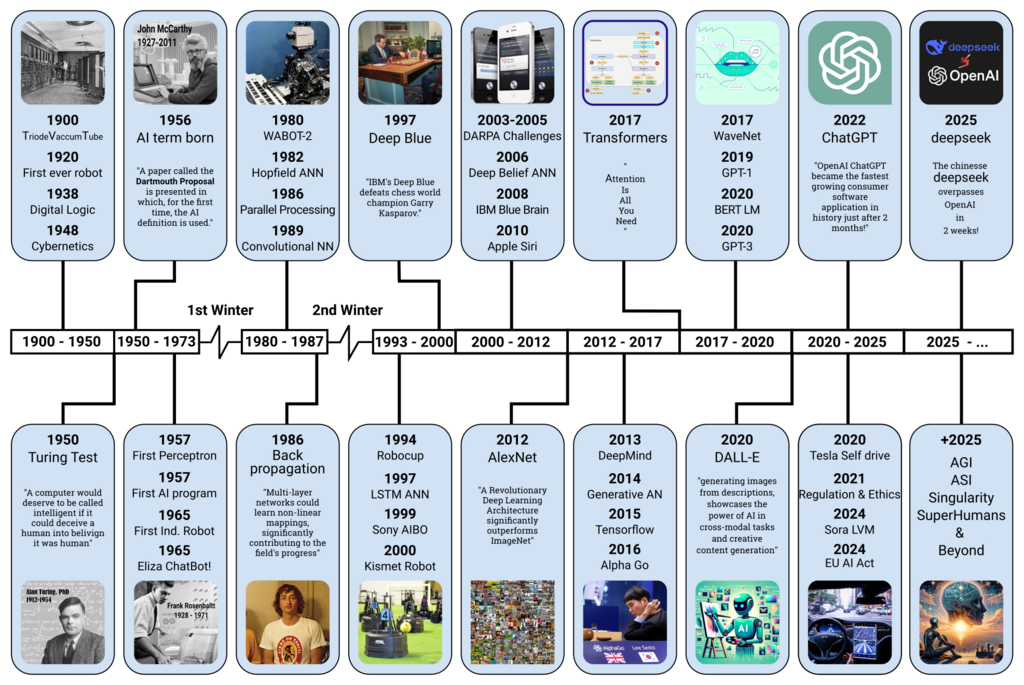
The arrival of the internet in the 1990s was a major turning point. Suddenly, agents had access to a vast, dynamic environment. This led to the development of web crawlers (agents that index websites for search engines) and early e-commerce bots. With the recent explosion of large language models (LLMs) like GPT, the capabilities of agents have taken another leap. Modern agents can understand natural language, reason about complex tasks, and interact with a wide array of digital tools.
A Family of Agents
Agents come in many forms, each suited for different tasks. We can classify them based on their intelligence and capabilities. Let's look at a few common types, from the simplest to the more complex.
| Agent Type | How It Works | Simple Example |
|---|---|---|
| Simple Reflex Agent | Acts only based on the current situation, using if-then rules. | A smart thermostat that turns on the heat if the temperature drops below 68°F. |
| Model-Based Reflex Agent | Maintains an internal model of the world to track things it can't see right now. | A self-driving car that remembers a pedestrian is hidden behind a bus. |
| Goal-Based Agent | Considers future outcomes to choose actions that will achieve a specific goal. | A GPS navigation system finding the best route to a destination. |
| Utility-Based Agent | Aims for the best possible outcome when there are multiple ways to achieve a goal. | A flight-booking agent that finds a route that's not just the cheapest, but also has the shortest layover. |
As you move down the table, each type of agent builds on the one before it, adding more sophisticated ways of thinking and acting. This hierarchy allows developers to choose the right level of complexity for the job. You don't need a utility-based agent to run a simple thermostat.
The concept of the 'agent' has profoundly shaped Artificial Intelligence (AI) research, guiding development from foundational theories to contemporary applications like Large Language Model (LLM)-based systems.
The significance of agents in AI is immense. They provide a powerful framework for building systems that can handle complex, dynamic tasks in the real world. From personal assistants on our phones to complex systems managing supply chains, agents are the driving force behind much of the AI we interact with daily.
By breaking down problems into perception, decision-making, and action, the agent model gives us a clear way to build and understand intelligent systems.
Time to check what you've learned.
What are the three fundamental components of an AI agent's operation cycle?
An early example of an AI agent, as described in the text, is a system designed to do what?
Understanding these core concepts is the first step. Next, we'll explore how these agents are designed and what components make them work.