Integration Made Simple
Understanding Integration
Finding Area with Curves
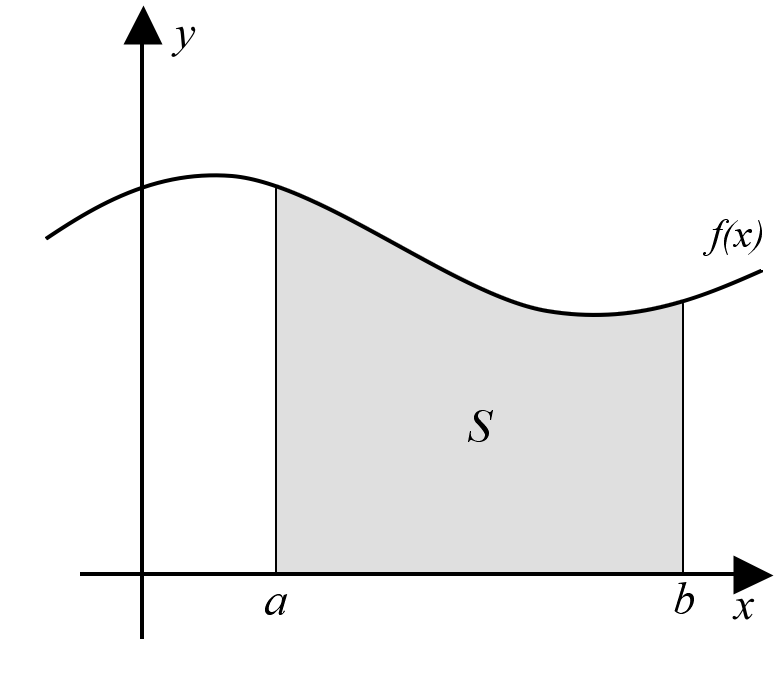
Imagine you want to paint a wall, but the top of the wall is a big, wavy curve. How would you figure out exactly how much paint you need? Calculating the area of a square or a rectangle is easy: length times width. But what about a shape with a curved side?
This is where a powerful tool in math called integration comes in. At its heart, integration is a way to find the area under a curve.
To understand this, we can start with a simple straight-line curve. Let's look at the graph of the function . If we want to find the area under this line between where is 0 and where is 4, we create a shape. What shape is it?
It's a triangle! We already know how to find the area of a triangle: . In this case, that's . So, the area under the curve from 0 to 4 is 8.
Integration gives us a way to do this for any curve, not just simple straight lines. The symbol for integration looks like a tall, skinny 'S'.
This expression means "find the area under the curve of the function from point to point on the x-axis."
The Reverse of Differentiation
In the last section, we learned about differentiation, which helps us find the rate of change, or the slope, of a curve at any point. Integration does the opposite. It's the reverse process of differentiation.
If you have a function that tells you the distance a car has traveled, differentiating it gives you the car's speed. If you have a function for the car's speed, integrating it tells you the total distance it has traveled. One process breaks things down, and the other builds them back up.
Differentiation asks: What is the slope of this curve? Integration asks: What is the area under this curve?
Because they are opposites, we can use what we know about derivatives to find integrals. For example, we know that the derivative of is . So, if we are asked to find the integral of , the answer must be . We're just thinking backward!
The Power Rule for Integrals
Just like with derivatives, there's a simple pattern for integrating functions with exponents, called the power rule. To integrate a term like , you do the reverse of the power rule for derivatives.
- Add one to the exponent.
- Divide by the new exponent.
So, the integral of would be . You can check this by finding the derivative of , which gets you right back to . What about the integral of ? It would be .
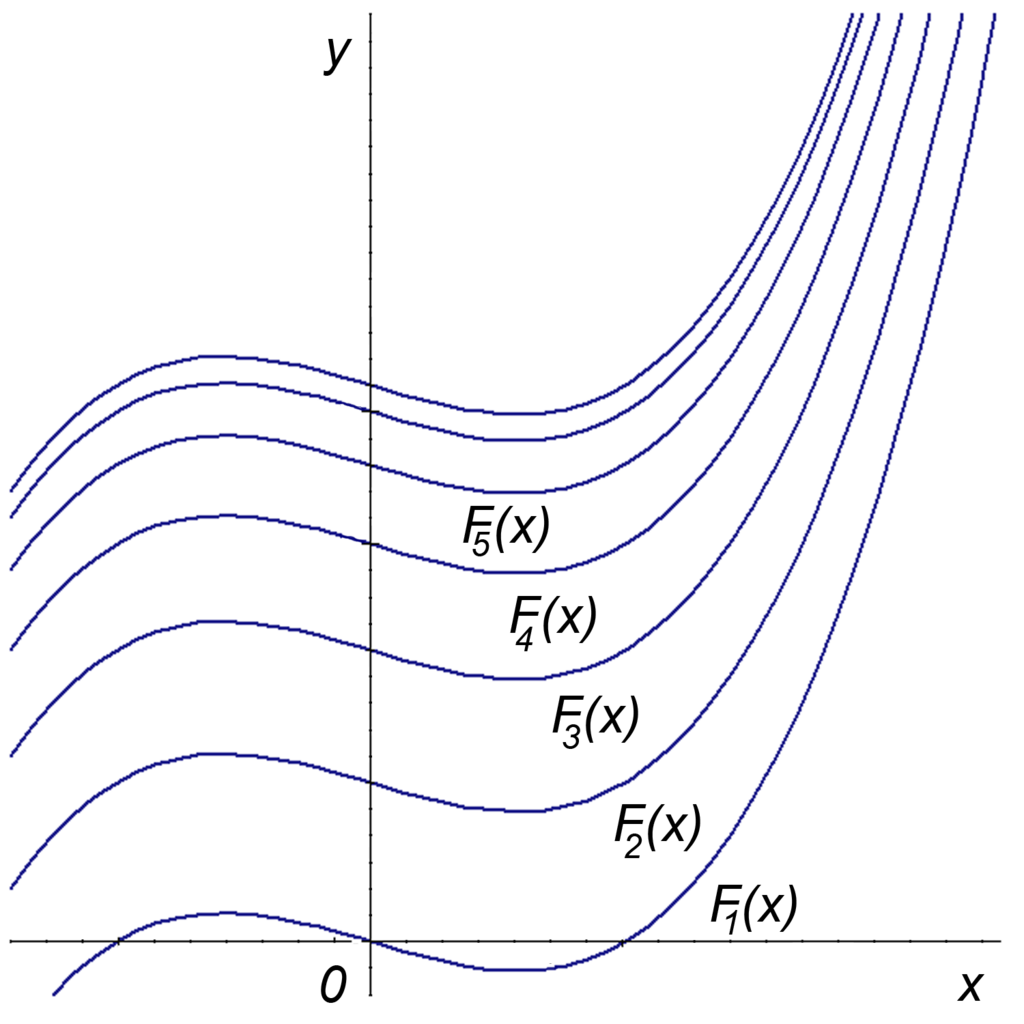
There's one small catch. The derivative of is . But the derivative of is also , because the constant (5) disappears. The derivative of is also .
When we integrate, we don't know if there was a constant there or not. So, we add a '' to our answer to represent any possible constant that might have existed. This is called the 'constant of integration'.
All the functions shown below have the exact same derivative. When we integrate, the '' accounts for the fact that the original function could have been any one of these curves, just shifted up or down.
That's the basic idea of integration. It's a way to sum up countless tiny pieces to find a whole, whether that whole is an area, a volume, or a total distance traveled.
What is the primary purpose of integration as described in the text?
How are the mathematical concepts of integration and differentiation related?