Integrating Policy Implementation and Research Frameworks
Policy Implementation Determinants Framework
A Framework for Success
Why do some policies succeed while others fail? A great idea is only the first step. Getting a policy from a document into the real world is a complex journey. The Policy Implementation Determinants Framework, or PIDF, gives us a map for that journey. It helps us understand the crucial factors that determine whether a policy will actually work as intended.
Developed by researchers to untangle the complexities of implementation, the PIDF isn't just an academic exercise. It's a practical tool for policymakers, project managers, and anyone involved in turning plans into action. It systematically breaks down the process and the environment, allowing for a clearer view of potential roadblocks and opportunities.
The framework is built on two core components: the policy process and the determinants. Think of the process as the sequence of actions taken, and the determinants as the surrounding conditions that help or hinder those actions.
The Policy Process
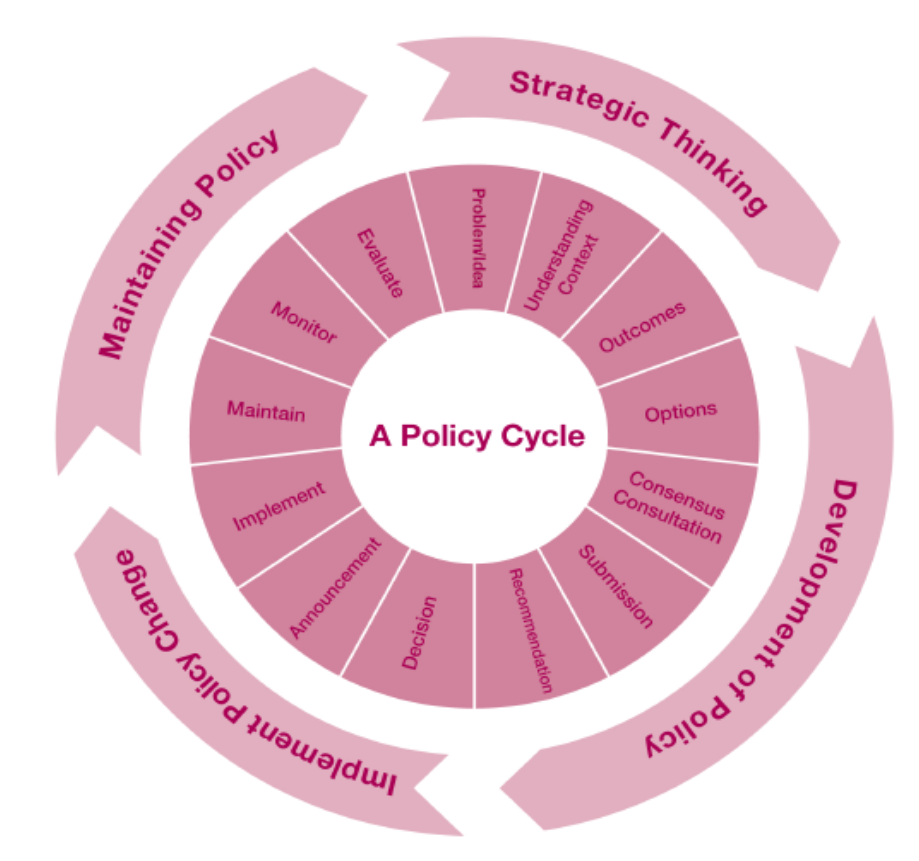
The policy process is the lifecycle of a policy, typically broken down into a few key stages. While it looks like a neat, linear progression, in reality, these stages often overlap and influence each other.
Agenda Setting: Getting the problem recognized and onto the official agenda. Formulation: Developing and debating potential solutions and policy options. Implementation: Putting the chosen policy into practice. This is where the real work happens. Evaluation: Assessing the policy's effectiveness and outcomes.
Understanding this lifecycle is the first step. It helps identify what should be happening at any given moment and what the immediate goals are. But the process doesn't happen in a vacuum.
The Determinants
Determinants are the specific factors within the political, economic, social, and organizational environment that can make or break a policy. The PIDF groups them into several categories to make them easier to analyze. Ignoring these is like planning a long road trip without checking the weather forecast or the condition of your car.
| Determinant Category | Description | Example |
|---|---|---|
| Political | The level of government support, political stability, and stakeholder interests. | A new environmental regulation has strong public support but faces opposition from powerful industry lobbyists. |
| Economic | The availability of funding, economic conditions, and resource allocation. | A public health initiative is well-designed but can't be fully implemented due to budget cuts. |
| Social & Cultural | Public values, social norms, and the demographic characteristics of the population. | A policy promoting bicycle commuting is more successful in a city with an existing culture of fitness and environmentalism. |
| Organizational | The capacity, skills, and structure of the agencies responsible for implementation. | A school district has the funding for new technology but lacks the IT staff and teacher training to use it effectively. |
How They Interact
The magic of the PIDF is in understanding the constant interplay between the process and the determinants. The determinants don't just matter at the beginning; they affect every single stage.
For example, during Agenda Setting, a lack of political will (a political determinant) can prevent a critical issue from ever being discussed. During Formulation, economic constraints (an economic determinant) might limit the possible solutions. When it's time for Implementation, the organizational capacity of the responsible agency becomes paramount. And finally, during Evaluation, social values (a social determinant) can influence how the policy's success is perceived by the public.
Think of it like building a house. The process is your blueprint and construction schedule. The determinants are the quality of your materials, the skill of your crew, the stability of the ground you're building on, and your available budget. A flawless blueprint won't matter if your foundation is shaky or you run out of money halfway through.
Let's consider a practical example: a city's plan to implement a new public transit line.
At the agenda setting stage, advocacy from community groups (social determinant) gets the issue attention. During formulation, the city council must weigh different routes, considering both the cost (economic determinant) and which neighborhoods have the most political influence (political determinant).
When it comes to implementation, the transit authority's ability to manage a large construction project and hire new drivers (organizational capacity) is critical. Finally, after a year, the evaluation will look at ridership numbers, but public perception (social determinant) will also shape whether the project is deemed a success, regardless of the data.
What are the two core components of the Policy Implementation Determinants Framework (PIDF)?
A city has a great plan for a new park, but it never gets discussed by the city council because powerful business interests oppose it. This failure is occurring at the Agenda Setting stage due to a lack of which determinant?
By systematically considering these factors at each step, policymakers can anticipate challenges, allocate resources more effectively, and design policies that are more likely to achieve their intended goals.