Integrated Systems of Human Anatomy
Musculoskeletal Mechanics
Bones as Levers
Your skeleton is more than just a passive frame. It's a dynamic system of levers that allows you to interact with the world. Every time you lift an object, kick a ball, or even nod your head, your bones, joints, and muscles are working together as a mechanical system. The long bones of your limbs are the rigid bars of these levers, while your joints act as the fulcrums, or pivot points.
These lever systems are categorized into three classes, based on the relative positions of the fulcrum (the joint), the effort (the muscle insertion point), and the resistance (the load being moved). Most of the levers in the human body are Class 3. This arrangement prioritizes speed and range of motion over raw force. For example, a small contraction of your bicep muscle results in a much larger, faster movement at your hand. This is a trade-off; we sacrifice some mechanical advantage for the ability to move our limbs quickly through a wide arc.
Joints The Articulation of Movement
Levers need pivots. In the body, these pivots are the synovial joints, where bones articulate to allow movement. The shape of the articulating bone surfaces dictates the type of movement possible. This form-follows-function relationship is central to biomechanics. A simple hinge joint, like your elbow, primarily allows motion in one plane (flexion and extension). In contrast, a ball-and-socket joint, like your shoulder, permits movement in all three planes, granting it a huge range of motion.
| Joint Type | Axes of Motion | Example |
|---|---|---|
| Hinge | Uniaxial | Elbow, Knee |
| Pivot | Uniaxial | Atlanto-axial joint (C1-C2 vertebrae) |
| Saddle | Biaxial | Carpometacarpal joint of the thumb |
| Condyloid | Biaxial | Wrist (radiocarpal) joint |
| Plane | Non-axial (gliding) | Intercarpal joints (in wrist) |
| Ball-and-Socket | Multiaxial | Shoulder, Hip |
This diversity in joint structure leads to a fundamental trade-off between mobility and stability. The shoulder joint is a perfect example of high mobility at the cost of stability. Its shallow socket allows for incredible range, but also makes it prone to dislocation. The hip joint, on the other hand, has a deep socket that securely holds the head of the femur. This provides immense stability for weight-bearing and locomotion, but with a more limited range of motion compared to the shoulder. Stability isn't just about bone structure; it's also about the supporting cast of ligaments and muscles.
Ligaments provide passive stability, acting like strong ropes that connect bone to bone and restrict excessive movement. Muscles provide active stability, constantly adjusting their tension to hold a joint in place.
The Engine of Motion
Muscles are the motors that power our lever systems. But how does a thought in your brain translate into a powerful contraction? The answer lies at the microscopic level, within the functional units of muscle fibres called sarcomeress. The sliding filament theory describes how this works. Inside each sarcomere, thick filaments (myosin) and thin filaments (actin) are arranged in parallel. When a muscle contracts, the myosin heads bind to actin, forming cross-bridges. They then pull the actin filaments toward the centre of the sarcomere, causing it to shorten. This process, repeated across millions of sarcomeres, results in the macroscopic shortening of the entire muscle.
A muscle doesn't contract with the same force every time. The nervous system precisely controls the strength of contraction through a process called motor unit recruitment. A consists of a single motor neuron and all the muscle fibres it innervates. For a fine, delicate movement like threading a needle, the brain recruits only a few small motor units. For a powerful action like lifting a heavy box, it recruits many large motor units simultaneously. This allows for a graded response, matching muscle force to the task at hand.
Coordinated Action
Movement is rarely the result of a single muscle working in isolation. Muscles are organized into functional groups that work in coordination. The prime mover, or agonist, is the muscle primarily responsible for a given movement. As the agonist contracts, another muscle, the antagonist, relaxes and lengthens. This pairing is essential for controlled, fluid motion.
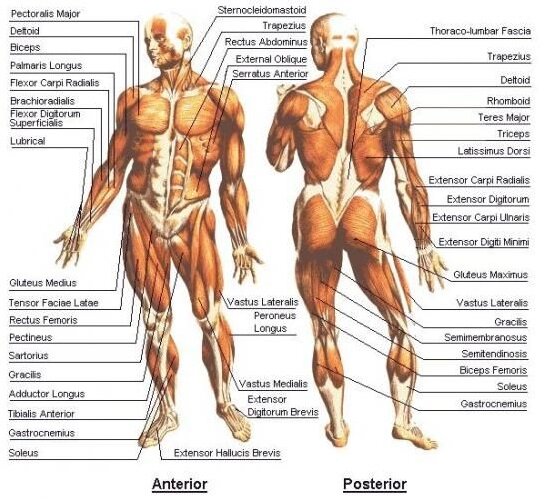
Consider the simple action of bending your elbow. The biceps brachii acts as the agonist, contracting to flex the arm. At the same time, its antagonist, the triceps brachii, must relax to allow the movement to occur. When you straighten your arm, their roles reverse: the triceps becomes the agonist and the biceps the antagonist. This agonist-antagonist relationship acts as a braking system, preventing jerky, uncontrolled movements and adding stability to the joint.
This intricate dance between bones, joints, and muscles allows for the incredible range of human movement, from the brute force of a powerlifter to the delicate precision of a surgeon.
Time to check your understanding of these mechanical principles.
Most levers in the human body are Class 3. What is the primary advantage of this arrangement?
The relationship between joint mobility and stability is a crucial trade-off. Which statement best describes the comparison between the shoulder and hip joints?
Understanding these biomechanical principles moves us beyond simple anatomy, revealing the elegant engineering that underpins every action we take.