Integrated Scientific Principles and Applications
Integrated Thermodynamics
Thermodynamics in Living Systems
The laws of thermodynamics weren't conceived with biology in mind. They were developed to describe the efficiency of steam engines. Yet, these same principles govern every process inside a living cell. The first law, conservation of energy, means that organisms can't create energy from nothing; they must transform it from other sources, like sunlight or food. The second law states that the total entropy, or disorder, of the universe always increases. At first glance, this seems to contradict the very nature of life, which is highly ordered.
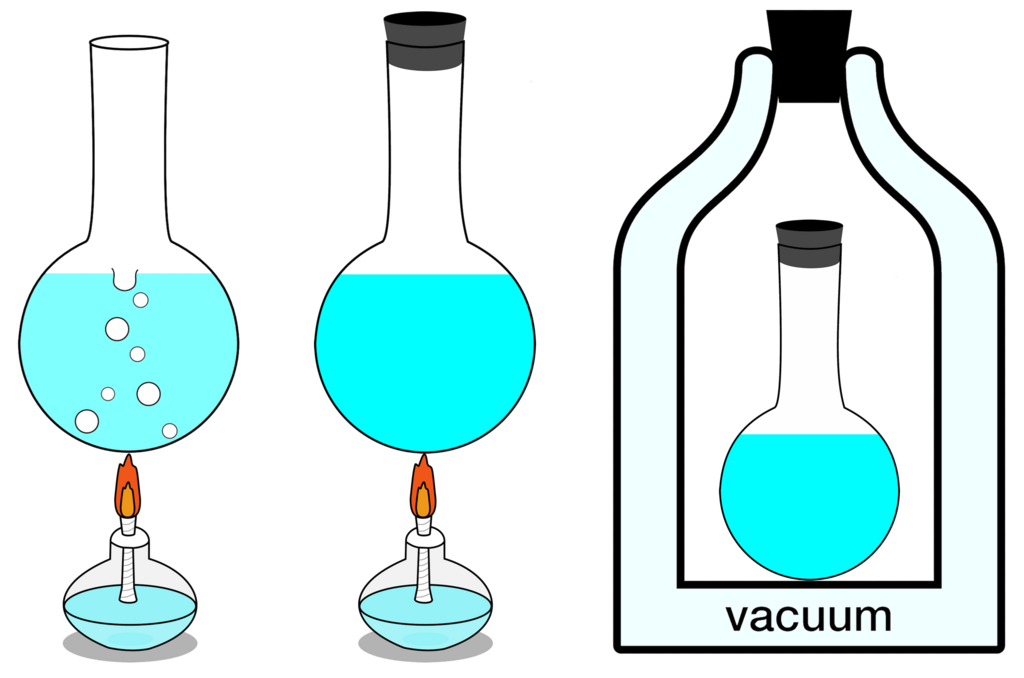
The key is that organisms are not isolated systems. They are open systems, constantly exchanging energy and matter with their surroundings. A cell maintains its internal order by taking in energy-rich molecules (like glucose) and breaking them down, releasing heat and less-ordered waste products (like and ) into the environment. This process increases the total entropy of the system and its surroundings, satisfying the second law while allowing for the creation of localized order.
The Currency of Spontaneity
How do we predict whether a biological process, from protein folding to DNA replication, will happen on its own? We need a way to account for both the change in heat (enthalpy) and the change in disorder (entropy). This is where Gibbs free energy comes in. It's the portion of a system's energy that can perform work. The change in Gibbs free energy () during a reaction determines its spontaneity.
This equation reveals a crucial trade-off. A reaction can be spontaneous even if it creates order ( is negative), as long as it releases enough heat ( is sufficiently negative) to overcome the entropy term. Conversely, a reaction that absorbs heat ( is positive) can still be spontaneous if it increases disorder enough ( is sufficiently positive). Biochemistry is filled with examples of this balancing act.
Paying for Biological Work
Many essential biological processes, like building proteins or contracting muscles, are endergonic. They require an input of energy to proceed. Life solves this problem through energy coupling: pairing an energetically unfavorable reaction with a highly favorable one. The most common favorable reaction used is ATP hydrolysis—the breakdown of adenosine triphosphate (ATP) into adenosine diphosphate (ADP) and an inorganic phosphate group ().
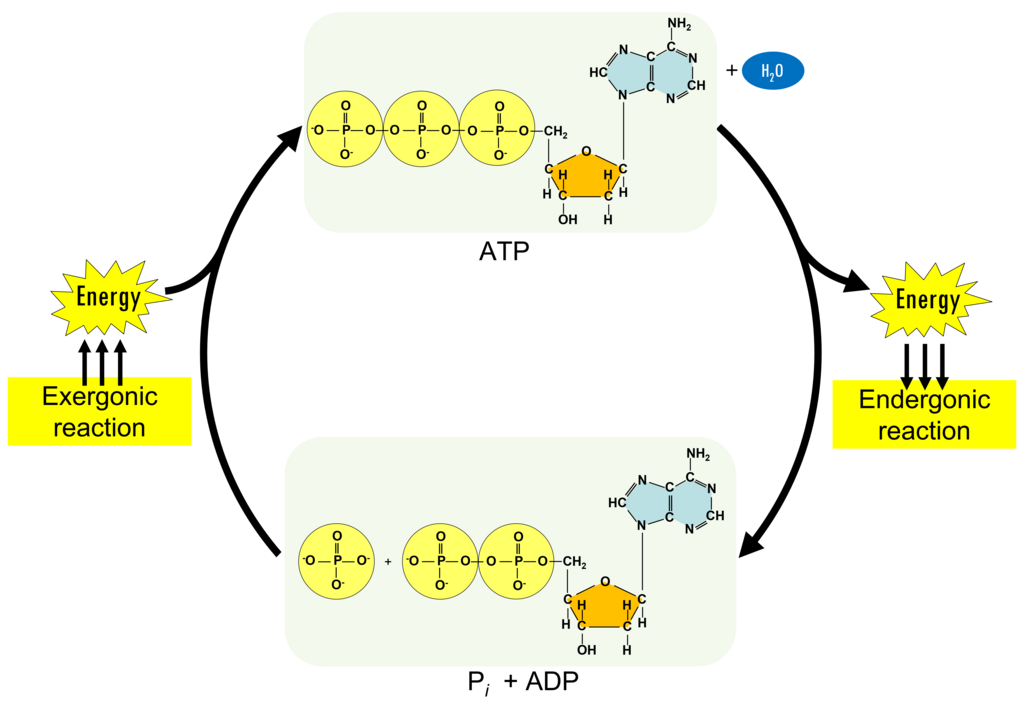
The hydrolysis of ATP releases a significant amount of free energy (about -30.5 kJ/mol under standard conditions). This burst of energy can be harnessed to drive a coupled endergonic reaction forward. Think of it like using the energy from water flowing downhill to turn a water wheel that lifts a bucket of water uphill. The overall process is spontaneous because the negative from ATP hydrolysis is larger than the positive of the work-performing reaction.
This coupling is the foundation of bioenergetics and is visible throughout metabolic pathways like cellular respiration. Instead of releasing all the energy from glucose in one explosive step (like burning it), the process unfolds over dozens of small, controlled reactions. At key steps, the released energy is captured to regenerate ATP from ADP. This multi-step approach is far more efficient, minimizing waste heat and maximizing the amount of useful energy captured for cellular work.
Efficiency and Complexity
The efficiency of energy transfer dictates the complexity of a system, whether it's a heat engine or a cell. In thermodynamics, the maximum theoretical efficiency of a heat engine is described by the Carnot cycle. While no real engine, biological or mechanical, can reach this ideal, the principle holds: the greater the temperature difference it can exploit, the more work it can do. Biological systems don't use large temperature gradients, but they achieve high efficiency through chemical gradients and the precise, enzyme-catalyzed reactions of metabolism. The tiered, cascading nature of metabolic pathways allows for a highly efficient extraction of energy from fuel, enabling the immense complexity we see in living organisms.
Living organisms create and maintain a high degree of internal order. How is this accomplished without violating the Second Law of Thermodynamics, which states that the total entropy of the universe always increases?
What is the primary function of ATP hydrolysis in cellular metabolism?
This integration of physical laws and biological processes shows that life doesn't defy thermodynamics; it is a masterful expression of it.