Integrated Neuroscience and Consciousness
Arousal and Awareness
The Two Sides of Consciousness
Consciousness isn't a single switch that's either on or off. It has two distinct dimensions: arousal and awareness.
Arousal is the state of being awake and alert. It's the physiological and psychological state of being responsive to stimuli. Think of it as the power supply to your brain. Without it, nothing else happens.
Awareness, on the other hand, is the content of your experience. It’s the stream of thoughts, sensations, and feelings that you perceive. If arousal is the TV being turned on, awareness is the specific show playing on the screen. You can be aroused but have limited awareness, as in certain dream states or neurological conditions.
The Engine of Wakefulness
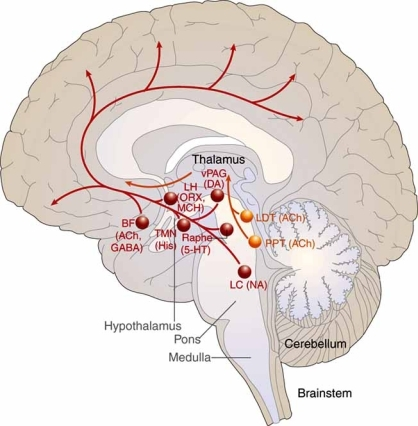
The primary driver of arousal is a network deep within the brainstem called the (ARAS). Located in the pons and midbrain, this collection of nuclei acts as the brain's ignition switch. It doesn't create the content of consciousness, but it generates the state of wakefulness required for awareness to occur.
The ARAS projects its signals upward to two key relay stations: the thalamus and the basal forebrain. From there, the alert signal is broadcast widely across the entire cerebral cortex, increasing its excitability and preparing it to process information. This constant stream of input from the ARAS is what keeps you awake and attentive throughout the day.
The Chemistry of Arousal
The ARAS doesn't work with electricity alone. It uses a cocktail of powerful neurotransmitters to modulate cortical activity. Several key players originate from specific nuclei within this system.
- Acetylcholine: Produced in the pons and basal forebrain, acetylcholine is crucial for alertness and attention. It enhances the responsiveness of cortical neurons to sensory input.
- Norepinephrine: Originating from the in the pons, this neurotransmitter boosts vigilance and arousal. It helps you stay focused and react quickly to new or important stimuli.
- Dopamine: While famous for its role in reward, dopamine from the ventral tegmental area (VTA) also contributes to wakefulness and motivation to engage with the world.
When the Switch Fails
The ARAS's critical role is most starkly demonstrated by what happens when it's damaged. The entire system is packed into the narrow brainstem, making it vulnerable.
A small lesion from a stroke, tumor, or trauma can disrupt the ARAS and its projections. When this happens, the cortex no longer receives its wake-up call. The result is a profound loss of arousal, leading to a coma or a — a condition where a person is awake (eyes may be open) but shows no signs of awareness.
This illustrates a crucial point: an intact cerebral cortex is not enough for consciousness. Without the arousal signals from the brainstem, the cortex remains 'offline,' unable to generate the rich tapestry of experience we know as awareness. Consciousness is not the property of any single brain region, but an emergent function of a distributed network, with the brainstem acting as its foundational power source.
Before you go, let's test your understanding of the brain's arousal system.
According to the TV analogy for consciousness, if arousal is the state of the TV being powered on, what represents awareness?
What is the primary function of the Ascending Reticular Activating System (ARAS)?
Understanding the distinction between arousal and awareness, and the vital role of the ARAS, is fundamental to grasping the neural underpinnings of consciousness.