Integrated Human Physiology and Organ Systems
Systemic Neural Control
The Autonomic Command Center
Your nervous system is constantly making decisions without your input. It adjusts your heart rate as you climb a flight of stairs, signals your stomach to digest lunch, and widens your pupils in a dim room. This silent, automatic regulation is the work of the autonomic nervous system (ANS).
The ANS is split into two main branches that act like a gas pedal and a brake for your body's systems: the sympathetic and parasympathetic divisions. You've likely heard of them as "fight or flight" (sympathetic) and "rest and digest" (parasympathetic). While this is a useful starting point, their relationship is more of a constant, delicate balancing act. They work in opposition to maintain a stable internal environment, a state known as homeostasis.
Think of it as autonomic tone. Both systems are always active to some degree, and your body dials one up and the other down depending on the immediate need.
When you're faced with a sudden stressor, like swerving to avoid a car, the sympathetic nervous system takes the lead. It rapidly increases heart rate, slows digestion, and redirects blood flow to your muscles, preparing your body for immediate action. Once the danger has passed, the parasympathetic system gently applies the brakes, slowing your heart rate and restarting digestive processes to conserve energy. This coordinated push and pull is how your body adapts to a constantly changing world.
The Hypothalamus Bridge
While the ANS operates locally at each organ, it needs a central conductor to orchestrate the whole symphony. This role is filled by the hypothalamus, a small but powerful region at the base of the brain. It acts as the critical link between the nervous system and the endocrine (hormone) system, integrating signals from both the body's internal state and the external environment.
Hypothalamus integrates signals from the body and environment to coordinate physiological responses
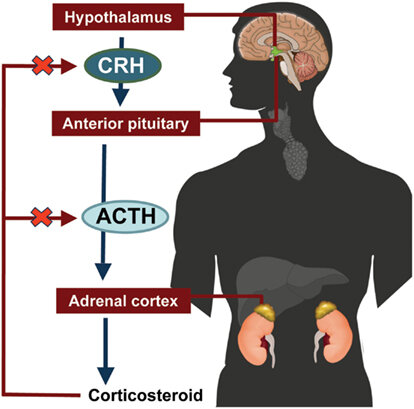
When the hypothalamus perceives a significant, ongoing stressor—one that requires more than a momentary sympathetic jolt—it initiates a slower, more sustained response through the Hypothalamic-Pituitary-Adrenal (HPA) axis. This is a cascade of hormonal signals.
First, the hypothalamus releases Corticotropin-Releasing Hormone (CRH).
CRH travels a short distance to the pituitary gland, telling it to release Adrenocorticotropic Hormone (ACTH) into the bloodstream.
ACTH then travels to the adrenal glands, which sit on top of the kidneys, signaling them to release cortisol, the body's primary stress hormone. Cortisol mobilizes energy reserves and suppresses non-essential functions, helping the body cope with prolonged stress.
Signaling Across the System
The speed and precision of the nervous system rely on chemical messengers called neurotransmitters. These molecules are released at synapses, the junctions between neurons or between a neuron and its target cell, like a muscle or gland cell. In the autonomic system, two key neurotransmitters orchestrate the body's response: acetylcholine and norepinephrine.
| Neurotransmitter | Primary Role in ANS | Associated Branch |
|---|---|---|
| Acetylcholine (ACh) | Generally inhibitory (slows things down) | Parasympathetic |
| Norepinephrine (NE) | Generally excitatory (speeds things up) | Sympathetic |
For example, when the parasympathetic system needs to slow your heart, its neurons release acetylcholine onto heart cells. Conversely, when the sympathetic system needs to increase your heart rate, its neurons release norepinephrine.
This simple chemical distinction allows for rapid and specific control over visceral organs throughout the body. The same neurotransmitter can even have different effects depending on the receptor it binds to on the target cell, adding another layer of sophisticated control to this intricate system.
Systemic Reflexes
While we often think of reflexes as simple actions like the knee-jerk response, the same principle—an automatic response to a stimulus—is fundamental to maintaining systemic homeostasis. These visceral reflex arcs operate constantly without our awareness.
One of the most important is the baroreceptor reflex, which regulates blood pressure. Specialized sensory neurons called baroreceptors, located in the walls of major arteries, constantly monitor how much the vessel walls are stretching. If your blood pressure suddenly rises, the baroreceptors fire more rapidly. This signal travels to the brainstem, which in turn increases parasympathetic output and decreases sympathetic output. The result? Your heart rate slows and your blood vessels dilate, quickly bringing your blood pressure back down.
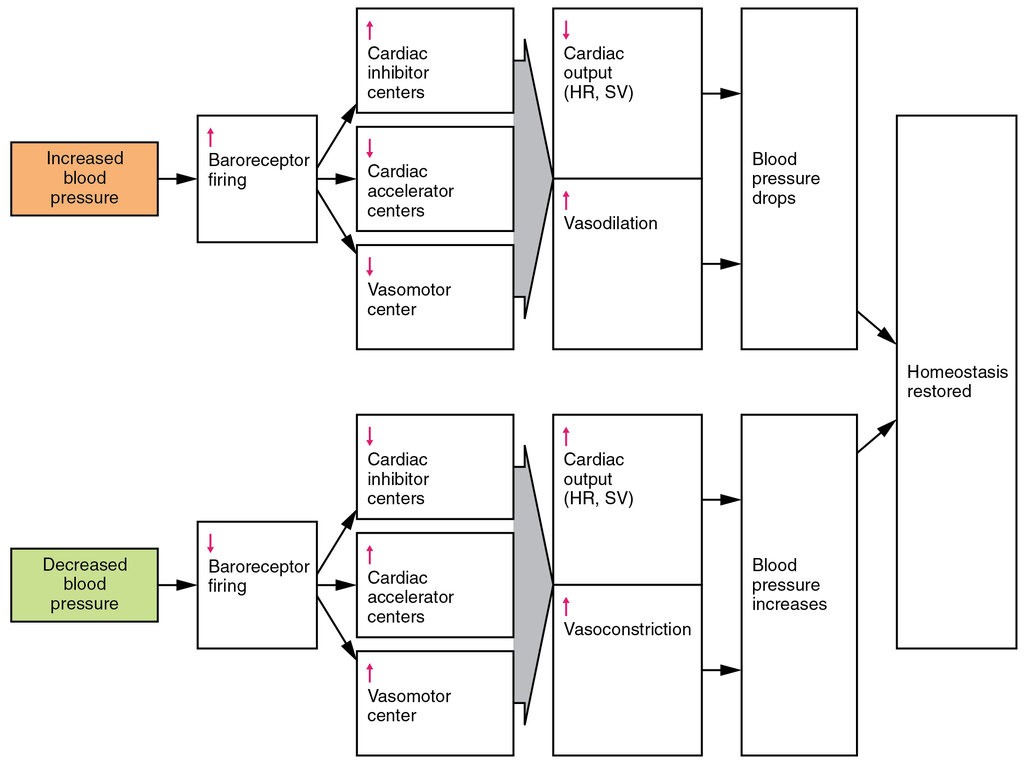
This reflex works in the opposite direction too. If you stand up too quickly and blood pressure drops, the baroreceptors fire less. The brainstem responds by ramping up sympathetic activity, increasing heart rate and constricting blood vessels to prevent you from feeling dizzy.
Similar reflex arcs regulate respiratory rate based on blood oxygen and carbon dioxide levels, and control digestive processes based on the presence of food in the gut. These continuous feedback loops are the essence of autonomic control, allowing the body to self-correct and maintain stability.
Let's check your understanding of how the nervous system maintains control.
What is the primary function of the autonomic nervous system (ANS)?
When you encounter a sudden stressful situation, like swerving to avoid an accident, which division of the ANS is activated for a rapid "fight or flight" response?
The nervous system's ability to integrate signals and generate coordinated responses across the entire body is a cornerstone of our physiology, allowing us to adapt and thrive in a dynamic world.