Integrals and Imaginary Numbers
Real Numbers
The Complete Number Line
So far, we've talked about different kinds of numbers: whole numbers, integers, and rational numbers. We've even touched on irrational numbers like and that can't be written as simple fractions.
Now, let's put them all together. Imagine a single, continuous line that stretches infinitely in both directions. Every single point on that line corresponds to a number. This complete set of numbers is what we call the real numbers.
Real Number
noun
Any number that can be found on the number line. This includes all rational numbers (like 1/2, -3, 0) and all irrational numbers (like π, √2).
The collection of real numbers, often symbolized by , fills in all the gaps on the number line. Between any two rational numbers, there are infinitely more rational numbers. But there are also infinitely many irrational numbers tucked in between, ensuring the line has no holes.
The Rules of the Road
Real numbers follow a consistent set of rules, or properties, that make arithmetic predictable. You already use these properties intuitively every day.
For example, the Commutative Property says that order doesn't matter for addition and multiplication. You know that is the same as , and is the same as . The same holds true for any real numbers, whether they're integers, fractions, or irrationals.
The Associative Property means that when you add or multiply three or more numbers, it doesn't matter how you group them. For instance, gives the same result as . This lets us perform calculations in the most convenient order.
Then there's the Distributive Property, which connects multiplication and addition. It's the reason why is the same as . This property is a cornerstone of algebra.
These rules ensure that math works consistently, allowing us to manipulate equations and solve problems with confidence.
Visualizing Real Numbers
The most powerful tool for understanding real numbers is the number line. It provides a perfect visual map of how all numbers relate to each other. Positive numbers are to the right of zero, negative numbers are to the left, and every number has a unique spot.
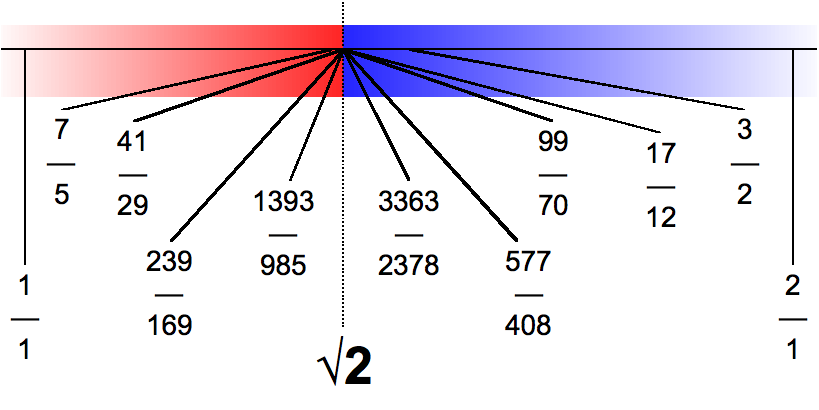
When we place a number on the line, we're showing its magnitude and its relationship to other numbers. For example, we can instantly see that -1 is greater than -3 because it lies to the right. We can also visualize the distance between two numbers.
This simple line is incredibly profound. It establishes an order for all real numbers and gives us a concrete way to think about abstract values.
The number line helps students visualise and understand the relationships between all numbers throughout their maths education.
Ready to check your understanding of real numbers?
What does the set of real numbers, symbolized by , represent on the number line?
The fact that you can calculate with the same result as demonstrates which property of real numbers?
Real numbers form the foundation of most of the math you'll encounter, from algebra to calculus. By understanding that they represent every point on a continuous line, you're ready to explore even more fascinating mathematical concepts.