Integralism Distributism and Capitalism Explained
Introduction to Economic Systems
Organizing Society
Every society needs to answer a few basic questions: What goods and services should we produce? How should we produce them? And who gets to use them? An economic system is the set of rules, institutions, and practices a country uses to answer these questions.
Think of it as a society's operating system for managing its resources. It determines who owns the farms and factories, who makes decisions about production, and how goods are distributed among the population. The answers to these questions shape everything from individual career choices to the nation's overall wealth and stability.
Two Major Models
Over the last few centuries, two major economic systems have dominated the global conversation: capitalism and socialism. While they have many variations, they are built on fundamentally different ideas about ownership and control.
Capitalism
noun
An economic system in which the means of production—such as factories, tools, and land—are privately owned and operated for profit.
In a capitalist system, individuals or companies own the resources used to create products. Decisions about what to produce are driven by supply and demand in the market. If people want more smartphones, companies will make more smartphones to earn a profit. The core idea is that competition and self-interest lead to efficiency and innovation, ultimately benefiting society as a whole. This system relies on markets to set prices, wage labor for production, and the accumulation of wealth, or capital, to fuel growth.
Socialism
noun
An economic system characterized by social ownership of the means of production. Ownership can be by the state, the community, or the workers themselves.
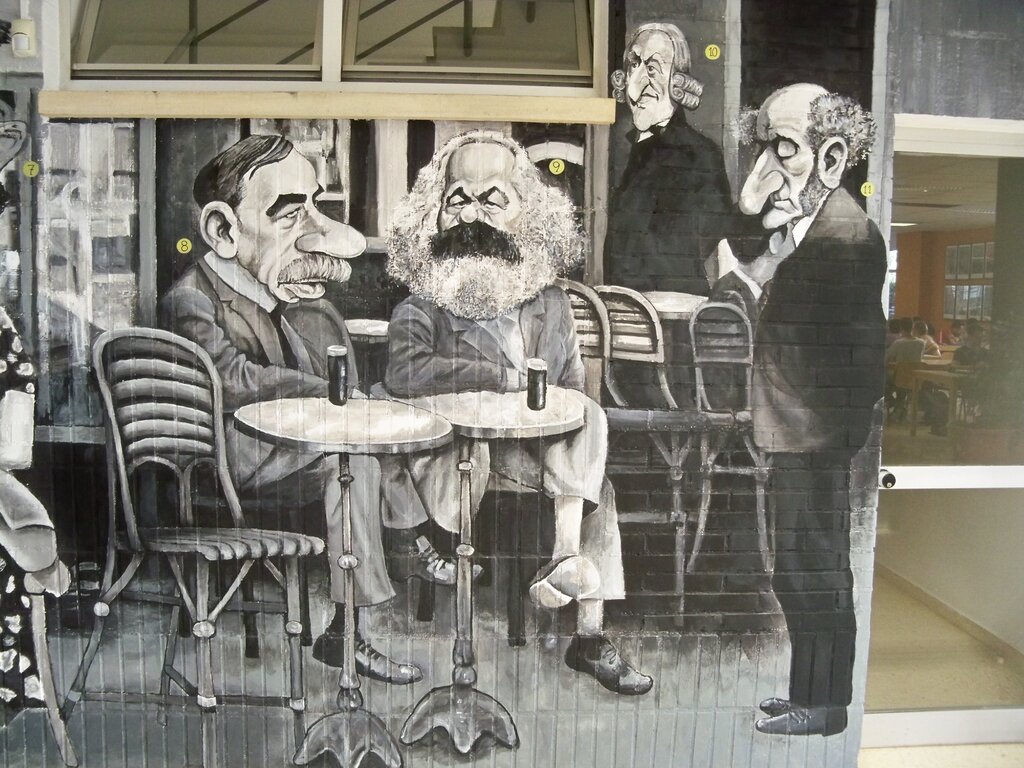
Socialism emerged as a response to the inequalities of industrial capitalism. The central goal is to operate the economy for the benefit of all society, not just for the profit of private owners. In practice, this can take many forms. Some socialist systems involve central planning, where the government makes all key economic decisions. Others incorporate market mechanisms, allowing for some competition and consumer choice within a framework of social ownership. The emphasis is on cooperation and equitable distribution of resources.
A Spectrum of Systems
In reality, no country is purely capitalist or purely socialist. Most modern economies are mixed, blending elements of both systems. They exist on a spectrum.
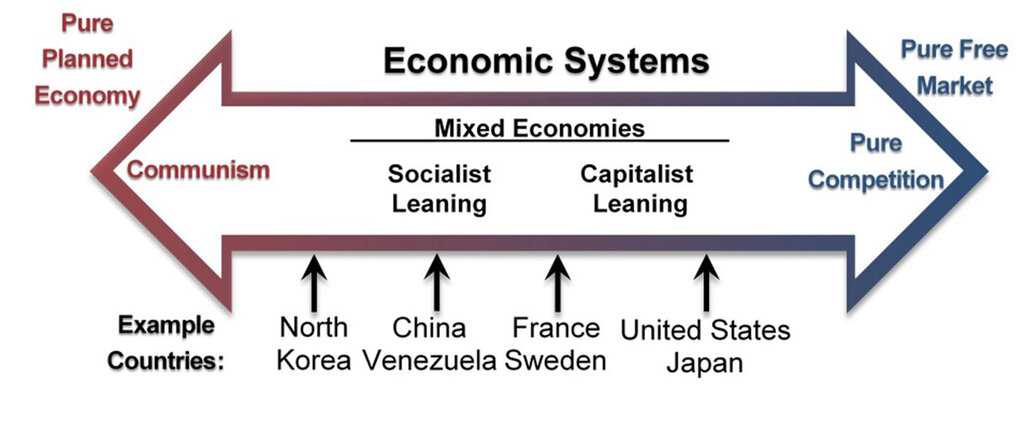
For example, the United States is considered a capitalist-leaning economy, but its government provides public education, builds roads, and regulates certain industries—all features that involve social control over economic resources. On the other hand, countries like Sweden and France have strong market economies but also feature extensive social welfare programs, such as universal healthcare and high taxation to fund public services, placing them closer to the socialist side of the spectrum.
Beyond these two models are other systems, such as traditional economies, based on custom and barter, and command economies, where a central authority makes all decisions. Historically, systems like feudalism, based on land ownership by nobility and labor by peasants, were dominant for centuries.
A Brief History
For most of human history, economies were agrarian and traditional. Feudalism dominated Europe for a thousand years. This began to change with the rise of mercantilism in the 16th century, where nations sought to accumulate wealth through trade and colonization.
The Industrial Revolution, starting in the 18th century, ushered in modern capitalism. Thinkers like Adam Smith argued that free markets, driven by individual self-interest, would create the most prosperity. This new system led to unprecedented economic growth but also created vast wealth disparities and harsh working conditions.
In the 19th century, Karl Marx and other thinkers developed socialist theories as a critique of capitalism's social costs. They envisioned a system where workers would own the means of production and share in the wealth they created. These ideas culminated in the 20th century with the rise of socialist states like the Soviet Union, which implemented centrally planned economies. The century was largely defined by the ideological and political conflict between these two major systems.
What is the primary function of an economic system?
In a capitalist system, decisions about what to produce are primarily driven by...
Understanding these foundational systems is the first step toward exploring more specific economic philosophies.