Integral Calculus Essentials
Introduction to Integrals
The Reverse of Differentiation
In our exploration of calculus so far, we've focused on differentiation—the process of finding a function's rate of change. We started with a function, say, for the position of a car, and we found its derivative to determine its velocity. But what if we want to go the other way? What if we know the car's velocity and want to figure out its position?
This reverse process is called integration, or finding the antiderivative. It's all about undoing differentiation. If differentiating gives you , then integrating takes you back to .
Differentiation breaks things down to find a rate of change. Integration builds them back up to find an accumulated amount.
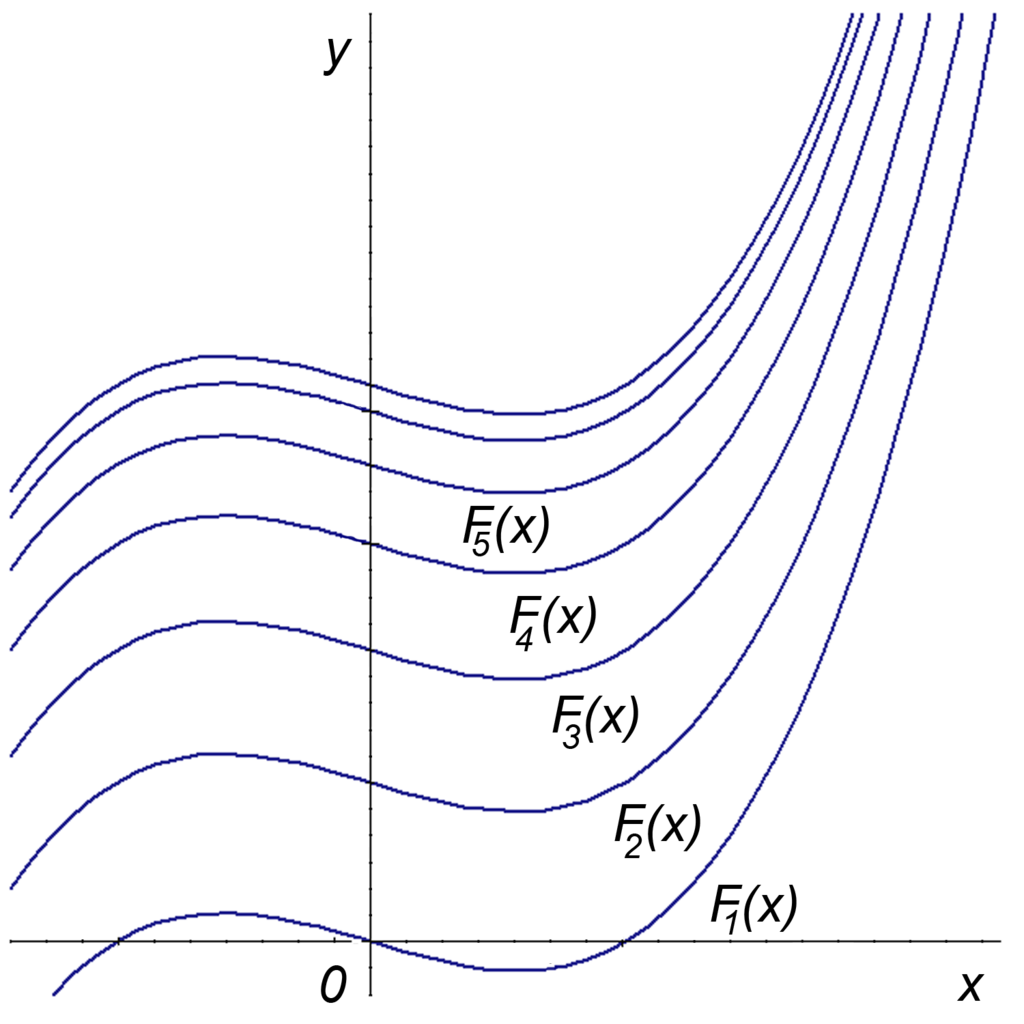
This idea of finding the original function introduces a small wrinkle. Consider the function . Its derivative is . But what about ? Its derivative is also , since the constant 5 disappears during differentiation. The same is true for or , where is any constant.
So, if we want to find the antiderivative of , we can't be sure which original function it came from. It could have been any function in the family of curves . This is why we call the general antiderivative an indefinite integral. It's 'indefinite' because of that unknown constant, called the constant of integration.
The notation for an indefinite integral looks like this:
Here, the symbol is the integral sign. The function is the integrand—the function we are integrating. The tells us we are integrating with respect to the variable . The result, , is the antiderivative, and acknowledges the constant of integration.
Finding the Antiderivative
Just as we have rules for differentiation, we have rules for integration. The simplest and most common is the reverse of the power rule.
For differentiation, the power rule is . To reverse this, we do the opposite operations in the reverse order: we add 1 to the exponent and then divide by the new exponent.
The Power Rule for Integration is: , for any .
Let's find the indefinite integral of .
- Identify the exponent, n. Here, .
- Add 1 to the exponent. .
- Divide by the new exponent. This gives us .
- Add the constant of integration. Don't forget the !
We can check our work by differentiating the result. The derivative of is indeed .
Calculating a Definite Amount
Indefinite integrals give us a general function. But what if we want to find a specific value, like the total distance a car traveled between two points in time, or the exact area under a curve between two x-values? For that, we use a definite integral.
A definite integral calculates the net accumulation of a quantity over a specific interval. Visually, it represents the signed area between the function's curve and the x-axis.
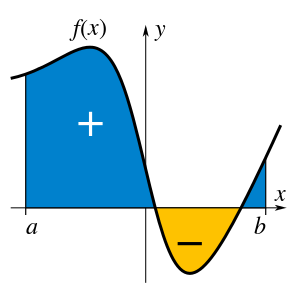
The notation includes limits of integration, which define the interval. The lower limit, , and the upper limit, , are written on the integral sign.
Unlike an indefinite integral, which results in a function (), a definite integral results in a single number. This number represents the total accumulated change from to . For example, if represents the rate of rainfall in inches per hour, would tell you the total number of inches of rain that fell between hour 1 and hour 3.
A key difference: an indefinite integral gives you a family of functions, while a definite integral gives you a specific numerical value.
We'll explore exactly how to calculate these values soon. For now, the important idea is that integration comes in two flavors: one for finding the general antiderivative function and another for finding a specific accumulated amount over an interval.
What is the primary purpose of integration in calculus?
Why is the constant of integration, + C, added to an indefinite integral?
This is just the beginning of our journey into integrals. We've seen how they reverse differentiation and how they can represent accumulated change. Next, we'll connect these two ideas and unlock the full power of calculus.