Instructional Design Portfolio Mastery
Learning Theories
How People Learn
To design effective instruction, you first need to understand how people learn. Learning isn't a single process; it's a complex activity that can be viewed from several different angles. Foundational learning theories provide frameworks for thinking about this process. They act as a toolkit, helping you choose the right strategies for a given learning goal and audience.
Learning theories describe the conditions and processes through which learning occurs, providing teachers with models to develop instruction sessions that lead to better learning.
Let's explore three major theories that have shaped instructional design: behaviorism, cognitivism, and constructivism. Each offers a unique perspective on the learning process.
Behaviorism: Learning by Doing
Behaviorism views learning as a change in observable behavior. It isn't concerned with what's happening inside the mind. Instead, it focuses on the relationship between a stimulus (the information or cue presented) and a response (the learner's action). According to behaviorists, learning occurs when the correct response is reinforced, making it more likely to happen again.
Think of it like training a dog. When the dog sits on command (response) after hearing the word "sit" (stimulus), it gets a treat (positive reinforcement). Over time, the dog learns to associate the command with the action.
In instructional design, behaviorism is useful for teaching procedural skills and foundational knowledge. The key is to provide clear cues, prompt the desired action, and offer immediate feedback or rewards to reinforce the correct behavior.
In a software tutorial, a user might be prompted to click a specific button. When they do, a pop-up confirms they did it correctly, reinforcing the action. This immediate feedback loop is a classic behaviorist technique.
Cognitivism: The Mind as a Computer
Where behaviorism ignores the mind, cognitivism dives right in. This theory arose from the desire to understand the mental processes that behaviorism called a "black box." Cognitivism suggests that learning is an internal process of acquiring, processing, storing, and retrieving information. It often uses a computer metaphor: the brain receives input, processes it, and stores it in memory for later retrieval.
This perspective emphasizes concepts like working memory, long-term memory, and cognitive load—the amount of mental effort required to learn something new. Cognitivist instructional designers focus on organizing information clearly to help learners process it efficiently. Strategies like breaking complex topics into smaller chunks, using diagrams to show relationships, and providing mnemonic devices all stem from cognitivist principles.
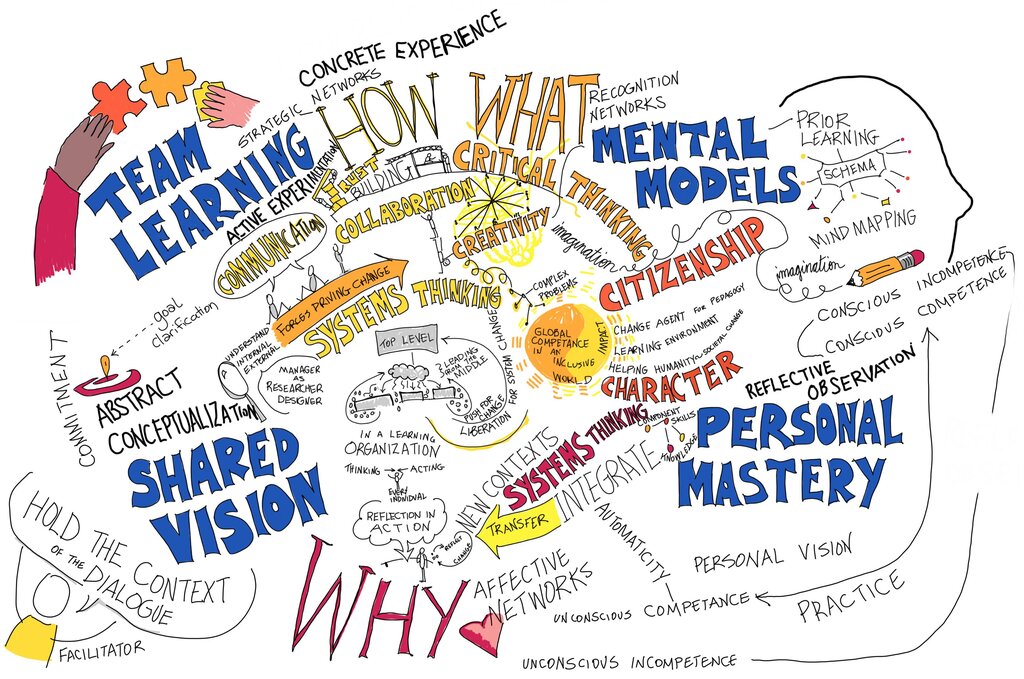
Imagine learning a new language. A cognitivist approach would involve not just memorizing vocabulary (behaviorism), but also understanding grammar rules and organizing words into categories (like food, animals, or travel) to make them easier to remember and use.
Constructivism: Building Knowledge
Constructivism takes the learner's role a step further. It proposes that people don't just passively receive information; they actively construct their own understanding of the world by connecting new information with their prior knowledge and experiences. Learning is a social and contextual process of making meaning.
In a constructivist model, the instructor acts as a facilitator rather than a lecturer. The goal is to create authentic, challenging environments where learners can explore, experiment, and collaborate. Problem-based learning, case studies, and simulations are all constructivist approaches.
The focus shifts from teaching a single, objective truth to helping learners build their own useful knowledge. A key idea is that two people can experience the same lesson but construct different understandings based on their unique backgrounds.
Instead of a lecture on physics, a constructivist classroom might have students work in groups to build a small catapult. Through trial and error, they actively discover principles of leverage, force, and trajectory, constructing their own understanding with the teacher's guidance.
Putting It All Together
These theories aren't mutually exclusive. Most effective instructional design borrows ideas from all three. The best approach depends on the learner and the learning objective.
| Theory | Best For... | Example Application |
|---|---|---|
| Behaviorism | Procedural skills, facts | A quiz with immediate feedback after each question. |
| Cognitivism | Complex information, problem-solving | An infographic that visually organizes the steps of a process. |
| Constructivism | Critical thinking, ambiguous problems | A group project where learners research and propose a solution to a real-world issue. |
By understanding these foundational theories, you can move beyond simply presenting information and start designing experiences that truly facilitate learning. You'll be better equipped to choose the right activities, structure content effectively, and create instruction that is engaging and memorable.