Instructional Design Fundamentals for Corporate Trainers
Introduction to Instructional Design
What Is Instructional Design?
Instructional Design, often shortened to ID, is the systematic process of creating learning experiences that are effective, engaging, and efficient. It's not just about creating content; it's about crafting a journey that helps people learn and apply new skills and knowledge in a meaningful way. Think of it as the architecture of learning. An architect doesn't just pile up bricks; they design a blueprint that ensures a building is functional, safe, and pleasant to be in. Similarly, an instructional designer creates a blueprint for training that ensures learning happens and sticks.
Instructional design is the process of planning, structuring, and creating learning experiences so people actually learn and take action, not just consume information.
In a corporate setting, this is crucial. Well-designed training doesn't just tick a box. It directly impacts performance, aligns with company goals, and ultimately contributes to the bottom line. When training is structured with clear objectives and a deep understanding of the learner's needs, employees are more likely to engage, retain information, and apply their new skills on the job. This systematic approach saves time and resources by focusing on what truly matters for performance improvement.
Effective instructional design turns training from an expense into a strategic investment.
Frameworks for Learning
Instructional designers don't start from a blank slate. They use established models as frameworks to guide the creation of training materials. These models provide a structured, step-by-step process, ensuring that all critical aspects of learning are considered. They act like a recipe, providing a reliable method to achieve a consistent, high-quality result every time.
| Model | Core Idea |
|---|---|
| ADDIE | A linear, five-phase process for building effective training. It's flexible and widely used. |
| SAM | An iterative model that emphasises rapid prototyping and repeated small steps. |
| Bloom's Taxonomy | A framework for categorising educational goals, moving from simple recall to complex creation. |
| Merrill's Principles | Focuses on five key principles for effective instruction, centred on problem-solving. |
While many models exist, one has become a cornerstone of the field: ADDIE. It's a great starting point for any trainer looking to bring more structure to their work.
Introducing ADDIE
The ADDIE model is a straightforward framework that breaks the design process into five distinct phases. Its name is an acronym for these five stages: Analysis, Design, Development, Implementation, and Evaluation.
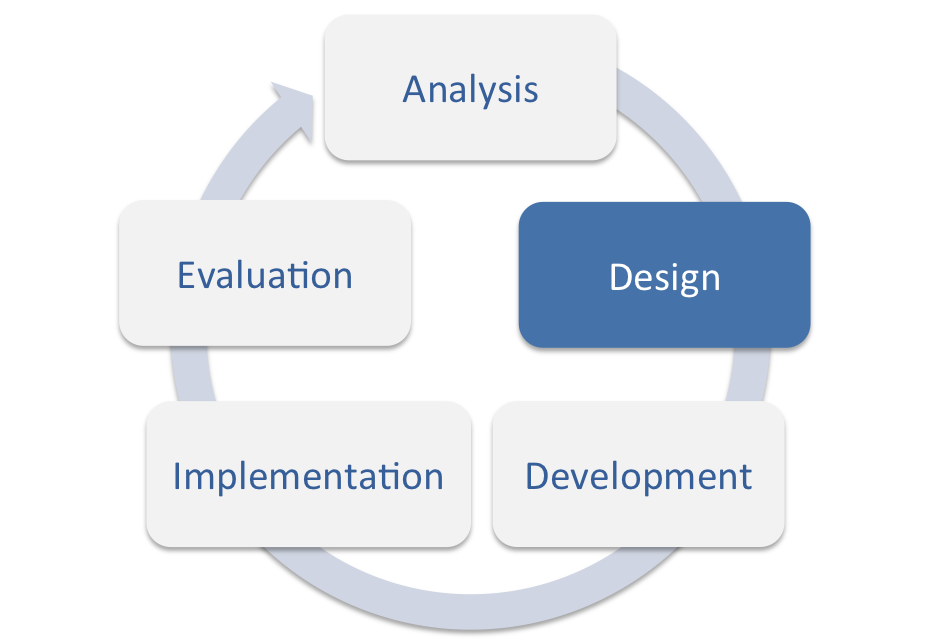
It’s often shown as a cycle because the insights from the final phase, Evaluation, feed back into the first phase, Analysis, allowing for continuous improvement of the training programme.
Here’s a quick look at what each phase involves:
- Analysis: You identify the learning problem, the goals, the audience's needs, and existing knowledge.
- Design: You outline the learning objectives, assessment instruments, exercises, content, and lesson planning.
- Development: You create the actual course materials and content detailed in the design phase.
- Implementation: The course is delivered to the target audience. This is the active training phase.
- Evaluation: You measure the effectiveness of the training. This happens after delivery and also at each of the preceding four stages.
Let's check your understanding of these core concepts.
What is the primary purpose of Instructional Design?
What does the acronym ADDIE stand for in the context of Instructional Design?
Understanding these fundamentals provides a solid foundation for creating corporate training that truly makes an impact.