Inorganic Chemistry Essentials
Atomic Structure
Inside the Atom
At the heart of everything we see and touch are atoms, the fundamental units of an element. For a long time, people thought atoms were the smallest possible things, indivisible and solid. But we now know they are made of even smaller components called subatomic particles.
Any high school chemistry student is familiar with the basic building blocks of atoms— electrons, protons, and neutrons.
An atom has two main regions. In the centre is a dense core called the nucleus, which contains positively charged protons and neutral neutrons. Whizzing around the nucleus in a cloud-like space are tiny, negatively charged electrons.
The attraction between the positive protons and negative electrons is what holds the atom together. Neutrons act like glue, helping to keep the protons in the nucleus from repelling each other.
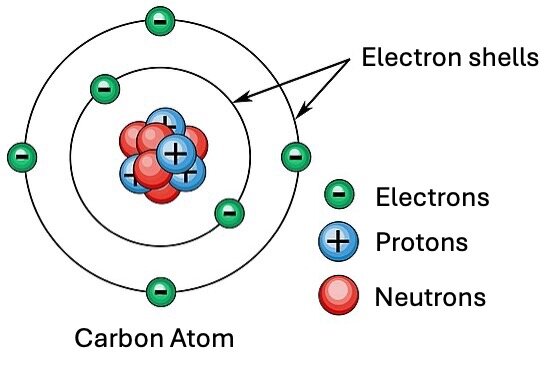
Here's a quick comparison of these three particles:
| Particle | Relative Charge | Relative Mass | Location in Atom |
|---|---|---|---|
| Proton | +1 | ~1 | Nucleus |
| Neutron | 0 | ~1 | Nucleus |
| Electron | -1 | ~1/1840 | Outside Nucleus |
As you can see, protons and neutrons are much heavier than electrons. Almost all of an atom's mass is packed into its tiny nucleus.
An Atom's Identity
What makes a carbon atom different from an oxygen atom? It all comes down to the number of protons. Every element is defined by a unique number of protons in its nucleus. This is known as the atomic number.
Atomic Number
noun
The number of protons in the nucleus of an atom. It is represented by the symbol Z.
We also have the mass number, which is simply the total count of protons and neutrons in the nucleus. We can represent an atom using a standard notation that includes both numbers.
For a neutral atom, the number of electrons is equal to the number of protons. For example, a neutral carbon atom (Z=6) has 6 protons and 6 electrons.
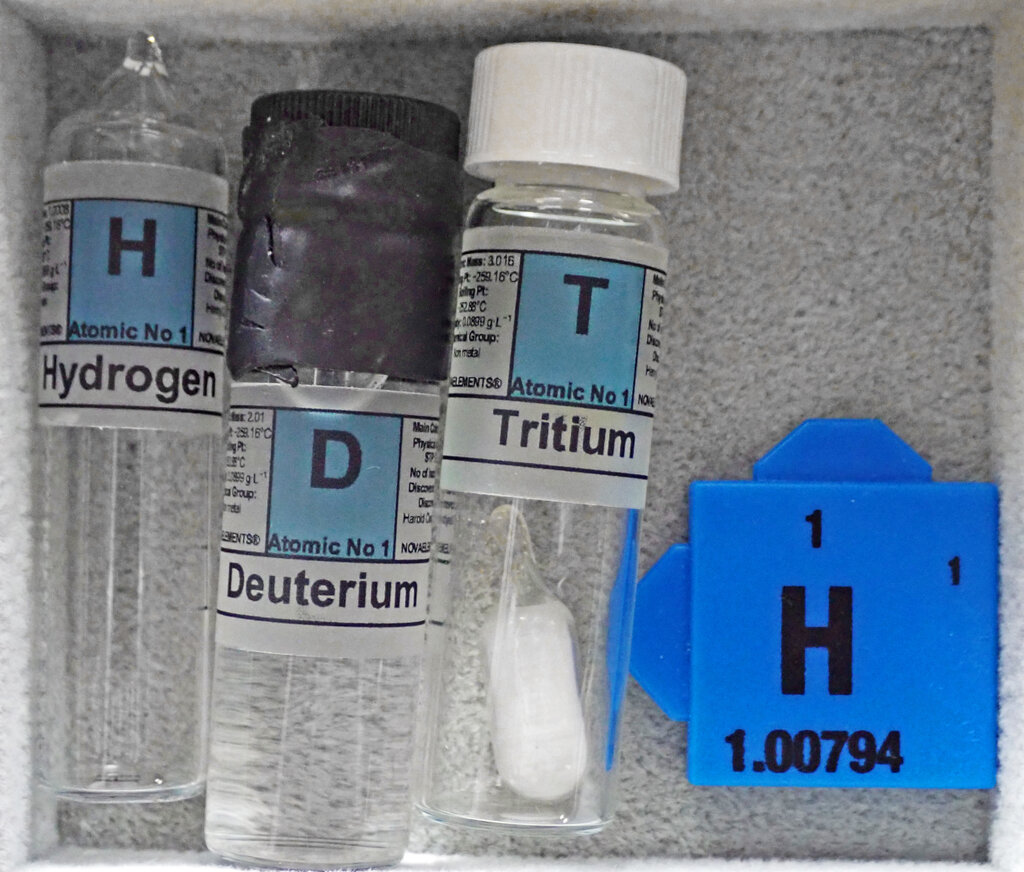
While the number of protons for an element is fixed, the number of neutrons can vary. Atoms of the same element with different numbers of neutrons are called isotopes.
Isotope
noun
Variants of a particular chemical element which differ in neutron number, and consequently in nucleon number (mass number).
Hydrogen, for example, has three common isotopes. All have one proton, but they have zero, one, or two neutrons.
Electron Neighbourhoods
Now let's turn to the electrons. They don't just fly around the nucleus randomly. Instead, they are confined to specific regions called electron shells, or energy levels. Think of it like a block of flats where electrons can only live on certain floors, and each floor has a set number of rooms.
The floors closest to the ground (the nucleus) have the lowest energy, and the energy increases as you move to higher floors.
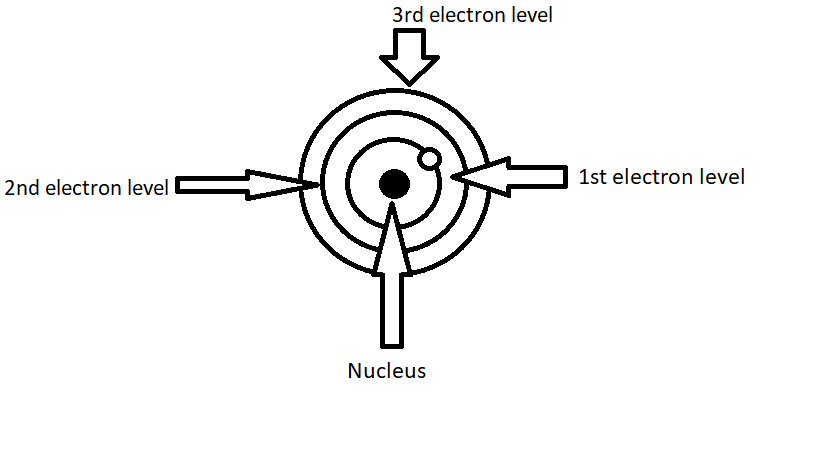
Each shell, identified by a principal quantum number (where ), is further divided into one or more subshells. These subshells are like different types of rooms on each floor, and they are labelled with the letters s, p, d, and f.
Within each subshell are orbitals, which are specific regions where an electron is most likely to be found. Each orbital can hold a maximum of two electrons.
Here’s how the capacity breaks down:
| Subshell Type | Number of Orbitals | Maximum Electrons |
|---|---|---|
| s | 1 | 2 |
| p | 3 | 6 |
| d | 5 | 10 |
| f | 7 | 14 |
The arrangement of electrons within these shells and subshells is called an atom's electron configuration. This configuration is crucial because it determines how an atom will behave chemically.
Writing Electron Configurations
To write an electron configuration, we follow a specific order for filling the subshells, starting from the lowest energy level and working our way up. This order is generally 1s, 2s, 2p, 3s, 3p, 4s, 3d, and so on.
Let’s take a neutral sodium atom as an example. Sodium has an atomic number of 11, which means it has 11 protons and 11 electrons.
- Start with the 1s subshell. It can hold 2 electrons. We write this as $1s^2$. We have $11 - 2 = 9$ electrons left.
- Move to the 2s subshell. It can also hold 2 electrons. This is $2s^2$. Now we have $9 - 2 = 7$ electrons left.
- Next is the 2p subshell. It can hold up to 6 electrons. This is $2p^6$. We have $7 - 6 = 1$ electron left.
- Finally, the last electron goes into the 3s subshell. This is $3s^1$.
Putting it all together, the electron configuration for sodium (Na) is $1s^2 2s^2 2p^6 3s^1$.
We can also represent this visually with an orbital diagram. In these diagrams, each orbital is shown as a box (or a line), and electrons are represented by arrows. An upward arrow (↑) and a downward arrow (↓) represent the two electrons in an orbital, which must have opposite spins. When filling orbitals within the same subshell (like the three p orbitals), we place one electron in each orbital before pairing any of them up.
Understanding these configurations is the first step toward predicting how different atoms will interact, bond, and form the complex world of molecules and materials around us.
What is the atomic nucleus composed of?
True or False: The mass of an electron is roughly equal to the mass of a proton.