Information Security Management Mastery
Information Security Fundamentals
The CIA Triad
At the heart of information security are three core principles: confidentiality, integrity, and availability. Known as the CIA triad, this model helps guide security policies and practices. Each principle represents a fundamental goal for protecting information.
Confidentiality, integrity, and availability—the CIA triad—are the three pillars of information security.
Confidentiality is about keeping secrets. It ensures that information is accessible only to authorized individuals. Think of it like a sealed letter. Only the intended recipient should be able to open it and read the contents. In the digital world, this is often achieved through encryption and access controls.
Integrity means maintaining the consistency, accuracy, and trustworthiness of data. Information must not be changed in transit or altered by unauthorized people. Imagine your bank account balance. You trust that the number you see is correct and hasn't been tampered with. Digital signatures and file permissions are common tools used to maintain data integrity.
Availability ensures that information is accessible when needed by authorized users. Systems, networks, and applications must be functioning correctly and efficiently. If you can't access your email or pull money from an ATM, availability has been compromised. This is why organizations invest in system redundancy, backups, and protection against attacks that could take a service offline.
Why Security Matters
Information is a valuable asset for any organization. Protecting it is not just an IT issue; it's a critical business function. A security breach can have severe consequences, ranging from financial loss to long-term damage to a company's reputation.
When sensitive data like customer information, financial records, or intellectual property is stolen or exposed, the direct costs can be enormous. Fines, legal fees, and the expense of notifying customers add up quickly. But the indirect costs can be even worse. A company that fails to protect its data loses the trust of its customers, partners, and the public. That loss of confidence can be much harder to recover from than the financial hit.

Threats and Attacks
To protect information effectively, we need to understand what we're protecting it from. In security, a threat is any potential for harm to an information system. A vulnerability is a weakness or gap in a system's protection that a threat can exploit.
Think of it this way: a potential thief casing your neighborhood is a threat. An unlocked door on your house is a vulnerability. The threat isn't dangerous until it exploits the vulnerability.
Attackers use various methods, known as attack vectors, to exploit vulnerabilities.
Phishing: Tricking someone into revealing sensitive information (like passwords or credit card numbers) by pretending to be a trustworthy entity in an email or message.
Malware: Malicious software (like viruses, ransomware, or spyware) designed to disrupt operations, gather sensitive information, or gain access to private computer systems.
Denial-of-Service (DoS) Attack: Overwhelming a system with traffic to make a network or machine unavailable to its intended users.
Many attacks follow a predictable pattern of steps, often called a "kill chain." Understanding this process helps security professionals know where and how to build defenses.
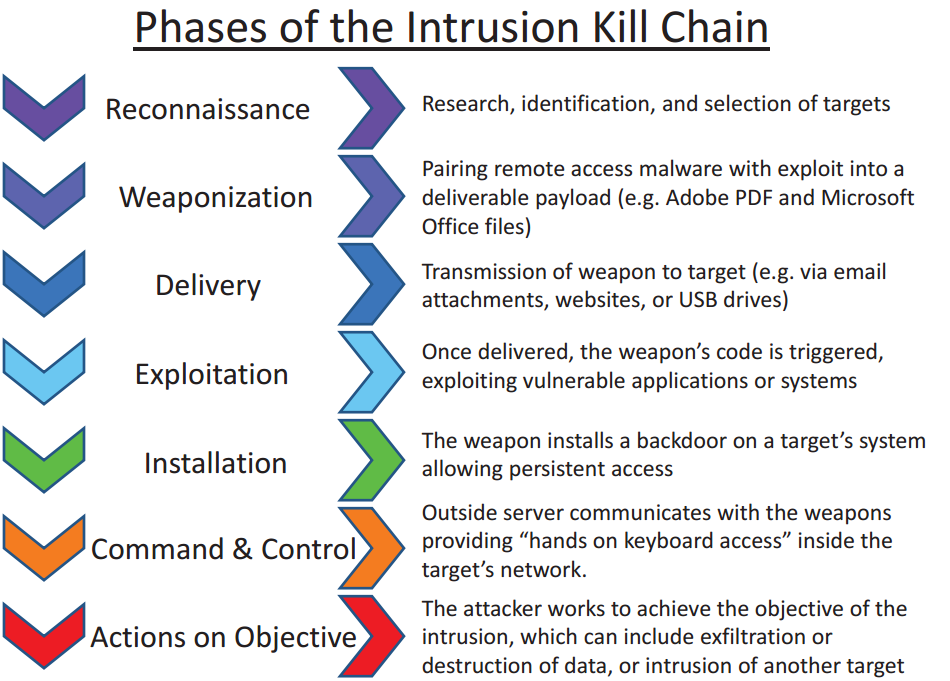
The motivations behind these attacks vary widely. Some attackers are driven by financial gain, using ransomware or stealing financial data. Others engage in corporate or state-sponsored espionage to steal trade secrets or intelligence. A growing number are "hacktivists," who use cyberattacks to promote a political or social agenda. Understanding these motivations helps predict what kind of attacks an organization might face.
Which of the following best describes the principle of 'Integrity' in the CIA triad?
A popular e-commerce website is overwhelmed with malicious traffic, making it impossible for legitimate customers to access the site. Which principle of the CIA triad has been primarily compromised?
Understanding these fundamental principles—confidentiality, integrity, availability, and the threat landscape—is the first step in building a strong security posture. They provide the foundation for all other security practices and controls.