Information and Communication Technology Basics
Computer Basics
Hardware, Software, and a Kitchen
Thinking about what makes a computer work can feel complicated. Let's simplify it with an analogy: a kitchen. A kitchen has physical tools—a stove, mixing bowls, knives, and a pantry. It also has instructions—the recipes you follow to create a meal. A computer is very similar. It has two main parts: hardware and software.
Hardware is any physical part of the computer you can touch. Software is a set of instructions that tells the hardware what to do.
In our kitchen analogy, the stove, bowls, and knives are the hardware. The recipe for baking a cake is the software. You need both to get the job done. A stove with no recipe won't produce a cake, and a recipe with no stove is just a piece of paper. Likewise, computer hardware needs software to be useful.
The Core Components
Every computer has a few key hardware components that work together. The most important one is the Central Processing Unit (CPU). Think of the CPU as the chef in the kitchen. It reads the recipe (software) and does all the main work, like measuring, mixing, and cooking. It's the brain of the operation, executing commands and making calculations.
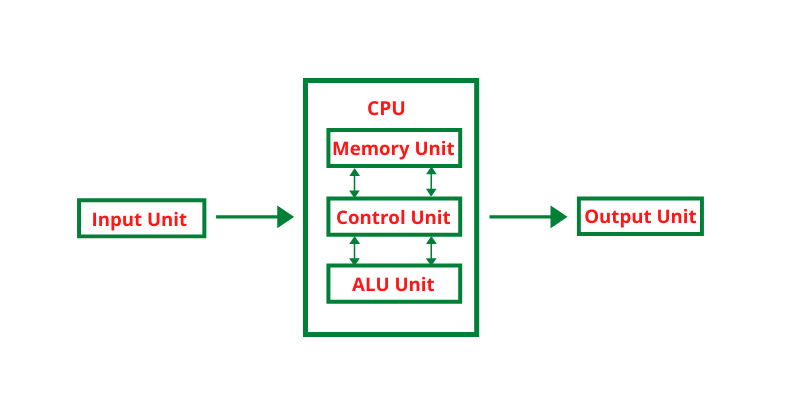
Next up is memory, or . RAM stands for Random Access Memory. In our kitchen, RAM is like your countertop space. It's where the chef (the CPU) keeps the ingredients and tools they are actively using. It's a temporary workspace that is fast to access. The more countertop space you have, the more things you can work on at once without getting cluttered.
Finally, there's storage. This is your computer's hard drive or solid-state drive (SSD). Storage is like the kitchen pantry or refrigerator. It's where you keep ingredients (your files, photos, and software) for the long term. When the chef needs an ingredient, they go to the pantry to get it. When you save a file, you're putting it back in the pantry for later.
RAM is for short-term tasks (what you're doing now). Storage is for long-term saving (what you want to keep).
Getting Information In and Out
So how do we give the computer instructions or see the results? We use input and output devices.
Input devices are how you get information into the computer. The most common examples are your keyboard and mouse. When you type or click, you're sending signals to the CPU to be processed.
Output devices are how the computer gets information out to you. The monitor you're looking at right now is an output device. It displays the results of the computer's work. Printers and speakers are other common output devices.
This flow is the basis of all computing. You provide an input, the computer processes it, and it delivers an output. This simple process allows us to do everything from writing an email to playing a complex video game.
Computers Come in All Shapes
The components we've discussed are fundamental to all modern computers, but they can be packaged in many different ways. A desktop computer has a tower that holds the main components, with a separate monitor, keyboard, and mouse. A laptop integrates all of these parts into a single portable unit. And your smartphone is a powerful, pocket-sized computer with the same basic parts: a CPU, memory, storage, and input/output devices (like its touchscreen).
No matter the shape or size, these devices are all tools designed to help us create, manage, and share information. They are the foundation of Information and Communication Technology (ICT).
In the kitchen analogy, which part represents the computer's software?
What is the primary role of the Central Processing Unit (CPU)?
This foundation gives you a mental model for how any computer works. By understanding the roles of hardware and software, you can better understand the technology that shapes our world.