Infleqtion's Quantum Computing Strategy
Introduction to Quantum Computing
Beyond Bits and Bytes
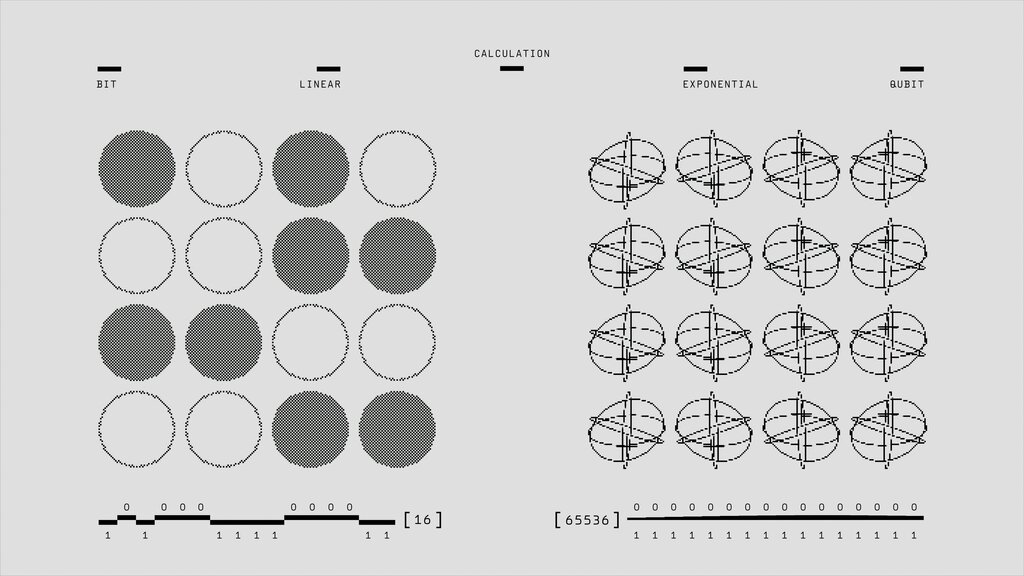
Classical computers, from your smartphone to the most powerful supercomputers, work with bits. A bit is a simple switch that can be in one of two states: on or off, represented as a 1 or a 0. All the amazing things classical computers do boil down to manipulating billions of these tiny switches.
Quantum computing operates on a completely different level. Instead of bits, it uses quantum bits, or qubits. This fundamental difference allows quantum computers to solve certain types of problems that are practically impossible for even the fastest classical computers.
Qubit
noun
The basic unit of quantum information. It's the quantum analogue of the classical bit.
A qubit can be a 1, a 0, or something else entirely. Thanks to a principle of quantum mechanics called superposition, a qubit can exist in a combination of both states at the same time. Think of it less like a light switch and more like a dimmer dial that can be at any point between off and fully on.
To represent this, we use a notation called Dirac notation, or bra-ket notation. The state of a qubit, which we'll call (pronounced "ket psi"), is a combination of the basis states and .
Here, and are complex numbers called probability amplitudes. The square of their magnitudes, and , represent the probability of finding the qubit in the state or the state when we measure it. The key is that before we measure it, the qubit is in both states at once. This ability to explore many possibilities simultaneously is where a quantum computer gets its power.
Superposition and Entanglement
Superposition is the first strange, powerful idea we need to grasp. Imagine a spinning coin. While it's in the air, it’s not heads and it’s not tails—it’s in a superposition of both. Only when it lands (when we measure it) does it settle into a definite state. A single qubit in superposition is like one spinning coin. Two qubits can explore four states at once (), three qubits can explore eight, and so on. The number of states grows exponentially.
With just 300 qubits in superposition, a quantum computer could represent more states than there are atoms in the observable universe.
The second key principle is entanglement. This is a special connection between two or more qubits. When qubits are entangled, their fates are linked, no matter how far apart they are. If you measure the state of one, you instantly know the state of the other.
Albert Einstein famously called this "spooky action at a distance." It's like having two magic coins. If you know they are entangled, the moment you see one land on heads, you know with absolute certainty that the other, even if it's across the galaxy, has also landed on heads.
By combining superposition and entanglement, quantum computers can process information in a fundamentally new way. They don't just try one solution at a time. They explore a vast landscape of potential solutions all at once, interfering with the probability waves of the qubits to make wrong answers cancel out and right answers stand out.
Ready to check your understanding of these new ideas?
What is the fundamental difference between a classical bit and a quantum bit (qubit)?
The state of a qubit is described by the equation . What do and represent?
These principles are the foundation of quantum computing. They open the door to solving problems in fields like medicine, materials science, and cryptography that will forever be beyond the reach of classical machines.