Industrial Robot Motion and ROS Python Programming
Joint and Cartesian Space
Two Paths to One Point
Getting a robotic arm from point A to point B isn't as simple as just telling it where to go. The controller needs to know how to get there. Should it prioritize the most efficient motion for its own joints, or should it prioritize a perfectly straight path for the tool at its tip? This choice defines the two fundamental motion commands in robotics: MoveJ and MoveL.
MoveJ commands the robot to move in joint space, while MoveL commands it to move in Cartesian space.
Imagine you're standing in a room and need to walk to the other side. You'd probably take the most direct, comfortable path, swinging your arms naturally. That's the essence of MoveJ (Joint motion). The robot's controller looks at the starting and ending angles of each joint. Then, it calculates the smoothest, fastest way for each joint to get to its destination angle. This process is called joint space interpolation and it's the most energy-efficient way for the robot to move.
The key thing to remember about MoveJ is that while the joints move efficiently, the path of the end-effector (the tool) through 3D space is a curve. For simply moving from one place to another in open space, this is perfect. It's fast and puts less strain on the motors.
Predictability and Precision
Now, imagine you need to draw a perfectly straight line on a whiteboard. You wouldn't just swing your arm; you'd carefully control your shoulder, elbow, and wrist to keep the marker tip on a precise path. This is MoveL (Linear motion).
With MoveL, you define a start and end point in Cartesian coordinates (X, Y, Z). The robot controller then does the hard work. It continuously runs Inverse Kinematics calculations to figure out the exact sequence of joint angles required to keep the end-effector moving in a dead straight line. This is crucial for tasks like welding a seam, applying sealant, or inserting a part into a tight fixture.
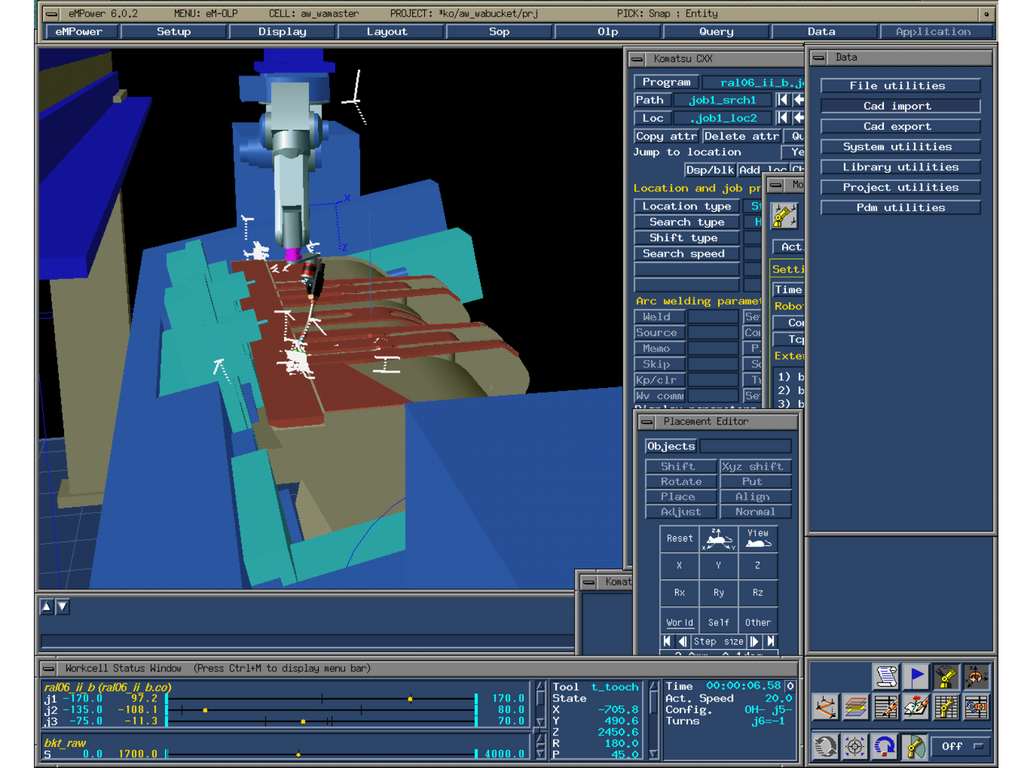
This precision comes at a cost. MoveL is almost always slower and more computationally intensive than MoveJ. The robot must constantly adjust all its joints in a coordinated, and sometimes non-intuitive, way.
The Danger of a Straight Line
The biggest risk with MoveL is encountering a kinematic singularity. This is a configuration where the robot loses one or more degrees of freedom. Think of it like trying to reach for something directly overhead. Your arm becomes fully extended, and you lose the ability to move your hand any further up. You also can't easily rotate your wrist in certain ways.
For a robot, a singularity can mean two or more joints line up, causing an unpredictable and potentially dangerous situation. To maintain the straight-line path through a singularity, some joints might need to move at infinite speed, which is physically impossible. The robot will either fault and stop, or it will deviate from the path.
MoveJ is naturally immune to these singularity issues because it doesn't force a specific path on the end-effector. It just finds a valid set of joint angles at the destination and moves there.
So, which one do you use? The choice depends entirely on the task.
- Use MoveJ for: General point-to-point movements where the path doesn't matter. Picking up a part from a bin, moving to a standby position, or any travel through open air. It's the workhorse for getting things done quickly.
- Use MoveL for: Any task where the path is critical. Welding, painting, dispensing glue, laser cutting, or inserting a peg. It's the tool for precision processes.
An industrial robot needs to move from a safe home position to a position just above a bin of parts before picking one up. The path it takes through the open air doesn't matter. Which motion command is most appropriate for this move?
What is the primary characteristic of a path created by a MoveL command?