Industrial Controls Troubleshooting
Industrial Control System Components
The Anatomy of an Automated System
Industrial Control Systems, or ICS, are the backbone of modern manufacturing, power plants, and countless other automated processes. Think of an ICS as a team of specialists working in perfect sync. Each member has a distinct role, but they all communicate to get a complex job done. Let's meet the key players: sensors, actuators, controllers, and the human-machine interface.
The Senses of the Machine
Every control system needs to know what’s happening in the physical world. This is the job of sensors. They act as the eyes, ears, and nerve endings of the machine, converting physical properties into electrical signals that a controller can understand.
Sensors measure everything from temperature and pressure to flow rate and liquid levels. A temperature sensor in a furnace tells the system if it’s too hot or too cold. A proximity sensor on a conveyor belt detects when a box is in the right position. Without sensors, the control system is blind and deaf, unable to react to its environment.
Sensor
noun
A device that detects or measures a physical property and records, indicates, or otherwise responds to it.
This signal is the raw data that the entire control system relies on. It’s the starting point for every decision the system makes.
The Muscles of the Operation
Once the system knows what’s going on, it needs to do something about it. That's where actuators come in. If sensors are the senses, actuators are the muscles. They take electrical commands from the controller and convert them into physical action.
Common actuators include motors that turn gears, valves that open or close pipes, and heaters that raise the temperature. When a sensor reports that a tank is full, the controller sends a command to an actuator, which might be a valve, to shut off the inflow.
Actuator
noun
A component of a machine that is responsible for moving or controlling a mechanism or system.
This action-reaction loop is the essence of automation. A sensor detects a state, and an actuator changes it based on a command.
The Brains Behind It All
The controller is the brain of the system. It's the central decision-maker that connects the sensors and actuators. The controller continuously reads the incoming signals from sensors, processes this information according to its programming, and sends commands to the actuators.
There are two main types of controllers in the industrial world:
-
Programmable Logic Controllers (PLCs): These are rugged, reliable computers designed for specific, often repetitive tasks, like controlling a single assembly line machine. They are the workhorses of discrete manufacturing.
-
Distributed Control Systems (DCS): These are used for larger, more complex operations, like an entire chemical plant or a power station. A DCS isn't a single controller but a network of them, managing thousands of data points and control loops across a facility.
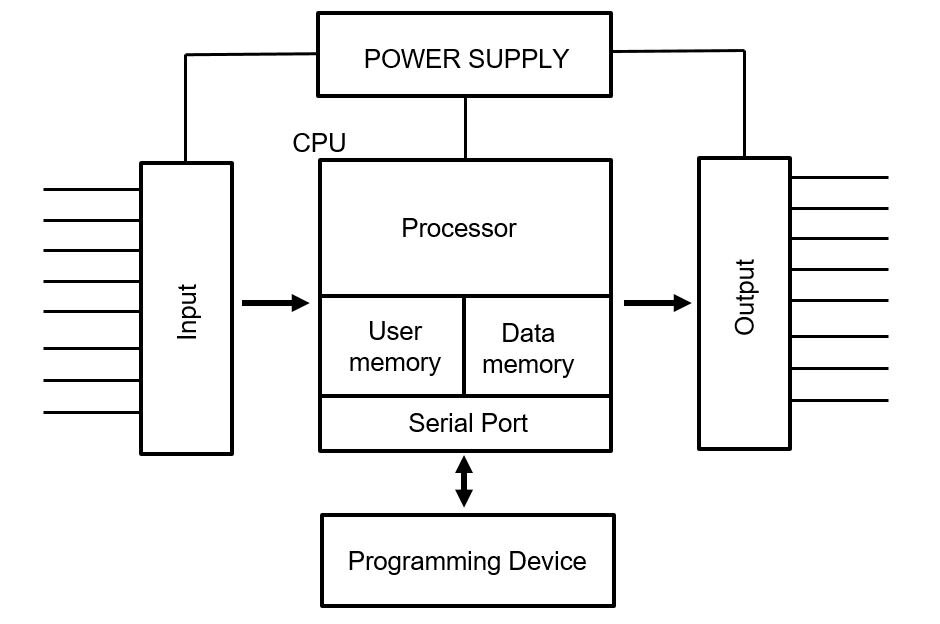
The fundamental flow of information is simple: Sensors report to the Controller, and the Controller commands the Actuators.
The logic programmed into the controller determines how the system behaves. For example, the logic might say, "IF the temperature sensor reads above 200 degrees, THEN command the cooling fan actuator to turn on."
The Human Connection
Even in a highly automated system, humans still need to supervise, monitor, and interact with the process. The Human-Machine Interface (HMI) makes this possible. It's the operator's window into the system, typically a screen or a set of panels that displays data and accepts commands.
An HMI provides a real-time view of what’s happening. It might show temperatures, pressures, and valve statuses on a graphical display. From the HMI, an operator can monitor the system's health, change settings (like the target temperature, or setpoint), acknowledge alarms, or manually override the automation if needed. It translates complex machine data into readable information for human operators.
Finally, all these components need a way to communicate. A communication network, like an industrial-grade Ethernet, acts as the nervous system, carrying signals between sensors, controllers, actuators, and HMIs. This network ensures that data is transmitted reliably and quickly, which is critical for keeping the process running smoothly and safely.
Now, let's test your knowledge of these core components.
What is the primary function of a sensor in an Industrial Control System?
If an Industrial Control System is compared to the human body, the actuators would be the ______.
Understanding these individual parts and how they connect is the first step to mastering how industrial control systems work as a whole.