Industrial Control Wiring for PLCs
Introduction to Industrial Control Systems
What Are Industrial Control Systems?
Industrial Control Systems, or ICS, are the brains and nervous systems behind large-scale industrial operations. Think of power plants, manufacturing assembly lines, or water treatment facilities. These systems automate and manage complex processes that would be impossible, inefficient, or unsafe for humans to handle directly.
The main purpose of an ICS is to monitor and control physical processes. It's a collection of hardware and software that works together to keep things running smoothly. An ICS takes in information from the environment, makes decisions based on a set of rules, and then takes action to adjust the process.
The key components include:
- Sensors: These are the 'senses' of the system. They measure physical quantities like temperature, pressure, or flow rate and convert them into electrical signals.
- Controllers: The 'brain' that receives signals from sensors, processes the information according to pre-programmed logic, and sends out commands.
- Actuators: These are the 'muscles'. They receive commands from the controller and perform a physical action, like opening a valve, starting a motor, or moving a robotic arm.
- Human-Machine Interface (HMI): This is the dashboard that allows human operators to monitor the system, view data, and manually issue commands if needed.
The Role of PLCs
At the heart of most modern control systems is the Programmable Logic Controller, or PLC. A PLC is essentially a rugged, specialized computer designed to withstand harsh industrial environments—think vibrations, extreme temperatures, and electrical noise. Its job is to execute a stored program that automates a specific process.
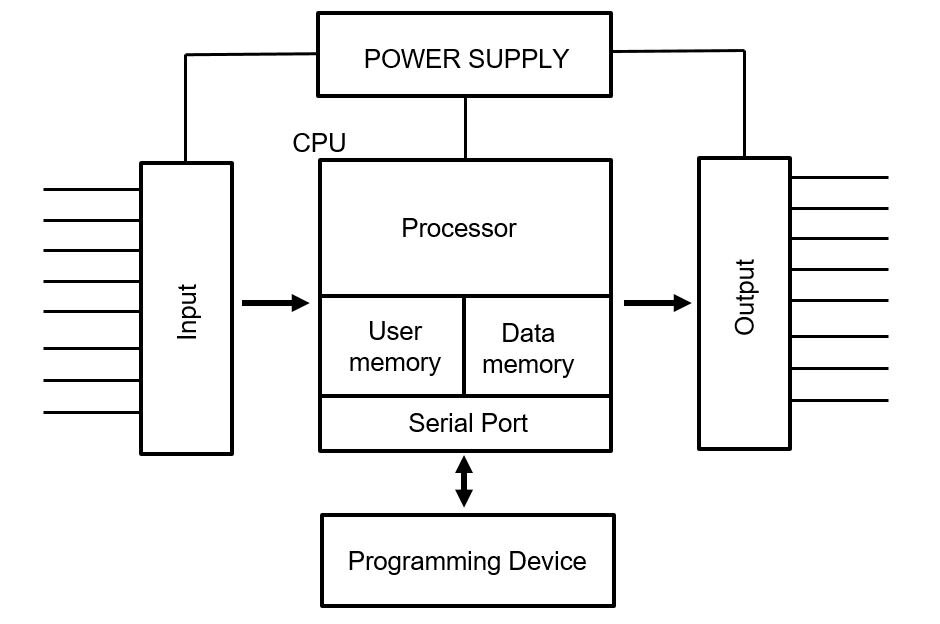
Unlike a regular computer, a PLC is built for reliability and real-time processing. It continuously scans its inputs, executes its program logic, and updates its outputs in a repeating loop. This cycle happens very quickly, often many times per second, ensuring the system responds immediately to changes in the process.
Programmable Logic Controllers (PLCs) are responsible for automating process control in many industrial systems (e.g. in manufacturing and public infrastructure), and thus it is critical to ensure that they operate correctly and safely.
Why Low Voltage Matters
Most of the communication within an ICS happens using low-voltage signals, typically 24 volts DC. This might seem minor, but it's a crucial design choice. Low voltage is used for control circuits because it is safer for personnel to work with and less susceptible to creating electrical arcs. It's also more energy-efficient and better suited for the sensitive electronic components inside controllers and sensors.
Think of low voltage as the language of the control system. Sensors, switches, and the PLC's input/output modules all 'speak' this language to communicate status and commands.
While the heavy machinery itself—like large motors—runs on high voltage, the devices that control them operate on a separate, low-voltage circuit. This separation between control power and load power is a fundamental principle of safe and reliable industrial design.
Putting It All Together
Component integration is what makes an ICS work. Each part has a specific job, and they must all function in harmony. Imagine a system designed to keep a tank's water level constant.
- A level sensor (a low-voltage device) in the tank constantly measures the water level and sends a signal to the PLC.
- The PLC reads this input signal. Its program might say, "If the water level drops below 50%, open the inlet valve."
- When the level drops, the PLC sends a low-voltage command to an actuator on the inlet valve.
- The actuator opens the valve, and water flows into the tank.
- The sensor continues to report the rising level to the PLC. When the level reaches the setpoint (say, 95%), the PLC sends another signal to close the valve.
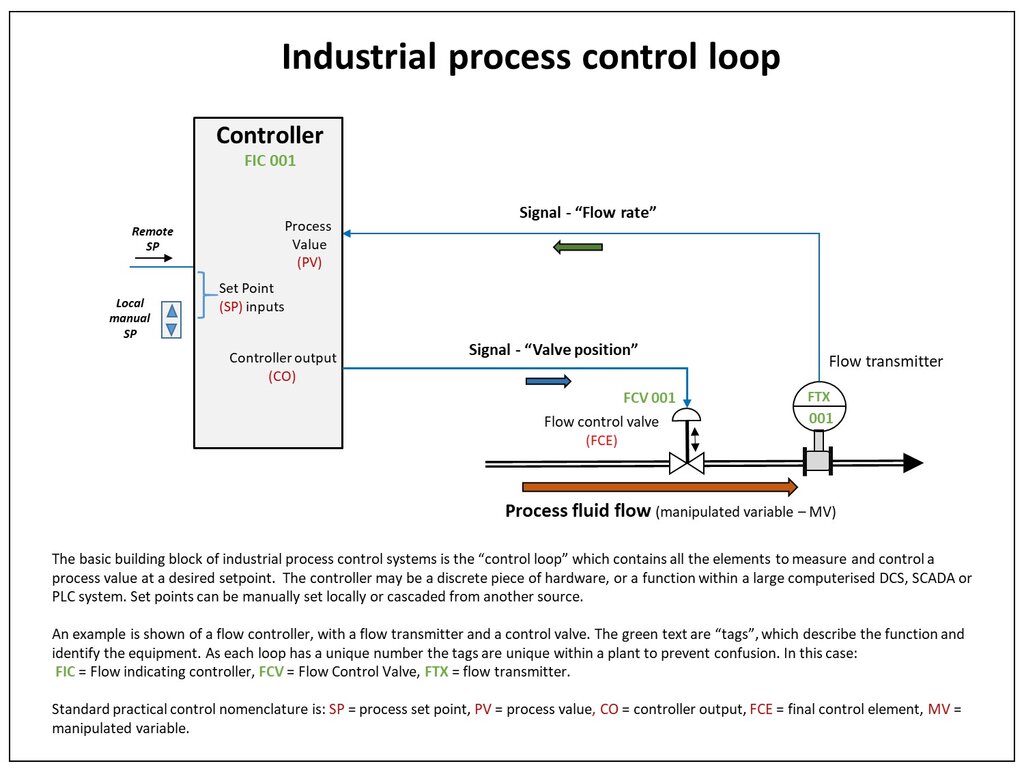
This simple feedback loop is the foundation of industrial automation. By integrating sensors, controllers, and actuators, an ICS can manage complex processes with precision and reliability, 24 hours a day.
In an Industrial Control System, which component is responsible for receiving a command from a controller and performing a physical action, such as opening a valve or starting a motor?
Why are low-voltage signals, such as 24V DC, typically used for the control circuits within an ICS?