Industrial Automation Essentials
Introduction to Industrial Automation
What Is Industrial Automation?
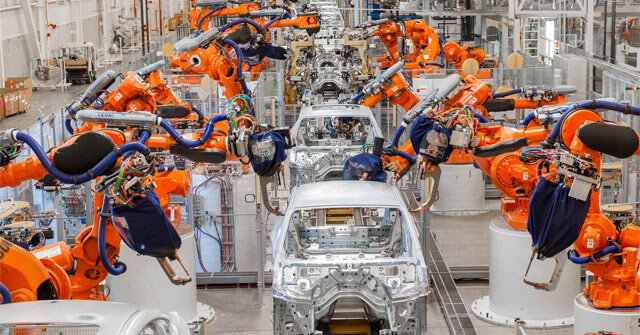
At its heart, industrial automation is about using technology to perform tasks and processes in a factory or industrial setting with minimal human help. Think of it as teaching machines to run the show. Instead of a person manually operating a machine, a control system—like a specialized computer or a robot—does the work.
The main goal is to make operations more efficient, reliable, and safe. It’s similar to how a thermostat in your home automates temperature control. You set the desired temperature (the instruction), the thermostat's sensor measures the current temperature (the data), and the system turns the heat or AC on or off to match your setting (the action). Industrial automation applies this same basic idea on a much larger and more complex scale.
A Quick Trip Through Time
Automation isn't a new idea. The journey began during the first Industrial Revolution with mechanization, where machines started doing work previously done by hand. The concept took a huge leap forward with Henry Ford's assembly line in the early 20th century, which streamlined manufacturing by breaking down complex jobs into smaller, repeatable steps.
But modern industrial automation truly took off in the 1970s with the invention of the Programmable Logic Controller (PLC). This was a rugged, adaptable computer designed specifically for manufacturing environments. For the first time, factories could easily reprogram machines for different tasks without costly and time-consuming rewiring. This shift from fixed, mechanical automation to flexible, computer-driven automation changed everything.
Why Bother with Automation?
Industries invest heavily in automation for a few key reasons. It fundamentally changes what's possible in terms of scale, speed, and precision.
Increased Productivity: Automated systems can operate 24/7 without breaks or fatigue, leading to a massive increase in output.
Enhanced Quality: Machines are incredibly consistent. A robot can weld a seam or tighten a bolt with the same precision every single time, drastically reducing defects and improving product quality.
Improved Safety: Automation allows us to move people away from dangerous jobs. Tasks that involve hazardous materials, extreme temperatures, or heavy lifting can be handed over to machines, creating a safer workplace.
The Building Blocks
Every industrial automation system, whether simple or complex, is built from the same core components. Think of them as the senses, brain, muscles, and nervous system of the operation.
Sensor
noun
A device that detects and responds to some type of input from the physical environment. It converts physical parameters like temperature, light, motion, or pressure into a signal that can be read by a controller.
Sensors are the eyes and ears of the system. They gather data from the physical world. For example, a temperature sensor measures heat in an oven, while a photoelectric sensor can detect if a box is present on a conveyor belt.
Controller
noun
The central processing unit or 'brain' of an automation system. It receives data from sensors, processes it according to a pre-written program, and sends commands to actuators.
The controller is the brain. It takes the information from the sensors and makes decisions based on its programming. If a sensor reports a bottle is in place, the controller might command a filling machine to start.
Actuator
noun
A component of a machine that is responsible for moving and controlling a mechanism or system. It takes an electrical signal from the controller and converts it into physical motion.
Actuators are the muscles. They receive commands from the controller and perform a physical action. This could be an electric motor that spins a conveyor belt, a pneumatic cylinder that pushes a product, or a valve that opens to release liquid.
Finally, communication networks are the nervous system that ties everything together. These networks allow the sensors, controllers, and actuators to exchange information quickly and reliably. Together, these components form a loop: sensors collect data, controllers make decisions, and actuators perform actions, creating a fully automated process.
What is the primary goal of industrial automation?
Which invention in the 1970s marked a major turning point for automation by introducing easily reprogrammable control without costly rewiring?