India's Modern History Journey
Decline of Mughal Rule
The Great Unraveling
For nearly two centuries, the Mughal Empire was a powerhouse, a vast and wealthy state covering most of the Indian subcontinent. But after the death of Emperor Aurangzeb in 1707, this formidable empire began to fray. Its decline wasn't a sudden collapse but a slow, complex unraveling caused by problems from within and pressures from without.
The Mughal Empire, which had once extended from Central Asia to almost the entire Indian subcontinent, began disintegrating rapidly after the death of Aurangzeb in 1707.
A string of weak and ineffective rulers followed Aurangzeb. Where once there were decisive leaders, now there were emperors who were often puppets of powerful nobles. This created instability at the very top. Without a strong hand to guide it, the massive imperial administration began to falter.
An Empire Spread Too Thin
The empire's sheer size became one of its biggest weaknesses. Aurangzeb’s long and costly wars in the Deccan, aimed at expanding Mughal territory, had drained the treasury and stretched the military to its limits. The administrative machinery, which relied on a system of land grants called jagirs to pay its officials (mansabdars), started to break down.
There was more demand for profitable jagirs than there was land available. This led to corruption and fierce competition among nobles. Many officials struggled to collect the revenue they were due, which meant they couldn't maintain their required contingents of soldiers. The military, once the backbone of Mughal power, grew weaker and less disciplined.
As the central government weakened, powerful regional governors and local chieftains began to assert their independence. They still paid lip service to the Mughal emperor, but in reality, they governed their territories as independent kingdoms, keeping the tax revenue for themselves. Provinces like Awadh, Bengal, and Hyderabad effectively broke away, shrinking the emperor's direct control to a small area around Delhi.
New Powers Rise
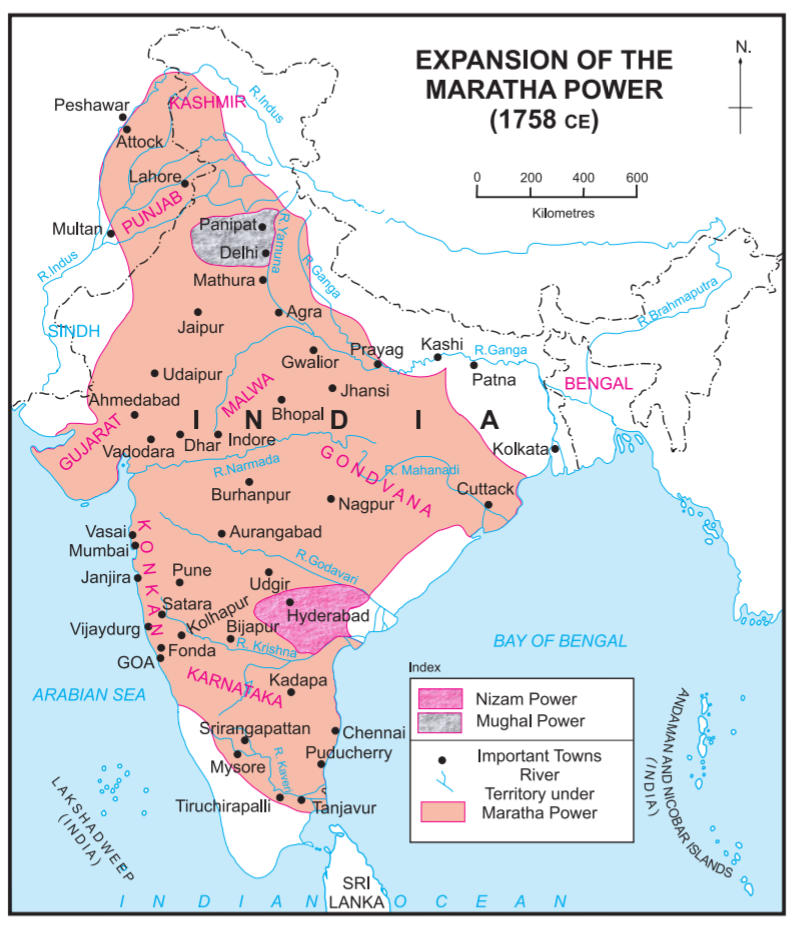
The most formidable challenge came from the Marathas. Originally a warrior group from the western Deccan plateau, they built a powerful and expanding confederacy. Under skilled leaders, their swift cavalry raided deep into Mughal territory, collecting taxes and challenging imperial authority. By the mid-1700s, the Marathas were the dominant power in India, controlling vast regions and influencing politics in Delhi itself.
At the same time, European trading companies were expanding their influence. The British East India Company and its French rival, the Compagnie française des Indes orientales, initially came for trade. But as Mughal power declined, they saw an opportunity. They built their own armies, fortified their trading posts, and began meddling in the conflicts between regional Indian rulers. Their superior military technology and tactics allowed them to punch far above their weight.
The arrival of European powers introduced a new, disruptive force into the already fractured political landscape of India.
This combination of internal decay and external threats created a perfect storm. The administrative breakdown, economic strain, and rise of powerful rivals all fed into one another, accelerating the empire's decline. The Mughal emperor became a symbolic figure with little real power, setting the stage for a new chapter in India's history.
Now, let's test your understanding of the factors that led to the Mughal Empire's decline.
What major event in 1707 is often cited as the start of the Mughal Empire's significant decline?
The administrative system based on land grants, known as jagirs, began to fail. What was a direct consequence of this crisis?
The crumbling of the Mughal Empire was a pivotal moment, creating a power vacuum that regional states and European companies would rush to fill.