Indian History from Early Medieval to the First War of Independence
Medieval Statecraft Evolution
Forging a Centralised State
When the Delhi Sultanate emerged in the 13th century, its rulers faced a monumental challenge. They had conquered vast territories, but how could they effectively govern them? The old model of decentralized regional kingdoms, where local lords held significant power, was inefficient and prone to rebellion. To build a lasting state, the Sultans needed a way to project power from Delhi, collect revenue consistently, and maintain a loyal, powerful army. This necessity drove one of the most significant administrative innovations of the era: the Iqta system.
Iqta
noun
A grant of land revenue from a specific territory, assigned by the Sultan to a noble or military commander in lieu of a cash salary. The holder was known as an Iqtadar or Muqti.
The Iqta system was the backbone of the Sultanate's administration. It wasn't simply a land grant. It was a sophisticated mechanism that linked revenue collection directly to military power. An Iqtadar was assigned a territory and tasked with collecting its taxes. From this revenue, he was expected to pay for his own expenses and, crucially, maintain a specified number of soldiers who could be called upon by the Sultan at any time. Any surplus revenue, known as fawazil, was to be sent back to the central treasury in Delhi.
This system was a masterstroke of centralization. It outsourced the difficult task of local tax collection while ensuring the Sultan had a standing army funded by the land itself. Unlike feudal lords who saw their land as a personal inheritance, an Iqtadar's assignment was not permanent. The Sultan could transfer him to a different Iqta at any time, preventing him from building a local power base that could challenge central authority. This kept the nobility dependent on the Sultan's favour and focused on their administrative duties.
The Khalji Reforms
By the late 13th century, the Sultanate faced a new threat: the Mongols. To counter this, Sultan Alauddin Khalji concluded he needed a massive, permanent standing army based in Delhi, directly under his command. But paying such an army was astronomically expensive. The Iqta system alone was not enough.
This challenge led to one of the most audacious economic experiments in medieval India. Alauddin Khalji implemented a series of radical market reforms designed to lower the cost of living for his soldiers, thereby allowing him to pay them a lower, but still livable, salary. He fixed the price of all essential goods, from grain and cloth to horses and slaves. To enforce these prices, he established a new bureaucracy of market controllers (shuhna-i-mandi) and spies (barids) who ruthlessly punished anyone caught cheating or hoarding. State-run granaries were built to ensure a steady supply of food, especially during famines. These measures transformed Delhi's economy, placing it under direct state control to serve a military purpose.
Alauddin's genius was in recognizing the link between market prices, soldier salaries, and military strength. By controlling the economy, he could afford an army large enough to repel the Mongol invasions and expand his empire.
He also reformed the agrarian system. He was one of the first Sultans to demand that land revenue be assessed based on measurement (paimash). This meant taxes were calculated based on the actual amount of cultivated land, not just a rough estimate. He also raised the state's share of the produce significantly, to one-half, and eliminated many of the traditional perquisites of local chieftains and headmen. This dramatically increased the flow of revenue to the central treasury, providing the cash needed to pay his soldiers and fund his administration.
Tughlaq's Bold Experiments
The Tughlaq dynasty that followed continued this trend of centralization, often in more extreme and controversial ways. Sultan Muhammad bin Tughlaq was a brilliant but impulsive ruler whose administrative experiments aimed to create a more integrated and efficient empire. However, his methods often proved disastrous.
One of his most famous (or infamous) decisions was the introduction of token currency. Facing a global shortage of silver, he issued brass and copper coins that were to be valued at the same rate as silver coins. In theory, this was a sophisticated idea, similar to modern fiat currency. In practice, it was a catastrophe. The state failed to prevent widespread counterfeiting, as any skilled coppersmith could produce fake coins. The value of the currency plummeted, trade ground to a halt, and the economy was thrown into chaos. He eventually had to recall the token currency and exchange the fakes for real silver at a crippling cost to the treasury.
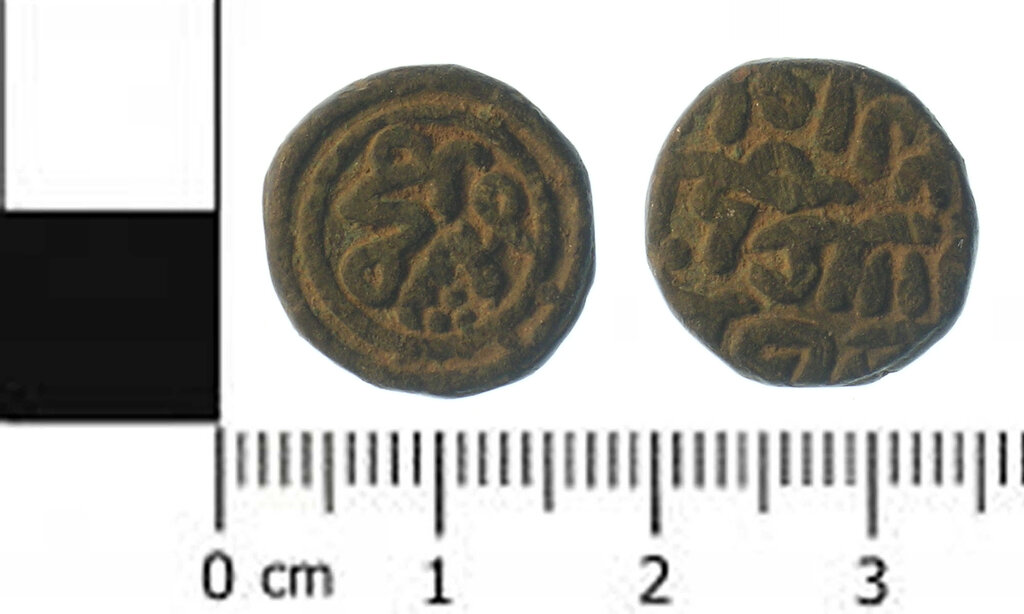
Another ambitious project was his attempt to shift the capital from Delhi to Daulatabad in the Deccan region. His logic was sound: Daulatabad was more centrally located within his expanding empire. But his execution was flawed. He forced a mass migration of Delhi's elite and government officials, a brutal and poorly managed affair that caused immense suffering and resentment. The new capital proved unsustainable, and he was eventually forced to move the court back to Delhi.
Despite these failures, Muhammad bin Tughlaq's reign demonstrates the Sultanate's ambition. He created a new department for agriculture (diwan-i-kohi) to improve cultivation and advanced large loans to peasants to expand farming. While these specific policies often failed, they showed a new level of state intervention in the economy and a vision of a truly centralized empire, where the Sultan's authority reached into every aspect of life.
What was the main function of the Iqta system introduced by the Delhi Sultanate?
The surplus revenue an Iqtadar was required to send to the central treasury in Delhi was known as _______.
The journey from scattered kingdoms to a powerful, centralized state was driven by military necessity and administrative innovation. The systems put in place by the Delhi Sultans, from the Iqta system to market controls, laid the administrative groundwork for future empires in India.