India 1851 Turning Point
British Colonial Rule
From Trade to Territory
The British arrival in India wasn't a military invasion in the traditional sense. It began with a business venture. The English East India Company (EIC), chartered in 1600, was a trading corporation interested in spices, cotton, and silk. For over a century, it operated from coastal trading posts, or 'factories,' negotiating with powerful Mughal emperors and local rulers.
By the mid-18th century, the Mughal Empire was crumbling. India was a patchwork of competing regional kingdoms. This political fragmentation created an opportunity. The EIC, with its private army and vast wealth, began to play politics, backing some rulers against others. The pivotal moment came in 1757 at the Battle of Plassey. Robert Clive, an EIC official, defeated the Nawab of Bengal with a combination of military force and treachery.
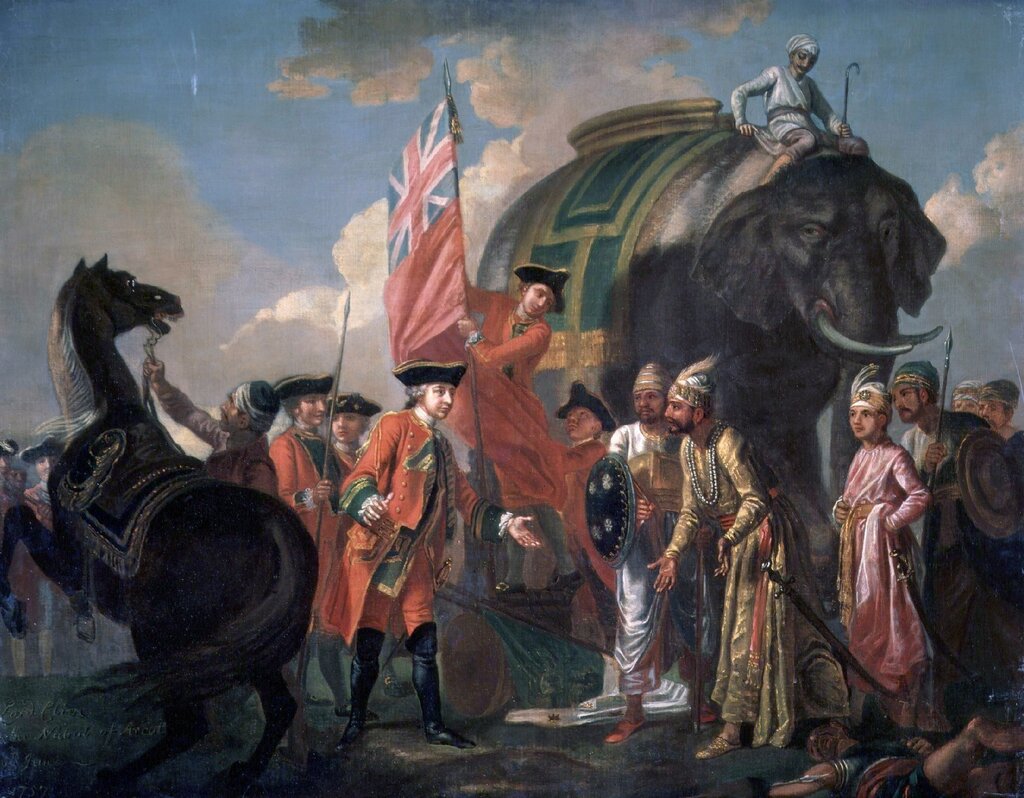
This victory marked the turning point. The EIC was no longer just a trading company; it was a kingmaker. In 1765, the weakened Mughal emperor granted the Company the Diwani of Bengal, Bihar, and Orissa. This gave them the right to collect taxes from over 20 million people. The revenue funded their armies, trade, and further expansion, creating a self-sustaining cycle of conquest.
Diwani
noun
The right to collect revenue or tax from a territory, granted by a sovereign ruler. It effectively transferred civil and financial administration to the recipient.
Over the next decades, the EIC expanded its control through wars and alliances. It defeated formidable rivals like the Marathas and the Kingdom of Mysore. Using policies like the 'Doctrine of Lapse,' which allowed the British to annex any princely state without a direct male heir, the Company absorbed more and more territory. By 1851, it was the dominant power across the subcontinent.
Governing a Subcontinent
Winning territory was one thing; running it was another. Initially, the EIC's administration was chaotic and corrupt. Company officials, known as 'nabobs,' amassed huge personal fortunes. The British Parliament grew concerned about this unchecked power and the mismanagement that led to a severe famine in Bengal.
To assert control, Parliament passed a series of laws. The Regulating Act of 1773 was the first major step, creating the post of Governor-General and a council in Calcutta to oversee Company affairs. This was followed by Pitt's India Act of 1784, which established a Board of Control in London, making the EIC a subordinate department of the British state. A private company was now formally tied to the Crown in governing India.
The goal was to create a 'steel frame' of administration that was efficient, centralized, and loyal to British interests, not local rulers.
The British built a new administrative machine. They established a professional civil service to manage districts, a modern police force to maintain order, and a new judicial system. English law was introduced, often replacing complex local customs. This created a uniform, hierarchical structure of rule that was entirely new to India. It was designed for one primary purpose: the efficient governance and economic exploitation of the colony.
Reshaping the Economy
With administrative control came economic restructuring. The British priority was maximizing revenue. To do this, they implemented new land revenue systems across India. These policies fundamentally changed the relationship between people and the land.
| System | Region | Key Feature |
|---|---|---|
| Permanent Settlement | Bengal, Bihar | Land revenue was fixed permanently with local landlords (Zamindars). |
| Ryotwari System | South and West India | Revenue was collected directly from the individual cultivators (Ryots). |
| Mahalwari System | North-West India, Punjab | Revenue was assessed on a village or estate (Mahal) and collected jointly. |
While the systems varied, the result was often the same: high taxes, rigid collection schedules, and hardship for peasants. Land, which was not traditionally a saleable commodity, could now be seized and sold for non-payment of taxes. This led to widespread rural debt and the rise of moneylenders.
At the same time, British policies transformed India from a producer of finished goods into a supplier of raw materials. India's famed textile industry, for example, couldn't compete with cheap, machine-made cloth imported from Britain's new factories. This process, often called de-industrialization, pushed many skilled artisans into poverty and back onto the land, increasing the pressure on agriculture.
A New Social Order
British rule also brought significant social changes. Initially, the EIC had little interest in Indian culture or religion, focusing solely on trade. However, as their power grew, so did the debate over their role in Indian society.
Some British officials, influenced by evangelical Christianity and utilitarian philosophy, saw Indian customs as backward and in need of reform. This led to campaigns against practices like sati (the immolation of widows on their husbands' funeral pyres), which was officially banned in 1829. The government also worked to suppress thuggee, a system of organized robbery and murder.
Education became another tool of transformation. The English Education Act of 1835, heavily influenced by Thomas Macaulay, shifted state funding towards English-language instruction. The goal was explicit: to form 'a class of persons, Indian in blood and colour, but English in taste, in opinions, in morals, and in intellect.' This new English-educated elite was needed to fill the lower ranks of the colonial administration, but it also introduced Western ideas of liberty and democracy that would later fuel the independence movement.
These reforms were a double-edged sword. While some were aimed at clear social evils, they were also seen by many Indians as an arrogant interference in their culture and religion, fueling resentment against foreign rule.
Time for a quick review of the key concepts we've covered.
Now, let's test your understanding of how the British established their rule.
What was the initial and primary purpose of the English East India Company when it was first established in India?
The granting of the Diwani to the EIC in 1765 was a critical step because it gave the Company the right to do what?
By the mid-19th century, the East India Company had transformed a commercial relationship into a colonial empire. It had built a powerful state with a sophisticated administration, a restructured economy, and a society undergoing profound change. This foundation of control, exploitation, and reform set the stage for everything that was to come.