Implementing Verbal Autopsy for Vital Statistics
VA Instruments Selection
Choosing Your Instrument
Selecting the right Verbal Autopsy (VA) instrument is a critical decision that balances international standards with local realities. Since you're already familiar with Civil Registration and Vital Statistics (CRVS) monitoring, we can jump directly into the technical specifics. The primary choice for most programs is between the World Health Organization's 2016 and 2022 VA instruments.
The 2022 version is a significant refinement of the 2016 model. It was redesigned based on extensive field data to be more efficient without sacrificing accuracy. The main goal was to shorten the interview time and reduce the burden on both interviewers and bereaved families.
| Feature | WHO 2016 Instrument | WHO 2022 Instrument |
|---|---|---|
| Total Questions | Significantly more questions across all modules. | Reduced question count by roughly 30%. |
| Interview Time | Longer, often exceeding 45 minutes for complex cases. | Shorter, streamlined to be completed more quickly. |
| Skip Patterns | Complex, with more potential for interviewer error. | Optimized and simplified for a smoother interview flow. |
| Diagnostic Accuracy | High, but with some redundancy in questioning. | Maintained, with similar accuracy for leading causes of death. |
For new VA implementations, the WHO 2022 instrument is the recommended starting point. It's more user-friendly and less resource-intensive, making it easier to deploy and scale.
Mapping Indicators to Codes
Regardless of which instrument you choose, its core function is to collect symptom and sign indicators that can be mapped to a cause of death. This mapping is not arbitrary; it must align with the International Classification of Diseases (ICD). Automated diagnostic algorithms, like SmartVA, analyze the pattern of 'yes'/'no' answers to assign a probable cause of death with a corresponding ICD code.
Indicator
noun
In the context of Verbal Autopsy, an indicator is a specific sign, symptom, or condition reported during the interview (e.g., 'fever for more than 14 days,' 'difficulty breathing').
The instrument is designed so that specific combinations of indicators point toward diagnoses in either ICD-10 or the newer ICD-11. For example, a series of questions about fever, headache, stiff neck, and confusion in an adult helps differentiate between meningitis, malaria, and other febrile illnesses, each with a distinct ICD code.
Adaptation vs. Standardization
A common challenge is adapting a standardized WHO instrument to a local context. You might need to translate it into a local language or rephrase questions to be culturally appropriate. However, this carries a significant technical risk.
Automated diagnostic algorithms are calibrated to the exact wording and structure of the standard instrument. Changing a question, even slightly, can break the logic of these algorithms. Altering the skip patterns is particularly dangerous, as it can prevent key diagnostic questions from being asked, rendering the collected data unusable for automated analysis.
The trade-off is clear: localization improves comprehension for the respondent, but standardization ensures compatibility with analytical tools. The best practice is to use a validated translation and conduct rigorous pilot testing before making any modifications.
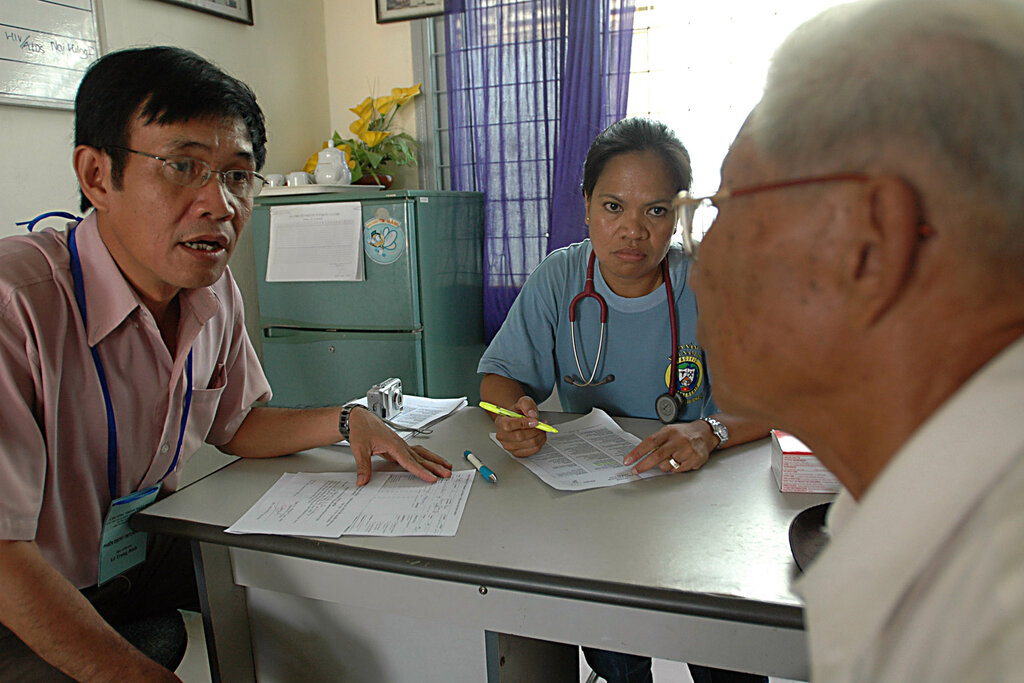
How the Modules Work
The VA instrument is not a single questionnaire but a set of modules. The interview starts with general questions, then directs the interviewer to the appropriate module based on the decedent's age and sex.
Each module contains carefully designed skip patterns. For example, in the maternal module, a 'yes' answer to whether the woman was pregnant at the time of death (or died within 42 days of delivery) triggers a detailed set of questions about hemorrhage, eclampsia, and infection. If the answer is 'no,' the entire section is skipped, and the interview proceeds with the standard adult questions.
Similarly, in the neonate module, questions about the baby's condition at birth (e.g., 'Did the baby cry immediately?') are fundamental. The answers guide the interviewer through questions about birth asphyxia, preterm complications, or neonatal infections, while skipping irrelevant sections.
This logical branching is what makes the instrument efficient. It ensures that families are only asked relevant questions, preserving their time and reducing distress while still collecting the specific indicators needed for an accurate diagnosis.
Let's test your understanding of selecting and using VA instruments.
What was the primary motivation for developing the WHO 2022 VA instrument as a refinement of the 2016 version?
A public health program decides to alter the skip patterns in the neonatal module of the VA instrument to 'simplify' the interview flow. What is the most significant technical risk of this modification?
Proper instrument selection and implementation are foundational for generating reliable mortality data. By understanding the technical differences between versions and the critical need for standardization, you can ensure your VA program produces data that is both locally relevant and internationally comparable.