Immunoglobulins Explained
Immunoglobulin Basics
The Body's Detectives
Your body has a sophisticated security system, and a key part of it is a group of proteins called immunoglobulins. You probably know them by their more common name: antibodies. These are the specialized agents of your adaptive immune system, designed to identify and neutralize foreign invaders like bacteria, viruses, and other pathogens.
Antibodies, also known as immunoglobulins, are Y-shaped proteins that play a crucial role in the adaptive immune system.
Think of them as highly specific detectives. Each antibody is trained to recognize one particular clue, or antigen—a unique molecule on the surface of a pathogen. When an antibody finds its target, it latches on, marking the invader for destruction by other immune cells.
A Protein with a Purpose
At a molecular level, an antibody has a distinct Y-shape. This structure isn't random; it's perfectly suited for its job. The molecule is built from four polypeptide chains: two identical heavy chains and two identical, smaller light chains. These chains are linked together, forming a flexible 'Y'.
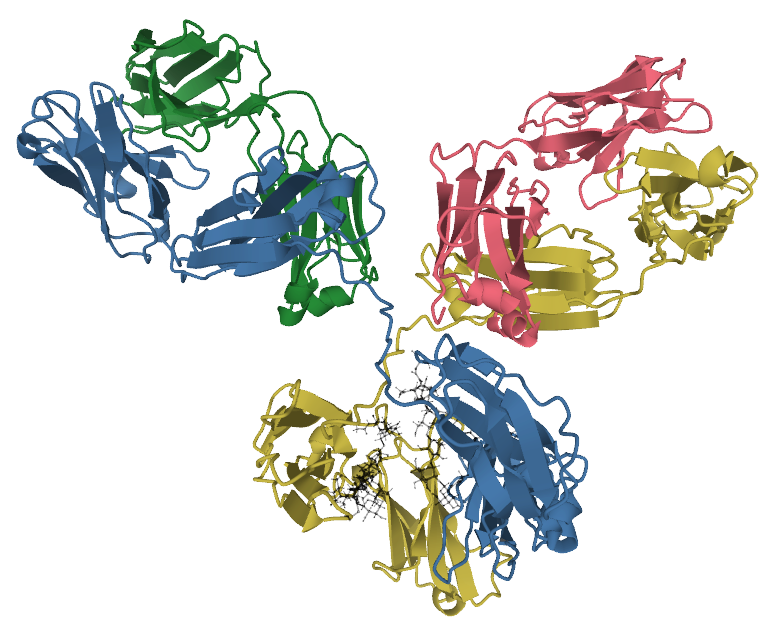
The base of the 'Y' is called the constant region. It's similar across many different antibodies and helps interact with other parts of the immune system. The two arms of the 'Y' are the variable regions. This is where the action happens.
The Antigen-Binding Site
At the very tip of each arm of the 'Y' is a unique structure called the antigen-binding site. This site is formed by the combination of the ends of one heavy and one light chain. Its shape is precisely molded to fit a specific antigen, much like a key fits into a lock.
This incredible specificity is the cornerstone of the adaptive immune response. Your body can produce billions of different antibodies, each with a uniquely shaped antigen-binding site ready to recognize a different potential threat.
Once an antibody binds to its antigen, it doesn't kill the pathogen itself. Instead, it acts as a flag, signaling other immune cells to come and clear out the marked invaders.
The Five Classes
While all immunoglobulins share the same basic Y-shaped structure, they come in five main classes, or isotypes. These classes are determined by differences in the heavy chain. Each class has a slightly different role in the immune defense.
| Class | Name | Quick Overview |
|---|---|---|
| IgG | Immunoglobulin G | The most common antibody; found in blood and tissues. |
| IgA | Immunoglobulin A | Found in mucosal areas like the gut and respiratory tract. |
| IgM | Immunoglobulin M | The first antibody produced in response to a new infection. |
| IgE | Immunoglobulin E | Involved in allergic reactions and fights parasites. |
| IgD | Immunoglobulin D | A less understood antibody that helps activate B cells. |
This fundamental structure and these five classes form the basis of how your body recognizes and remembers pathogens, allowing for a swift and targeted response if the same invader ever returns.