Immersion Cooling for AI Infrastructure
Immersion Cooling Fundamentals
The Air Cooling Wall
For decades, data centers have relied on a simple strategy to keep servers from overheating: blasting them with cold air. This approach, known as air cooling, works well for traditional computing loads. But AI workloads are a different beast entirely. Training large models and running complex inferences pushes processors to their limits, generating a tremendous amount of heat in a very small space.
A standard server rack cooled by air starts to struggle when its power consumption hits 20 to 30 kilowatts (kW). Beyond this point, the fans simply can't move enough air, and the air itself can't absorb and carry away heat fast enough. It's a fundamental problem of physics. Air has a very low heat capacity, meaning a large volume of it is needed to transport a small amount of thermal energy. For the dense, power-hungry racks common in AI clusters, air cooling is like trying to tame a volcano with an office fan. The hardware throttles its performance to avoid damage, or worse, fails completely.
With the powerful processing of modern AI workloads comes increased heat generation, and using liquid-cooled servers significantly reduces the electricity required for thermal management versus air-cooled servers.
Diving into Liquid
The solution is to bypass air entirely and use a liquid. Immersion cooling submerges IT hardware directly into a thermally conductive but electrically non-conductive fluid. This method leverages the superior heat transfer properties of liquids to cool components far more effectively than air ever could.
The entire server, motherboards and all, is lowered into a tank filled with a specially designed dielectric fluid. Because the liquid is in direct contact with every heat-generating component, from the CPU to the memory modules, heat is wicked away instantly and efficiently. This direct-contact approach eliminates the need for complex heatsinks and loud, power-hungry server fans, enabling rack densities to soar past 100 kW and beyond.
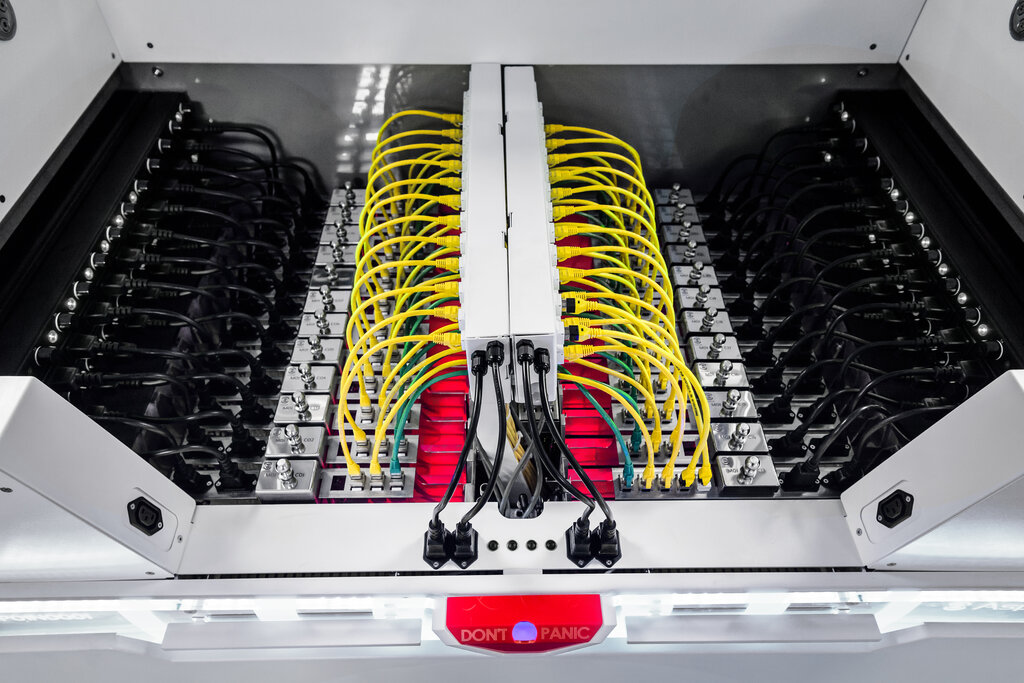
This radical shift in thermal management not only solves the heat problem but also dramatically reduces energy consumption. The fans inside a typical server can account for 10-20% of its total power draw. Removing them slashes this , improving the overall energy efficiency of the data center.
Two Paths to Cool
Immersion cooling systems are typically built around one of two core architectures: single-phase or two-phase.
Single-Phase Immersion Cooling (1-PIC) In this method, the dielectric fluid always remains in its liquid state. Pumps circulate the warmed fluid out of the server tank to a heat exchanger, where it's cooled by a water loop. The chilled fluid is then pumped back into the tank to absorb more heat. It's a simple, reliable, and continuous cycle.
Two-Phase Immersion Cooling (2-PIC) This approach is more complex but even more efficient. It uses an engineered fluid with a very low boiling point, often around 50°C (122°F). As components like CPUs heat up, they cause the fluid in direct contact with them to boil. This phase change from liquid to vapor absorbs a massive amount of thermal energy through a process called latent heat of vaporization.
The vapor rises, cools on a condenser coil at the top of the sealed tank, turns back into a liquid, and rains back down on the components. This creates a passive, self-contained cooling cycle without the need for pumps to circulate the dielectric fluid itself.
| Feature | Single-Phase (1-PIC) | Two-Phase (2-PIC) |
|---|---|---|
| Mechanism | Fluid remains liquid | Fluid boils into vapor |
| Fluid Circulation | Active (pumps) | Passive (convection) |
| Heat Transfer | Convection | Latent heat of vaporization |
| Complexity | Simpler, less maintenance | More complex, sealed tanks |
| Cooling Capacity | Very high | Extremely high |
Anatomy of an Immersion System
Regardless of the approach, immersion systems share a few core components that replace traditional data center cooling infrastructure.
Immersion Tanks: These are specially designed tubs that hold the servers and the dielectric fluid. In two-phase systems, these tanks are sealed to contain the vapor and have integrated condenser coils at the top.
Coolant Distribution Units (CDUs): These units act as the bridge between the hot dielectric fluid and the building's main water-cooling loop. A CDU contains a heat exchanger that transfers thermal energy from the fluid to the facility water without the two liquids ever mixing.
Pumps: In single-phase systems, pumps are required to circulate the dielectric fluid between the immersion tank and the CDU, ensuring a constant flow of cool liquid over the hot IT components.
By replacing fans with fluid, data centers can not only handle the intense thermal demands of AI but also operate more quietly and efficiently. This fundamental shift from air to liquid is a critical step in building sustainable infrastructure for the future of computing.
Why is traditional air cooling often insufficient for dense AI server racks?
In the context of immersion cooling, what is a dielectric fluid?