IMAT Preparation and Strategy
Logical Problem Solving
Solving Under Pressure
The IMAT's first section isn't just a math test; it's a test of your reasoning under extreme time constraints. With roughly 90 seconds per question, you don't have time for leisurely calculation. Success hinges on quickly identifying the problem type and applying a targeted strategy. We'll focus on three key patterns: finding the necessary data, determining the right method, and spotting similarities.
Relevant Selection
Many IMAT problems present a wall of data. Your first task is to figure out what you actually need. Most of the numbers and text are distractions. This skill is called Relevant Selection, and it's about finding the signal in the noise. Before you even think about calculating, you must isolate the critical pieces of information. The test-makers want to see if you can filter out irrelevant details under pressure.
| Flight | Departure City | Arrival City | Departure (Local) | Arrival (Local) | Airline | Price (€) |
|---|---|---|---|---|---|---|
| AZ201 | Rome | Milan | 08:30 | 09:40 | ITA | 95 |
| FR902 | Milan | Rome | 10:15 | 11:25 | Ryanair | 45 |
| LH305 | Frankfurt | Rome | 11:00 | 12:35 | Lufthansa | 120 |
| AZ204 | Rome | Milan | 14:00 | 15:10 | ITA | 110 |
Consider the table above. A typical question might ask: "How much longer is the morning flight from Rome to Milan than the afternoon flight?" Your eyes should immediately scan for the two rows with "Rome" as the departure city and "Milan" as the arrival city. You only need the departure and arrival times from those two rows. The flight numbers, airlines, and prices are all irrelevant noise.
The morning flight (AZ201) is 1 hour and 10 minutes (70 minutes). The afternoon flight (AZ204) is also 1 hour and 10 minutes (70 minutes). The difference is zero. You save precious seconds by never even looking at the other data.
Finding Procedures
Once you have the right data, you need the right method. This is where Finding Procedures comes in. These questions require you to construct a path to the solution. Sometimes it's a straightforward formula, but often it's a multi-step process you have to build on the fly. Don't just start calculating; map out your steps first.
For example, a question might give you the dimensions of a room and the dimensions of a tile, then ask how many tiles are needed to cover the floor. The procedure is:
- Calculate the area of the room.
- Calculate the area of a single tile.
- Divide the room's area by the tile's area.
Forgetting to convert units (e.g., meters to centimeters) is a common trap in these problems. Always write down your steps, even if they seem simple.
To solve this, you need a procedure. You could calculate the area of the whole pizza and subtract the area of the slice. Or, more directly, you can find the area of the remaining portion.
- Total Area: The formula is . So, .
- Fraction Remaining: A full circle is 360°. The slice is 45°. The remaining portion is . As a fraction of the whole, this is .
- Simplify Fraction: simplifies to .
- Final Calculation: The area of the remaining pizza is of the total area. So, .
Knowing the procedure is more important than the final number. It's the map that gets you to the destination.
Identifying Similarity
The third type of problem involves Identifying Similarity or pattern recognition. These can be spatial, like a series of shapes, or numerical, like a sequence of numbers. Your job is to deduce the underlying rule that governs the pattern.
For spatial reasoning, break the problem down. Analyze one element at a time. How does the circle move? How does the shaded square rotate? Does the number of sides on the polygon increase? Track each change separately before trying to understand the whole system.
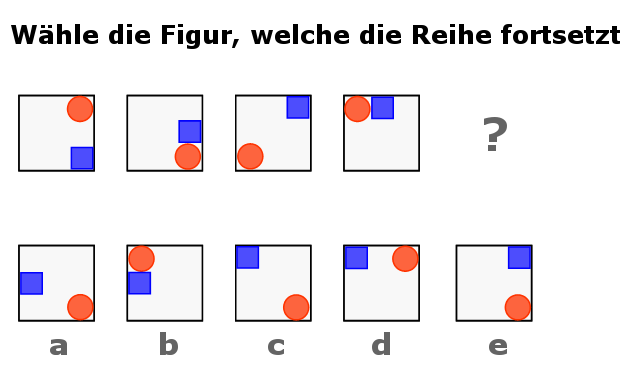
In the example above, you must identify the rules for both the red circles and the blue squares. Let's analyze:
- Red Circles: One circle is added in each step, placed in the corner that follows a clockwise rotation (top-left, top-right, bottom-right, bottom-left...).
- Blue Squares: The single blue square moves one position counter-clockwise with each step.
To find the fifth pattern, you apply these rules. A fifth red circle would be added to the top-left corner, and the blue square would move from the top-right to the top-left position. The correct answer is therefore 'a'.
These three techniques—Relevant Selection, Finding Procedures, and Identifying Similarity—form the core of your strategy for the IMAT's problem-solving questions. Mastering them isn't about knowing more math, but about thinking more strategically.
When facing a problem with a large amount of data, what is the most effective first step according to the principle of Relevant Selection?
A room measures 5 meters by 4 meters. You want to tile the floor with square tiles that are 50 centimeters on each side. What is the correct procedure to find the number of tiles needed?