Image Interpretation
Introduction to Art Analysis
Learning to Look
Have you ever stood in front of a painting and thought, "I don't get it"? Looking at art can feel intimidating, as if you need a secret decoder ring to understand what's going on. But you don't. You just need to learn the language of images.
This is called visual literacy. It's the ability to read and interpret what you see. Just like learning the alphabet helps you read a book, understanding the basic components of art helps you understand a painting, sculpture, or photograph. It's a skill that allows you to move from just seeing an artwork to truly understanding it.
Developing visual literacy isn't about finding the single "right" answer. It's about training your eyes to notice details and asking questions about what those details might mean.
The Basic Ingredients
Every artwork is made from the same set of fundamental ingredients, known as the elements of art. Think of them as the nouns of visual language. They are the raw materials the artist uses.
| Element | What It Is |
|---|---|
| Line | A path made by a moving point. Lines can be thick, thin, curved, or straight. They can define edges or suggest movement. |
| Shape | A two-dimensional, enclosed area. Shapes can be geometric, like circles and squares, or organic and free-flowing. |
| Color | The visual property of light. It has three main characteristics: hue (the name, like red), value (lightness or darkness), and intensity (brightness or dullness). |
| Texture | The surface quality of an object. It can be actual (how it really feels, like the rough surface of a sculpture) or implied (how it looks like it would feel, like a painted silk dress). |
| Space | The area within, around, or between objects. Artists use space to create a sense of depth and perspective. This includes positive space (the main subjects) and negative space (the area around them). |
The Artist's Recipe
If elements are the ingredients, the principles of design are the recipe. They describe how the artist arranges the elements to create a specific effect. This is the grammar of visual language, guiding how the parts relate to each other and to the whole.
Balance
noun
The distribution of visual weight in a composition. It can be symmetrical (mirrored on both sides), asymmetrical (different but equally weighted on both sides), or radial (arranged around a central point).
Contrast is the use of opposing elements—like light and dark colors, or smooth and rough textures—to create visual interest.
Emphasis creates a focal point, drawing your eye to the most important part of the artwork.
Movement is the path your eye takes through the work of art, often guided by lines, edges, and color.
Pattern and rhythm involve the repetition of elements. Pattern is a predictable repetition, while rhythm is more varied, creating a sense of visual beat.
Finally, unity is the feeling of harmony between all parts of the work, creating a sense that everything belongs.
Formal elements like color, composition, brushwork, and subject matter provide important clues
Your First Analysis
Now you have the tools for a formal analysis. This method focuses only on what you can see: the elements and principles. It's a way to analyze an artwork without needing to know about the artist's life or the historical context. It’s all about looking closely.
A simple way to start is with three steps:
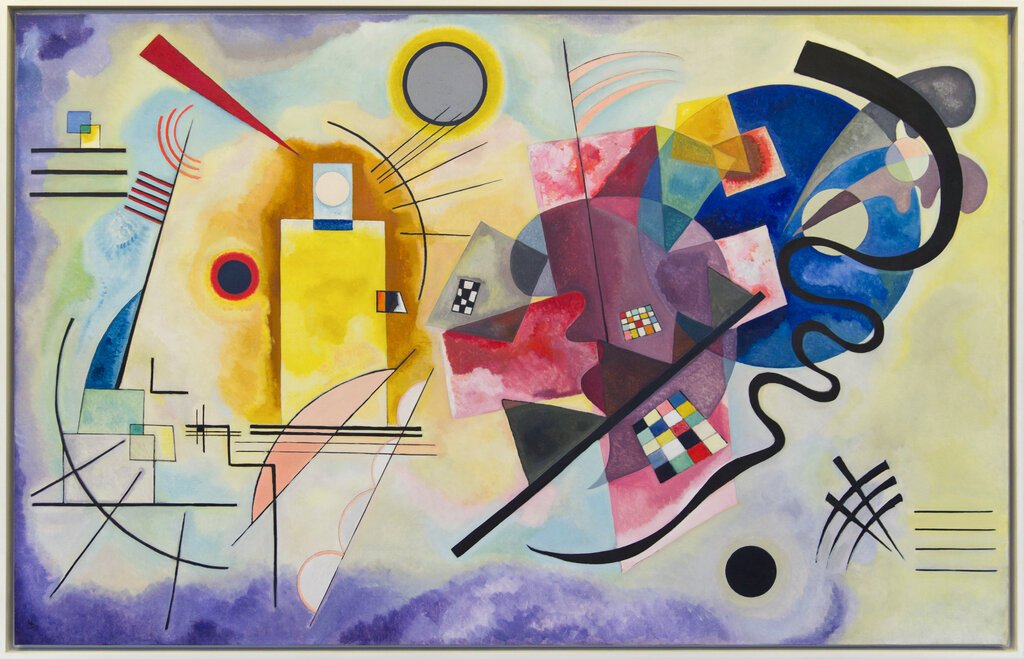
- Describe: What elements do you see? Start with the obvious. "I see straight black lines, a large yellow rectangle, and a deep blue circle."
- Analyze: How are the elements arranged? Talk about the principles. "The bright yellow on the left balances the darker blue on the right. There's a strong contrast between the sharp geometric shapes and the soft, blended colors."
- Interpret: What is the overall effect? This is your conclusion based on your observations. "The combination of energetic lines and calming circles creates a feeling of both chaos and order."
This process turns looking into an active investigation. You're not just a passive viewer; you're a detective, piecing together visual clues to understand the whole picture.
What is the primary goal of visual literacy?
In the language of art, the elements are like the __________, while the principles of design are like the __________.
With these foundational concepts, you're ready to look at any artwork and begin to uncover its meaning. The more you practice, the more you'll see.