IIT Thermodynamics Essentials
Introduction to Thermodynamics
What is Thermodynamics?
At its heart, thermodynamics is the science of energy in all its forms, especially heat and work. It's the branch of physics that deals with the relationships between heat and other forms of energy. Think of it as the rulebook for how energy moves and changes, governing everything from the engine in a car to the chemical reactions in our bodies.
Thermodynamics is a phenomenological science based on three fundamental laws, generalized from a broad range of scientific observations, that describes the energy and behavior of an arbitrary system.
To study these energy transformations, we need to be very precise about what we're looking at. Scientists do this by defining a 'system' and its 'surroundings'.
Systems and Surroundings
Imagine a cup of hot coffee on your desk. In thermodynamics, the coffee itself is what we want to study. We call this the system. Everything outside the coffee—the cup, the desk, the air in the room, the rest of the universe—is called the surroundings.
The line that separates the system from its surroundings is the boundary. In this case, it's the inner surface of the coffee cup and the top surface of the coffee exposed to the air. The boundary can be real, like a container wall, or imaginary.
Systems are categorized based on what they exchange with their surroundings across this boundary: matter and energy.
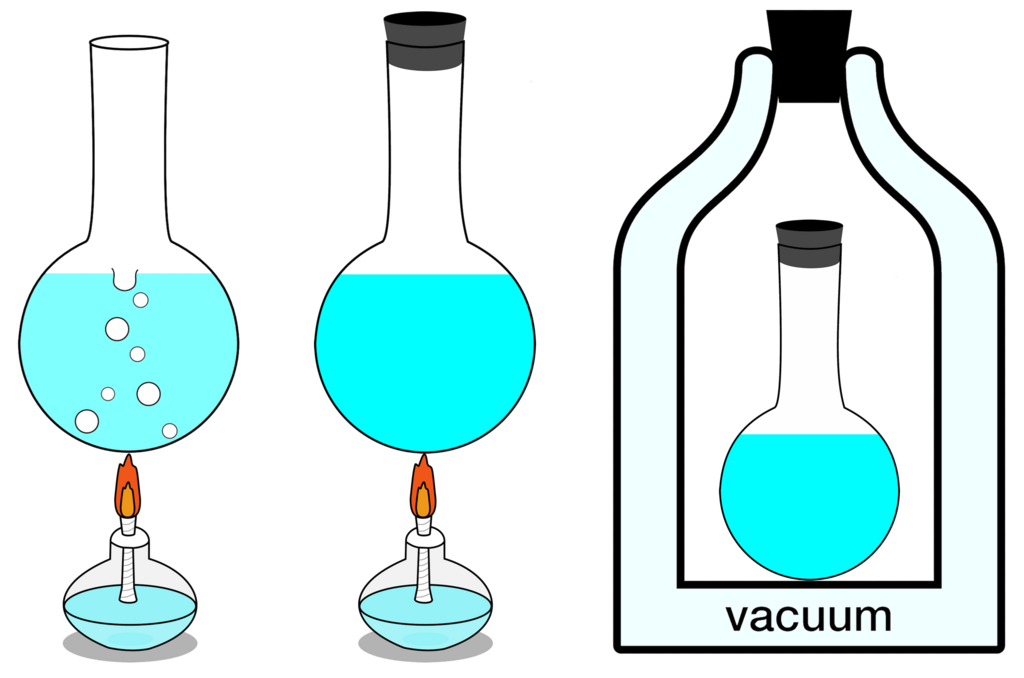
Open System: An open system can exchange both energy (like heat) and matter with its surroundings. Our cup of coffee is an open system. It radiates heat into the room (exchanging energy) and steam evaporates from its surface (exchanging matter).
Closed System: A closed system can exchange energy but not matter. If you put a tight lid on that coffee cup, it becomes a closed system. It will still cool down by losing heat through the cup walls, but no water vapor can escape.
Isolated System: An isolated system cannot exchange either energy or matter with its surroundings. A perfect thermos would be an isolated system. In reality, perfectly isolated systems don't exist, but we can get very close. They are a useful concept for understanding thermodynamic principles.
Describing a System's State
To describe a system, we use a set of measurable properties called state variables. These variables tell us the condition, or state, of the system at a specific moment. The most common state variables are pressure, volume, temperature, and internal energy.
Pressure
noun
The force exerted by a substance per unit of area on its container or boundary. It's often measured in Pascals (Pa) or atmospheres (atm).
Volume
noun
The amount of three-dimensional space that a substance or system occupies. It is usually measured in cubic meters (m³) or liters (L).
Temperature
noun
A measure of the average kinetic energy of the atoms or molecules in a system. It indicates how hot or cold something is and is measured in Kelvin (K), Celsius (°C), or Fahrenheit (°F).
The fourth key variable is internal energy (U). This represents the total energy contained within a system. It's the sum of all the kinetic energy (from the motion of particles) and potential energy (from the forces between particles) of all the particles in the system. We can't measure internal energy directly, but we can measure how it changes.
Processes of Change
A thermodynamic process occurs when a system's state variables change, moving it from one state of equilibrium to another. There are several specific types of processes where one state variable is held constant. These special cases make calculations and analysis much simpler.
| Process | Constant Property | Description |
|---|---|---|
| Isothermal | Temperature () | The process happens at a constant temperature. Any heat added to the system is balanced by work done by the system. |
| Isobaric | Pressure () | The process occurs at constant pressure. A common example is water boiling in an open pot. |
| Isochoric | Volume () | The process takes place at constant volume. Since the volume doesn't change, the system does no work. |
| Adiabatic | No Heat Exchange () | No heat is transferred into or out of the system. This can happen if the system is perfectly insulated or if the process happens extremely quickly. |
Understanding these basic terms—systems, state variables, and processes—is the first step into the world of thermodynamics. They are the building blocks we'll use to explore the fundamental laws that govern energy and the universe.
Ready to check your understanding? Let's see what you've learned.
Which of the following best defines a thermodynamic 'system'?
A pot of boiling water on a stove, without a lid, is an example of what kind of system?