IIT Chemistry Essentials
Atomic Structure
A Planetary Model for the Atom
Early in the 20th century, scientists pictured the atom like a tiny solar system. At the center was the nucleus, a dense sun, and orbiting it were electrons, like planets. This simple picture, known as the Bohr model, was a huge leap forward. It suggested that electrons couldn't just orbit anywhere they wanted. Instead, they were restricted to specific paths, or energy levels, much like lanes on a circular track.
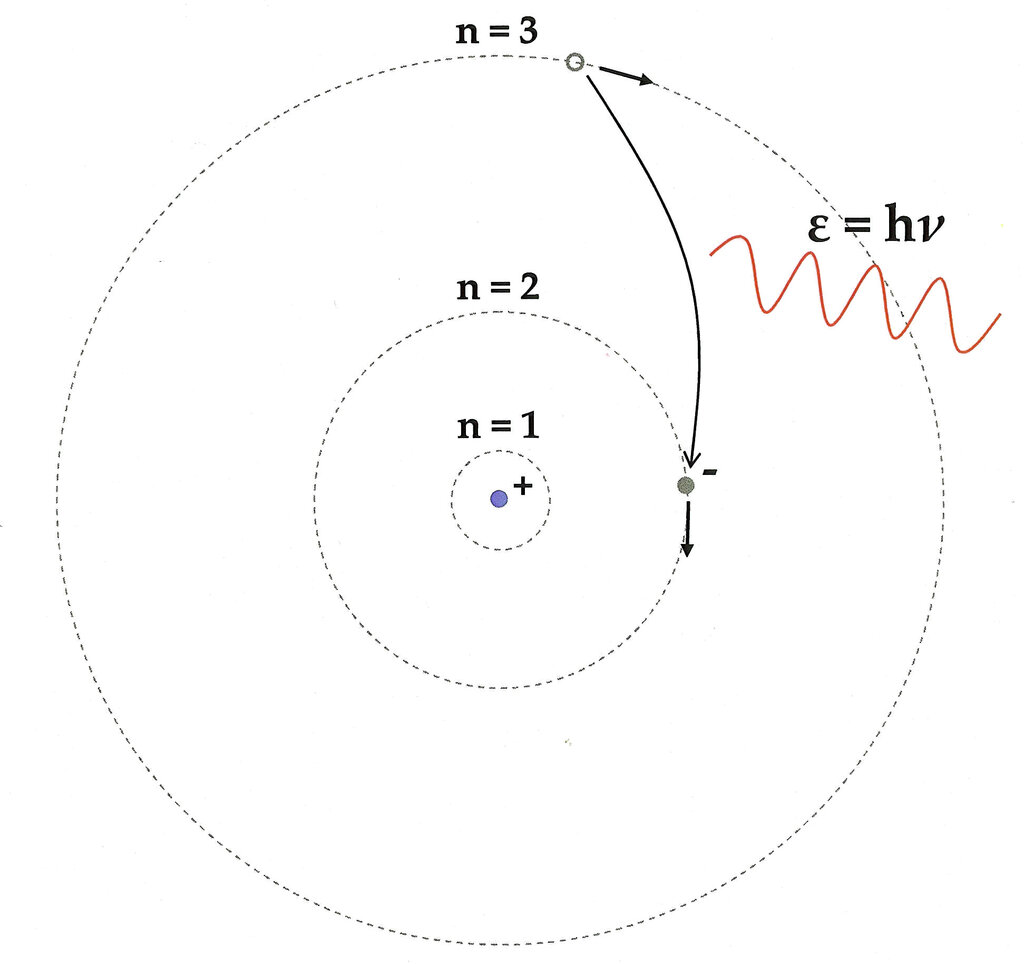
An electron in a shell close to the nucleus has low energy. To jump to a shell farther out, it needs to absorb a precise amount of energy. When it falls back down to a lower shell, it releases that energy, often as a flash of light. This idea of fixed energy levels explained why elements emit specific colors of light when heated.
The Bohr model was brilliant for hydrogen, which has only one electron. But for atoms with more electrons, the model started to break down. The neat, flat orbits couldn't explain the complex behavior of larger atoms. A new, more detailed model was needed.
The Quantum Address System
The modern view of the atom is based on quantum mechanics. It replaces Bohr's simple orbits with something more complex: orbitals. An orbital isn't a path; it's a three-dimensional region of space where an electron is most likely to be found. You can think of it as a blurry cloud of probability.
To describe an electron's location and state within an atom, we use a set of four quantum numbers. Think of them as an address for an electron, with each number specifying a different part of that address, from the state down to the specific house.
Each electron in an atom has a unique set of four quantum numbers, like a unique address.
The first number tells us about the electron's main energy level.
1. The Principal Quantum Number () This number describes the main energy level, or shell, the electron is in. It can be any positive integer: 1, 2, 3, and so on. A higher value of means the electron is in a higher energy shell, is generally farther from the nucleus, and its orbital is larger.
Next, we need to know the shape of the electron's home.
2. The Angular Momentum Quantum Number () This number defines the shape of the orbital. Its value depends on ; it can be any integer from 0 up to . Each value of corresponds to a different orbital shape, which we label with letters for convenience:
- is an s orbital (spherical)
- is a p orbital (dumbbell-shaped)
- is a d orbital (more complex shapes)
- is an f orbital (even more complex)
So, the first energy shell () can only have an s orbital (). The second shell () can have s and p orbitals ( and ).
Once we have the shape, we need its orientation.
3. The Magnetic Quantum Number () This number describes the orbital's orientation in 3D space. Its value depends on and can be any integer from to , including 0.
- For an s orbital (), can only be 0. Since a sphere looks the same from any direction, there's only one orientation.
- For p orbitals (), can be -1, 0, or +1. This corresponds to three p orbitals, oriented along the x, y, and z axes ().
- For d orbitals (), can be -2, -1, 0, +1, or +2, giving five different d orbitals.
Finally, every electron has its own spin.
4. The Spin Quantum Number () This number describes the intrinsic spin of the electron, which creates a tiny magnetic field. It can have one of two values: (spin up) or (spin down).
Orbital Shapes
The quantum numbers and give orbitals distinct shapes and orientations. These shapes aren't random; they represent the high-probability zones where an electron can be found.
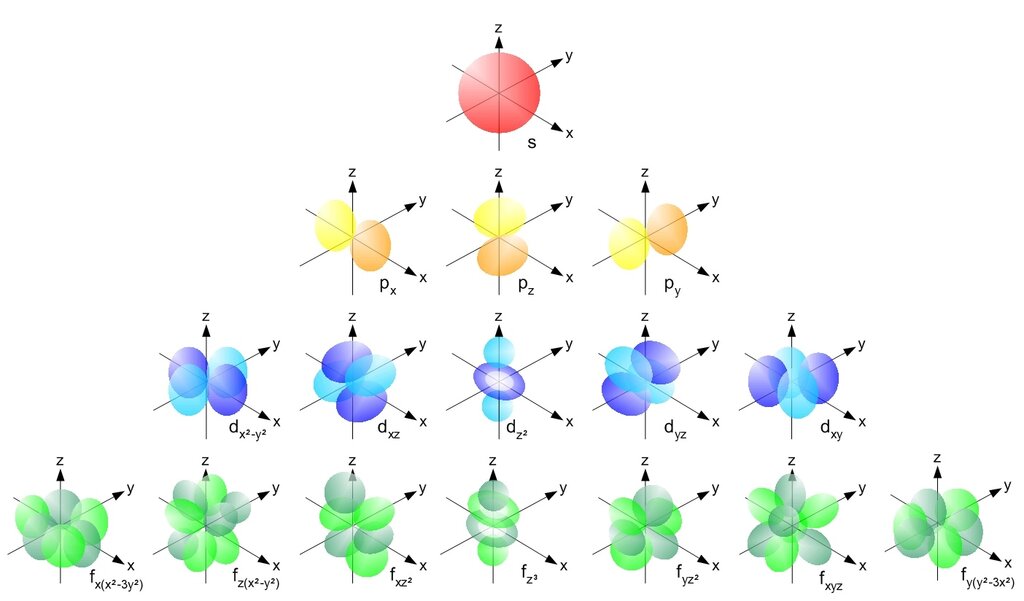
s Orbitals () are spherical. For every energy level (), there is one s orbital. The 2s orbital is larger than the 1s, the 3s is larger than the 2s, and so on.
p Orbitals () are shaped like dumbbells or figure-eights. They appear starting from the second energy level (). There are three p orbitals for each energy level, oriented at 90-degree angles to each other along the x, y, and z axes.
d Orbitals () have more intricate shapes. They first appear in the third energy level (). There are five d orbitals, four of which look like four-leaf clovers, with the fifth resembling a dumbbell with a donut around the middle.
Filling the Orbitals
So, how do electrons fill up these available orbitals in an atom? They follow a few simple rules to achieve the most stable, lowest-energy arrangement possible. This arrangement is called the atom's electron configuration.
It’s essential for students to understand how electrons are arranged in shells, subshells and orbitals, and the order orbitals are filled.
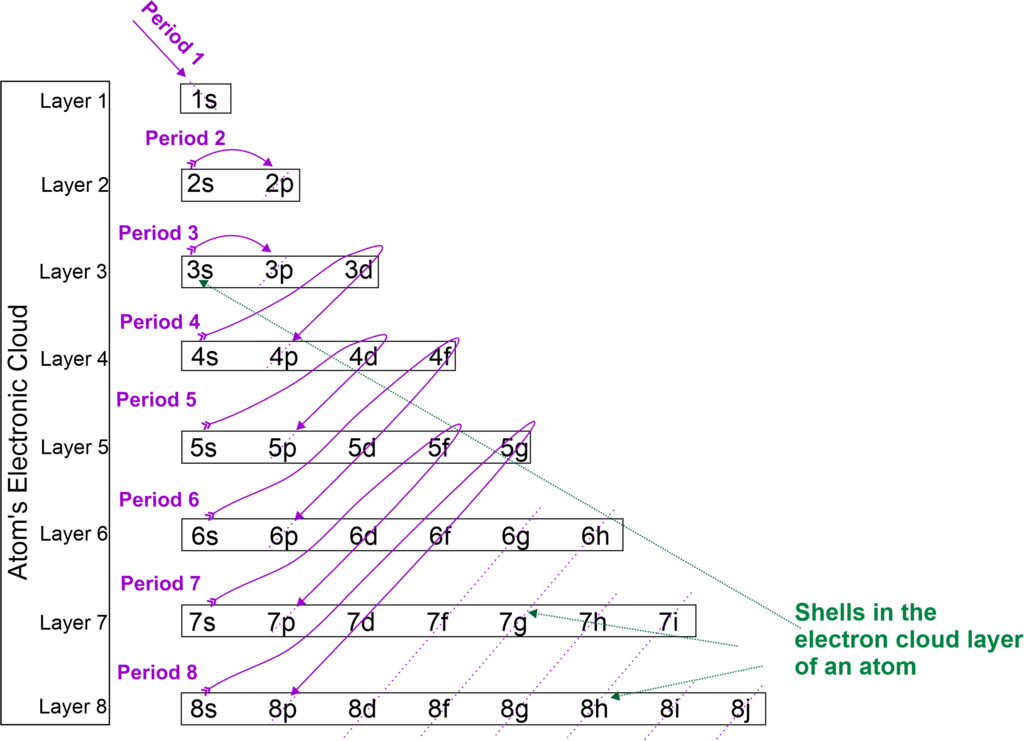
Aufbau Principle This rule states that electrons fill the lowest-energy orbitals first before moving to higher-energy ones. This means the 1s orbital is filled first, then 2s, then 2p, then 3s, and so on. It's like filling seats in a theater starting from the front row.
Pauli Exclusion Principle This principle states that no two electrons in the same atom can have the exact same set of four quantum numbers. Since an orbital is defined by the first three quantum numbers (), this means an orbital can hold a maximum of two electrons, and those two electrons must have opposite spins ( and ).
Hund's Rule When filling orbitals that have the same energy, like the three p orbitals or the five d orbitals, electrons will occupy separate orbitals first before pairing up. Think of people getting on an empty bus—they'll each take their own row before sitting next to someone. Furthermore, these single electrons will all have the same spin (all spin up, for example).
Together, these rules determine the electron configuration for every element, which in turn dictates its chemical properties.
Let's test your knowledge of these atomic building blocks.
What is the primary difference between the Bohr model's 'orbit' and the quantum mechanical model's 'orbital'?
If an electron is in the third energy shell (), what are the possible values for its angular momentum quantum number ()?
Understanding the structure of the atom is the first step toward understanding how atoms join together to form molecules and create the world around us.