IGCSE Geography Rivers Mastery
Drainage Basin Systems
The Basin as a System
Think of a drainage basin not just as a piece of land, but as an open system—a machine that processes water. Like any system, it has inputs, processes, and outputs. The boundary of this system is called the watershed, which is the high ground separating one basin from another. Everything that happens with water inside this boundary is part of the basin's story.
Drainage Basin
noun
An area of land drained by a river and its tributaries. It is an open system with inputs, outputs, flows, and stores of both water and sediment.
The main input is precipitation. The main outputs are river discharge—the water flowing out of the basin—and evapotranspiration. In between, water is stored (in soil, rock, or on the surface) and transferred through various flows. The system's goal is to balance itself, described by a simple water balance equation.
Water's Journey to the Ground
When rain falls, especially in a forested area, its journey to the ground isn't straightforward. Some water is caught by leaves and branches, a process called interception. From there, it can either evaporate directly back into the atmosphere or make its way down.
Water that drips from the canopy is called throughfall. Water that trickles down the trunks and stems of plants is known as stemflow. These two processes slow the delivery of water to the ground, reducing the immediate impact of a storm and preventing soil erosion.
Underground Pathways
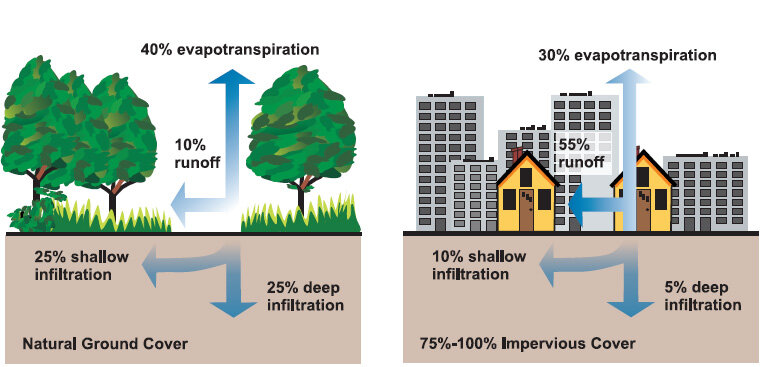
Once water reaches the ground, it begins its downward movement. Infiltration is the process of water soaking into the soil. The rate at which this happens depends on factors like soil type (sandy soil absorbs faster than clay), how saturated the soil already is, and the land cover. Urban areas with lots of concrete have very low infiltration rates, leading to high surface runoff.
As water moves deeper, it percolates through the soil and rock layers. This is percolation. This process is much slower than infiltration and is driven by gravity. It's how deep underground water stores, known as aquifers, are replenished.
Water doesn't just move straight down. Some of it flows sideways through the soil layers, a process called throughflow. This is a relatively fast way for water to get to a river channel. Deeper down, below the water table, is groundwater flow, which is a much slower, long-term movement of water through saturated rock.
The water table isn't flat; it generally mimics the shape of the land surface above it. It rises after prolonged rainfall and falls during dry periods.
The total volume of water flowing through a river at a given point and time is its . It's a key measure of a basin's output. To calculate it, you need to know the river's cross-sectional area and its velocity.
Now that we've covered the key parts of the drainage basin system, let's test your understanding.
In the context of a drainage basin as an open system, which of the following correctly identifies the main input and the main outputs?
The boundary of a drainage basin, typically high ground that separates it from adjacent basins, is called the __________.
Understanding these interconnected processes helps explain why rivers behave differently and how land use changes can have significant impacts on water flow and availability.