IELTS Success Mastery
IELTS Format Mastery
Academic vs General Training
The first step in mastering the IELTS is choosing the right test. Your choice between the Academic and General Training modules depends entirely on your goals. The Academic module is for those applying for higher education or professional registration in an English-speaking environment. The General Training module is for those migrating to an English-speaking country or applying for secondary education, training programmes, and work experience.
The Listening and Speaking sections are identical for both modules. The difference lies in the Reading and Writing sections. Academic Reading passages are longer and more complex, drawn from books, journals, and newspapers. General Training Reading passages are shorter and relate to everyday situations, workplace contexts, and general interest topics. Similarly, the Writing tasks differ significantly.
| Module | Writing Task 1 (20 mins) | Writing Task 2 (40 mins) |
|---|---|---|
| Academic | Describe, summarise, or explain a graph, table, chart, or diagram. | Write a formal essay in response to a point of view, argument, or problem. |
| General Training | Write a letter requesting information or explaining a situation (personal, semi-formal, or formal). | Write a personal essay in response to a point of view, argument, or problem. |
Choosing the wrong module is a common and costly mistake. Always confirm which test is required by the institution or immigration body you are applying to before you book your exam.
Timings and Structure
The IELTS is divided into four sections—Listening, Reading, Writing, and Speaking—and takes around 2 hours 45 minutes to complete.
The Listening, Reading, and Writing tests are completed on the same day with no breaks in between. The Speaking test might be on the same day, or up to seven days before or after the other tests. Understanding the strict time limits is crucial for success.
| Section | Timing | Details |
|---|---|---|
| Listening | 30 minutes (+10) | Four recordings with 40 questions. The extra 10 minutes are for transferring answers to the answer sheet (paper-based test only). |
| Reading | 60 minutes | Three long passages with 40 questions. No extra time is given to transfer answers. |
| Writing | 60 minutes | Two tasks. You should aim to spend about 20 minutes on Task 1 and 40 minutes on Task 2. |
| Speaking | 11-14 minutes | A face-to-face interview with an examiner, consisting of three parts. |
Understanding the Scores
IELTS uses a 9-band scale to report scores, from non-user (band 1) to expert user (band 9). You receive an individual band score for each of the four skills (Listening, Reading, Writing, Speaking) and an overall band score, which is the average of the four. Scores can be reported in whole or half bands (e.g., 6.0, 7.5).
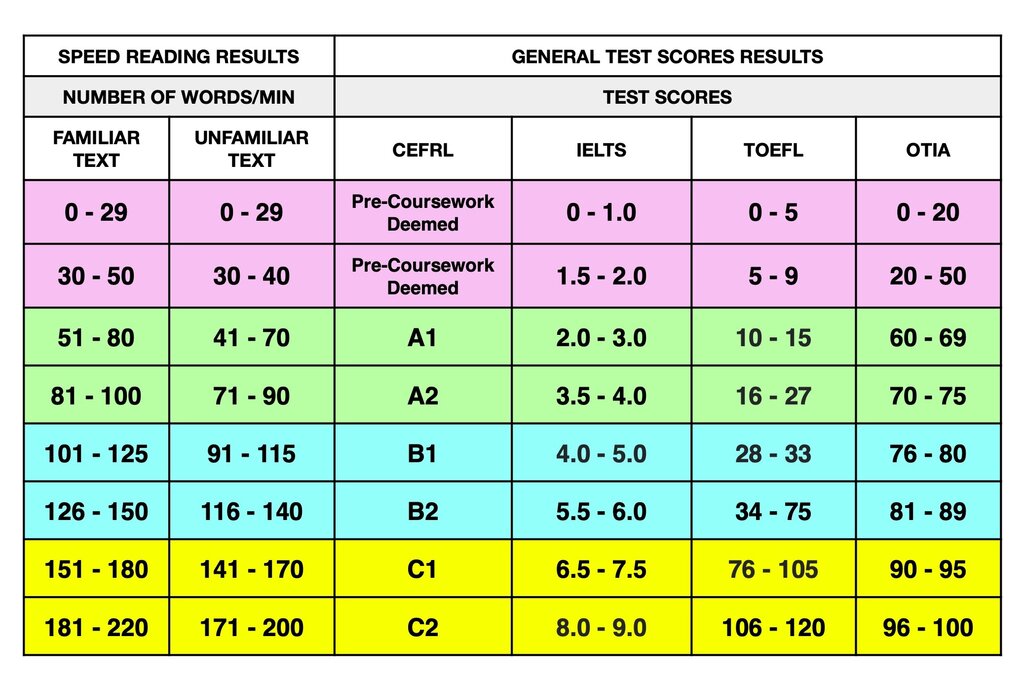
The Listening and Reading tests are marked based on the number of correct answers out of 40. The Writing and Speaking tests are assessed by certified examiners against a detailed set of criteria. For the Writing test, examiners assess Task Achievement (for Task 1) or Task Response (for Task 2), , Lexical Resource, and Grammatical Range and Accuracy. Each criterion is equally weighted.
In the Speaking test, the criteria are Fluency and Coherence, , Grammatical Range and Accuracy, and Pronunciation. Just like in the Writing test, these four criteria contribute equally to your final band score for the section.
A student planning to apply for a master's degree programme at a university in the UK should take which IELTS module?
Which two sections of the IELTS test are different for the Academic and General Training modules?
Knowing the test format, timing, and marking criteria is the first and most critical step. It transforms your general English skills into a targeted strategy for achieving your desired score.