Identify Quadrilaterals from Coordinates
Coordinate Plane Basics
Mapping Our Space
How do you describe where something is? You could say "it's over there," but that's not very precise. To pinpoint an exact location, we need a reference system. Think of a city map. To find a specific building, you might look for the intersection of a street and an avenue. The coordinate plane works the same way for numbers and shapes.
The coordinate plane is a flat, two-dimensional surface formed by two number lines that cross at a right angle. The horizontal line is called the x-axis, and the vertical line is called the y-axis.
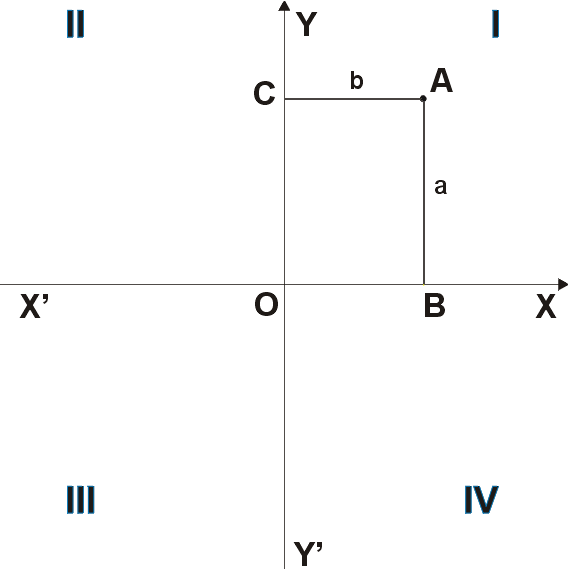
The point where these two axes intersect is a special landmark. It's called the origin.
origin
noun
The point where the x-axis and y-axis intersect on the coordinate plane. Its coordinates are (0, 0).
Coordinates as an Address
Every point on the plane has a unique address, written as an ordered pair of numbers, like . These are called coordinates.
The first number, the x-coordinate, tells you how far to move along the x-axis (left for negative, right for positive). The second number, the y-coordinate, tells you how far to move up or down along the y-axis (down for negative, up for positive).
Think of it like giving directions: first walk along the horizontal street, then take the elevator up or down.
The order is crucial. The point (2, 5) is completely different from the point (5, 2).
Plotting a Point
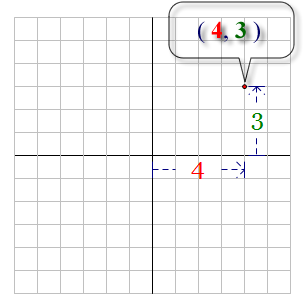
Let's plot the point .
- Start at the origin .
- The x-coordinate is 4, which is positive. Move 4 units to the right along the x-axis.
- The y-coordinate is 3, which is positive. From there, move 3 units straight up, parallel to the y-axis.
That's it. You've found the location of .
What about a point with negative coordinates, like ? We follow the same process.
- Start at the origin .
- The x-coordinate is -3. Move 3 units to the left along the x-axis.
- The y-coordinate is 1. From there, move 1 unit up.
This system of coordinates allows us to translate geometry into the language of algebra, opening up powerful ways to analyze shapes and solve problems.
What is the name of the horizontal number line in the coordinate plane?
What are the coordinates of the origin?