Ideal Gas Laws Explained
Introduction to Gases
What Makes a Gas a Gas?
Solids have a fixed shape. Liquids take the shape of their container but have a fixed volume. Gases are different. They have neither a fixed shape nor a fixed volume. A gas will expand to fill any container you put it in, no matter how large.
Imagine the particles that make up matter. In a solid, they're packed tightly together in an orderly way. In a liquid, they're still close but can slide past one another. In a gas, the particles are far apart and move around randomly and rapidly. This is why you can walk through the air with ease, but you can't walk through a wall.
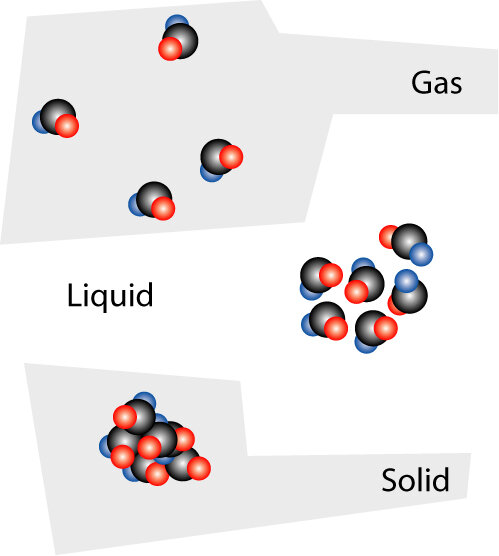
Because the particles are so spread out, gases are much less dense than liquids or solids. This also means you can compress them, squishing the particles closer together. Think about pumping air into a bicycle tire; you're forcing more and more gas into the same fixed volume.
The Key Variables
To describe the state of a gas, scientists use four main properties: pressure, volume, temperature, and the amount of gas. Understanding these is the first step to predicting how a gas will behave.
Volume (V) This is the simplest one. The volume of a gas is the amount of space it takes up. Since a gas expands to fill its container, the volume of the gas is simply the volume of the container it's in. It's usually measured in liters (L) or cubic meters ().
Temperature (T) Temperature tells us how hot or cold the gas is. On a microscopic level, it's a measure of the average kinetic energy of the gas particles. In simpler terms, hotter gas particles move faster. In science, temperature is often measured in Kelvin (K), not Celsius or Fahrenheit. To convert from Celsius to Kelvin, you just add 273.15.
Pressure (P) Pressure is the amount of force the gas exerts on the walls of its container. It's caused by the countless collisions of fast-moving gas particles with the container's surface. Think of a balloon. The air inside pushes outward on the rubber, keeping it inflated. That push is pressure. Pressure is commonly measured in atmospheres (atm), pascals (Pa), or pounds per square inch (psi).
Counting Gas Particles
The fourth variable is the amount of gas, which is often the trickiest to measure directly. Since we can't count individual atoms or molecules, chemists came up with a convenient unit called the mole.
mole
noun
A unit used in chemistry to express amounts of a chemical substance. One mole contains Avogadro's number of particles.
A mole is just a specific number, like how a "dozen" means 12. A mole is a much, much bigger number, though. One mole of any substance contains approximately particles. This huge number is known as Avogadro's number.
Avogadro's Number () = particles per mole.
Using moles makes it much easier to work with the enormous quantities of molecules in even a small sample of gas. The amount of gas, represented by the letter 'n', is measured in moles.
Which of the following best describes the shape and volume of a gas?
Gases are easily compressible because...