ICT in Trading Systems
Introduction to ICT
What Is ICT?
Information and Communication Technology, or ICT, is a broad term that covers any product that will store, retrieve, manipulate, transmit, or receive information electronically in a digital form. Think of it as the entire ecosystem that lets us create, share, and use digital information.
Information and Communication Technology (ICT)
noun
The infrastructure and components that enable modern computing and communication.
At its core, ICT is built on a few key components working together:
- Hardware: These are the physical parts you can touch. Your phone, laptop, the servers in a data center, and the cables connecting them are all hardware.
- Software: This is the set of instructions that tells the hardware what to do. It includes operating systems like Windows or iOS, and applications like your web browser or a stock trading app.
- Networks: These are the pathways that connect hardware and allow them to communicate. The internet is the biggest network of all, but your home Wi-Fi is also a network.
- Data: This is the raw information that gets processed, stored, and sent across networks. It can be anything from a simple text message to complex financial market data.
Think of ICT as a postal service. The hardware is the mail truck and post office, the software is the system for sorting and tracking letters, the network is the road system, and the data is the message inside the envelope.
A Quick History
While ICT feels modern, its roots go back over a century. The telegraph, invented in the 1830s, was the first major step. For the first time, information could travel faster than a person on a horse.
Things accelerated with the invention of the telephone and radio. But the true game-changer was the electronic computer in the mid-20th century. These room-sized machines were initially used for complex military and scientific calculations. Over time, they became smaller, faster, and more accessible, leading to the personal computer (PC) revolution in the 1980s.
The final piece of the puzzle was the internet. Originally a government project to create a decentralized communication network, it evolved into the World Wide Web, connecting billions of people and devices globally. The rise of mobile devices in the 2000s put all this power into our pockets, making ICT a constant part of daily life.
ICT in the Business World
In business, ICT isn't just a tool; it's a fundamental driver of strategy and operations. It has completely reshaped how companies create value, interact with customers, and compete in the market.
One of the biggest impacts is on efficiency. ICT automates routine tasks, from inventory management to payroll, freeing up employees to focus on more strategic work. It also enables seamless communication. A team can collaborate on a project from different continents, sharing files and holding video meetings as if they were in the same room.
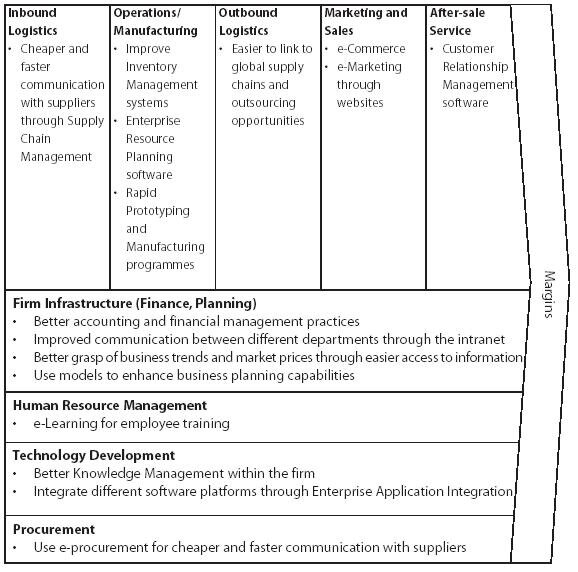
Furthermore, ICT is crucial for data management. Businesses collect vast amounts of data on customers, sales, and market trends. ICT systems allow them to store, analyze, and turn this data into actionable insights. This leads to better decision-making, from personalizing marketing campaigns to optimizing supply chains. Ultimately, a strong ICT foundation allows a business to be more agile, responsive, and competitive.
The Building Blocks
Let's look closer at the basic infrastructure that makes up a typical ICT system. These components are the foundation upon which applications and services are built.
This setup is common in both homes and businesses. The router acts as a gateway, connecting a Local Area Network (LAN) of internal devices to the wider internet, or a Wide Area Network (WAN).
- Servers are powerful computers that provide services to other computers on the network. They might host a company's website, store shared files, or run business-critical applications.
- Client Devices like desktops, laptops, and smartphones are what users interact with directly to access those services.
- Network Devices like routers and switches direct traffic, ensuring that data gets from its source to its destination efficiently and securely.
Now that you understand the key pieces of ICT, let's review the main concepts.
Ready to check your understanding?
Which of the following best defines Information and Communication Technology (ICT)?
What component of ICT provides the instructions that tell the physical hardware what to do?
Understanding these fundamentals is the first step. Next, we'll see how this powerful technological framework is specifically applied to revolutionize the world of trading.