ICSE Grade 10 Physics 2026
Rotational Force
The Turning Effect of Force
You know that a force can move an object in a straight line. But what happens when you want to make something turn? Pushing a door open, tightening a nut with a spanner, or even just turning a steering wheel all involve rotational motion. The force that causes this turning is called torque, or the moment of a force.
Torque isn't just about how hard you push or pull. It also depends on where you apply that force. Imagine trying to open a heavy door by pushing near its hinges. It’s incredibly difficult. But if you push on the side farthest from the hinges, near the handle, it swings open easily. The turning effect is much greater.
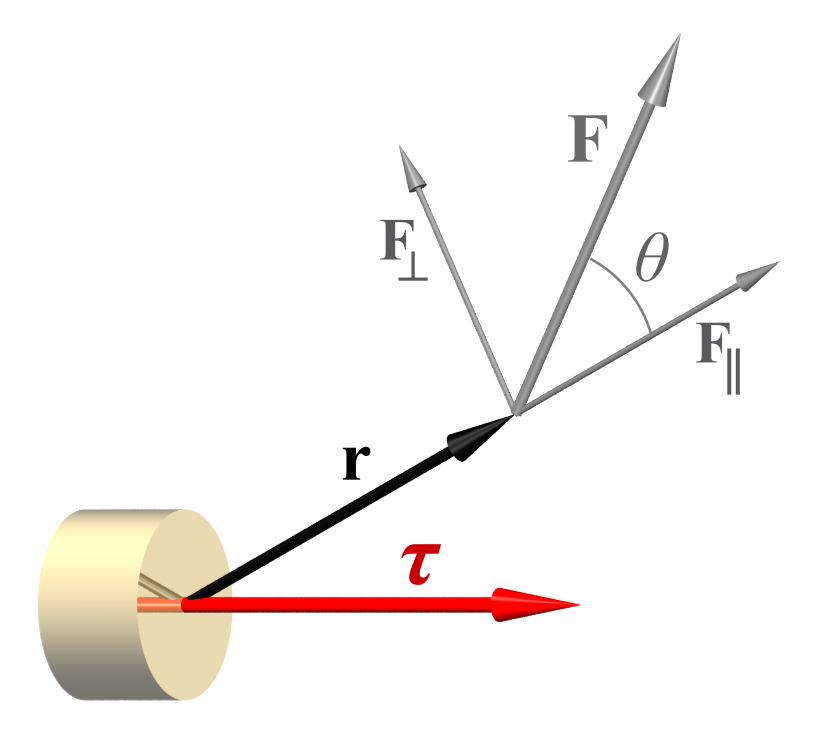
This leads us to the two key factors affecting torque: the magnitude of the force applied () and the perpendicular distance from the axis of rotation to the point where the force is applied. This distance is called the lever arm (). The relationship is simple and direct.
The direction of the turn matters. We define these as clockwise and anticlockwise moments. A force that tends to rotate an object in the direction the hands of a clock move produces a clockwise moment. A force causing rotation in the opposite direction produces an anticlockwise moments. By convention, clockwise moments are often taken as negative, and anticlockwise moments as positive.
The Principle of Moments
Have you ever played on a seesaw? If two people of different weights want to balance it, the heavier person must sit closer to the pivot (the fulcrum), and the lighter person must sit farther away. This is a perfect real-world example of the Principle of Moments.
When a body is in rotational equilibrium, the sum of the clockwise moments about any point is equal to the sum of the anticlockwise moments about the same point.
Couples and Equilibrium
Sometimes, a turning effect is produced not by one force, but by two. When two equal, opposite, and parallel forces act on a body along different lines, they form what is known as a s. A couple produces pure rotation without any linear motion. Think about turning a tap or winding a key. Your thumb and index finger apply equal and opposite forces, creating a couple that turns the object.
An object is in equilibrium when it's not accelerating—neither linearly nor rotationally. This requires two conditions to be met:
- The net force acting on the object is zero. (Static Equilibrium)
- The net torque (or moment) about any point is zero. (Rotational Equilibrium)
An object at rest is in static equilibrium. An object moving with constant velocity and constant angular velocity is in dynamic equilibrium.
Center of Gravity
Every object is made up of countless tiny particles, each pulled by gravity. The s (CG) is the single point where the entire weight of the object can be considered to act. For regular shapes like a sphere, cube, or a uniform rod, the CG is at their geometric center.
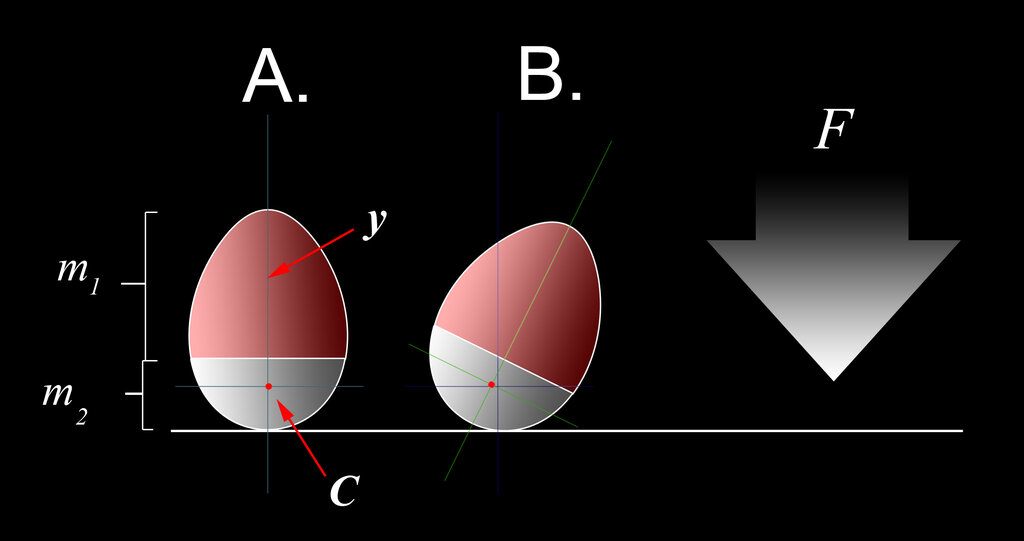
But what about an irregular object, like a piece of cardboard cut into a random shape? To find its CG, you can suspend it freely from a point on its edge. Hang a plumb line (a string with a weight) from the same point and draw a line along the string. Then, repeat the process by hanging the object from a different point. The point where the two lines intersect is the Center of Gravity.
Understanding these principles of rotational motion is essential for solving many physics problems, especially those involving levers, beams, and balanced systems.
Now, let's test your understanding of these rotational concepts.
What is the turning effect of a force on an object known as?
To maximise the torque when using a spanner to tighten a nut, you should apply the force:
Mastering torque, moments, and the center of gravity provides a powerful toolkit for analyzing how forces make the world turn.