ICSE Class 7 Biology Essentials
Plant Tissue Systems
The Building Blocks of a Plant
Just like a building is made of different materials, a plant is built from various types of tissues. Each tissue is a group of similar cells working together to perform a specific job. At the highest level, we can classify all plant tissues into two main groups: meristematic and permanent.
Meristematic tissues are for growth. Permanent tissues are for everything else, like support, transport, and protection.
Let's explore the tissues responsible for growth first.
Meristematic Tissues Growth Engines
Meristematic tissues are the plant's zones of active cell division. Think of them as construction sites where new cells are constantly being produced. These cells are small, have thin walls, and are packed with cytoplasm because their main job is to divide and create more cells. They are the reason plants grow taller, wider, and repair damage.
There are three types, based on their location:
- Apical Meristem: Found at the tips of roots and shoots. This is responsible for primary growth, making the plant taller and its roots longer.
- Lateral Meristem: Located along the sides of stems and roots. It's responsible for secondary growth, which increases the girth or thickness of the plant. This is what creates tree rings.
- Intercalary Meristem: Found at the base of leaves or internodes, especially in grasses. It allows for rapid regrowth. When you mow a lawn, the grass grows back thanks to its s.
Permanent Tissues Specialised Workers
Once cells from meristematic tissues are formed, they mature and take on specific roles. They lose their ability to divide and become permanent tissues. These are the specialised workers of the plant body, performing functions from support to transport. Permanent tissues are divided into simple and complex types.
Simple tissues are made of one type of cell. Complex tissues are made of multiple cell types working together.
Simple Permanent Tissues
These tissues form the bulk of the plant body and provide support and storage.
Parenchyma: These are the most common plant cells. They are living cells with thin walls and large vacuoles for storing food and water. When they contain chloroplasts for photosynthesis, they're called chlorenchyma. In aquatic plants, they can have large air cavities (aerenchyma) to provide buoyancy.
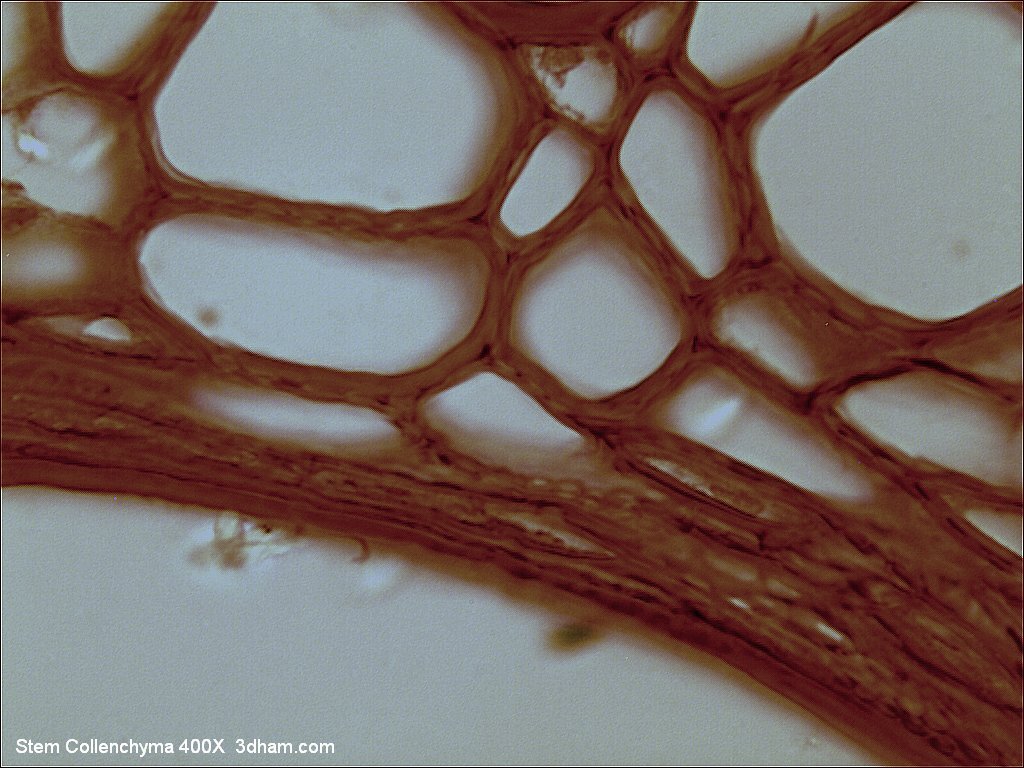
Collenchyma: Found below the epidermis in stems and leaves, these living cells provide flexible support. Their cell walls are unevenly thickened, usually at the corners. This allows young stems to bend without breaking.
Sclerenchyma: These cells provide rigid support. They have thick, hardened walls due to a substance called and are usually dead at maturity. There are two types: long, narrow fibres (like in jute) and shorter, irregular sclereids or stone cells (which give pears their gritty texture).
Complex Permanent Tissues
These are the plant's transport systems, moving water, minerals, and food throughout the organism. They are like the plumbing and delivery network of a city.
Vascular Tissue
noun
The transport system in vascular plants, made up primarily of xylem and phloem. These tissues are typically bundled together in vascular bundles.
Xylem: This tissue is responsible for transporting water and dissolved minerals from the roots up to the rest of the plant. It also provides mechanical strength. It's composed of four types of cells:
- Tracheids: Long, tapering cells with pits that allow water to pass from cell to cell.
- Vessels: Shorter, wider tube-like structures joined end to end to form a continuous pipe.
- Xylem Parenchyma: Living cells that store food and help in the sideways conduction of water.
- Xylem Fibres: Sclerenchymatous fibres that provide support.
Phloem: This tissue transports food, primarily sugars made during photosynthesis, from the leaves to other parts of the plant where it's needed for growth or storage. It's composed of:
- Sieve Tubes: Long, tube-like cells with perforated end walls called that allow food to pass through.
- Companion Cells: Associated with sieve tubes, these cells help regulate their activity.
- Phloem Parenchyma: Store food and help with transport.
- Phloem Fibres: Provide mechanical strength.
| Feature | Xylem | Phloem |
|---|---|---|
| Function | Transports water & minerals | Transports food (sugars) |
| Direction | Unidirectional (upwards) | Bidirectional (up & down) |
| Main Cells | Tracheids & Vessels | Sieve Tubes |
| Nature of Cells | Mostly dead at maturity | Mostly living at maturity |
| Provides | Mechanical Support | No mechanical support |
Protective Tissues
Finally, plants need a layer of protection from the outside world. This is the job of protective tissues.
Epidermis: This is the outermost single layer of cells covering the entire plant. It's like the plant's skin. It protects against water loss, infection, and injury. In leaves, the epidermis contains small pores called stomata for gas exchange, and in roots, it forms root hairs for water absorption.
Cork: As plants, especially trees, grow older and wider, the epidermis on the stem gets replaced by a tougher protective layer called cork or phellem. The cells of the cork are dead and have a waxy substance called suberin in their walls, making them impermeable to water and gases. This is the material we use for bottle stoppers and cork boards.
Which type of meristematic tissue is responsible for the increase in the girth or thickness of a plant stem?
The gritty texture of a pear is due to the presence of short, irregular sclerenchyma cells. What are these cells called?
Understanding these tissue systems is key to appreciating how a plant grows, transports vital substances, and protects itself from its environment.