ICSE 10 Numericals and MCQs
Force and Moments
The Balancing Act
When an object is balanced, it's in a state of rotational equilibrium. This means it isn't tipping one way or the other. The principle that governs this balance is the Principle of Moments. It states that for equilibrium, the sum of the anticlockwise moments about a pivot point must equal the sum of the clockwise moments about the same pivot.
A moment is the turning effect of a force. We calculate it by multiplying the force by the perpendicular distance from the pivot to the line of action of the force.
By convention, we treat anticlockwise moments as positive and clockwise moments as negative. When an object is perfectly balanced, the total positive moments cancel out the total negative moments, summing to zero. This leads to the core equation for solving these problems.
Solving for Equilibrium
Let's apply this. Imagine a uniform metre rule pivoted at its centre, the 50 cm mark. A weight of 40 gf (gram-force) is placed at the 20 cm mark. Where must a weight of 80 gf be placed to balance the rule?
First, identify the pivot. Here, it's at 50 cm.
Next, identify the forces. The 40 gf weight is on the left side. Since it's at the 20 cm mark, its distance from the pivot is . This force will try to turn the rule anticlockwise.
To balance this, the 80 gf weight must be placed on the right side, creating a clockwise moment. Let's call its distance from the pivot 'd'.
Now, we set up our equation based on the Principle of Moments.
Accounting for the Rule's Mass
What happens when the pivot isn't at the centre? In this case, the weight of the metre rule itself creates a moment. For any uniform object, we can treat its entire mass as acting at a single point called the . For a uniform metre rule, this is always at the 50 cm mark.
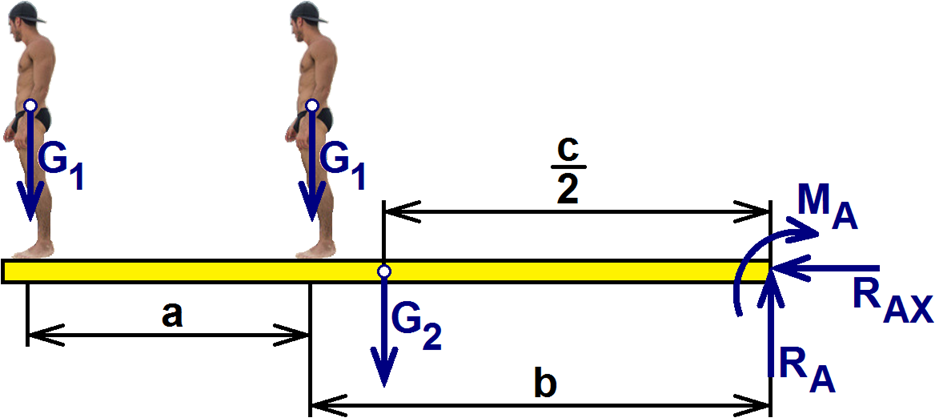
Let's say a uniform metre rule of mass 100 g is pivoted at the 30 cm mark. Where should a weight of 150 g be placed to balance it?
First, identify the forces and their positions:
- The rule's own weight: 100 g, acting downwards at the 50 cm mark.
- The added weight: 150 g, acting downwards at an unknown position, 'x'.
The pivot is at 30 cm. The rule's weight (at 50 cm) is to the right of the pivot, so it will create a clockwise moment. Its distance from the pivot is $50 - 30 = 20$ cm.
To balance this, the 150 g weight must be placed to the left of the pivot to create an anticlockwise moment. Its distance from the pivot will be $30 - x$.
Putting It All Together
Final problem: A uniform metre rule is pivoted at the 40 cm mark. It balances when a weight of 50 gf is hung at the 10 cm mark. What is the mass of the rule?
Here, the unknown is the mass of the rule, which we'll call 'M'.
- Pivot: 40 cm.
- Anticlockwise Moment: Caused by the 50 gf weight at the 10 cm mark. The distance is $40 - 10 = 30$ cm.
- Clockwise Moment: Caused by the rule's own mass, M, acting at the 50 cm mark. The distance is $50 - 40 = 10$ cm.
Now, apply the Principle of Moments.
Solving these problems always follows the same pattern. Identify the pivot, identify every force, calculate each force's distance from the pivot, and then carefully place each moment on the correct side of the equals sign.
What is the 'centre of gravity' of a uniform object?
A uniform metre rule is pivoted at its centre (the 50 cm mark). A weight of 40 gf is placed at the 20 cm mark. Where must an 80 gf weight be placed to balance the rule?