IB MYP Geography Essentials
MYP Geography Framework
The Geography Framework
In the International Baccalaureate (IB) Middle Years Programme (MYP), geography isn't taught in isolation. It sits within a broader subject group called 'Individuals and Societies'. This group also includes subjects like history, economics, and civics. The goal is to help students understand the world through an integrated lens, exploring the complex interactions between people, cultures, and their environments.
By design, this structure encourages interdisciplinary learning. A unit on urbanization, for instance, isn't just about drawing city maps. Students might explore the historical reasons for a city's growth, the economic factors driving its expansion, and the social challenges that arise from population density. They connect geographical concepts to real-world issues, seeing how different fields of knowledge overlap and influence one another.
How Students Are Assessed
MYP Geography assessment moves beyond simple fact recall. It evaluates what students can do with their knowledge. Four key criteria provide a consistent framework for measuring progress. These criteria focus on developing skills that are essential for inquiry and critical thinking in the social sciences.
| Criterion | Objective |
|---|---|
| A: Knowing and understanding | Use geographical terminology, demonstrate knowledge of concepts, and explain relationships between concepts and real-world examples. |
| B: Investigating | Formulate research questions, follow an action plan to collect and record information, and evaluate the research process. |
| C: Communicating | Communicate information using appropriate structures, varied formats (like maps, graphs, and essays), and citing sources correctly. |
| D: Thinking critically | Analyze concepts and sources, identify different perspectives, and synthesize information to form well-supported arguments. |
This approach ensures that students are not just passive recipients of information. They are active learners who must investigate issues, organize and present their findings, and think deeply about the meaning and implications of what they have learned.
Connecting to the World
To ensure that learning is relevant and meaningful, the entire MYP curriculum is framed by six global contexts. These are not topics to be studied, but rather lenses through which to view the material. They provide a shared starting point for inquiry and help students connect their learning to their own lives and to the wider world.
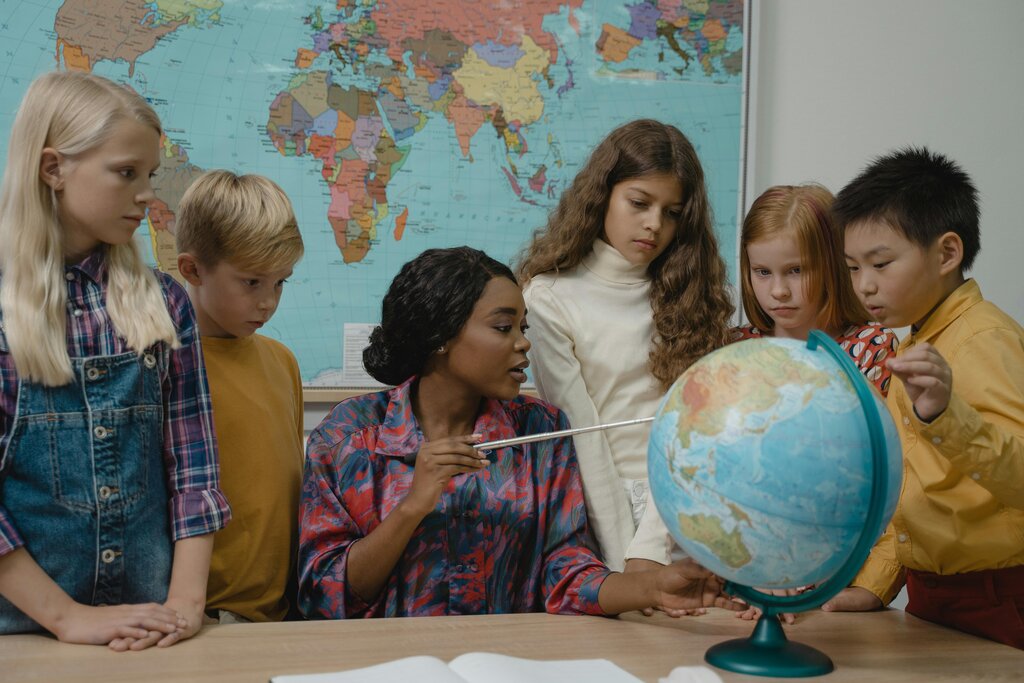
For a geography unit on water scarcity, a teacher might frame it within the global context of 'Globalization and sustainability'. This prompts students to explore questions about shared resources, international conflict, and the environmental impact of global consumption patterns. The global contexts push learning beyond the classroom, encouraging students to consider their role as responsible global citizens.
The six MYP Global Contexts are: • Identities and relationships • Orientation in space and time • Personal and cultural expression • Scientific and technical innovation • Globalization and sustainability • Fairness and development
In the IB Middle Years Programme (MYP), geography is taught as part of which subject group?
True or False: The primary focus of MYP Geography assessment is a student's ability to recall specific geographical facts and figures.
By integrating subject matter, focusing on skill-based assessment, and framing learning through global contexts, the MYP Geography curriculum prepares students to be thoughtful, engaged, and critical thinkers.