IB Biology Core and HL Mastery
Molecular Interactions
Water: The Molecule of Life
Life as we know it depends on water. Its unique properties aren't accidental; they stem from its simple yet powerful molecular structure. A water molecule () is polar. The oxygen atom pulls electrons closer, creating a slight negative charge, while the two hydrogen atoms become slightly positive. This polarity allows water molecules to attract each other, forming weak interactions called hydrogen bonds
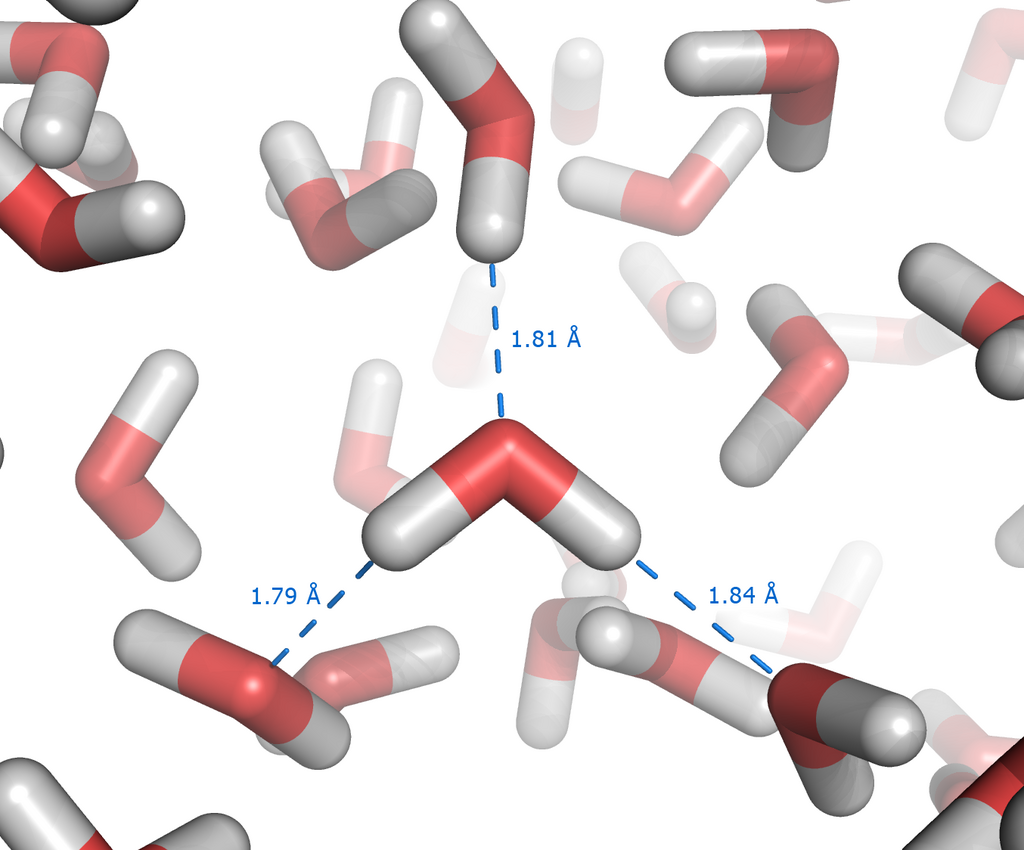
These bonds are constantly breaking and reforming, but collectively they are strong enough to give water remarkable thermal properties. A large amount of energy is needed to increase water's temperature because the energy is first used to break the hydrogen bonds. This is called a high specific heat capacity. It's why large bodies of water, and even our own bodies, maintain a stable temperature.
Similarly, a lot of heat is needed to turn liquid water into vapour. This high latent heat of vaporisation is crucial for cooling organisms through processes like sweating. As water evaporates from your skin, it takes a significant amount of heat with it.
Building and Breaking Life's Molecules
Life's large molecules, or macromolecules, are polymers built from smaller repeating subunits called monomers. The assembly and disassembly of these polymers follow a simple, elegant logic.
Condensation is the process that builds larger molecules. Two monomers join together, and a water molecule is removed in the process. This forms a new covalent bond between the monomers.
Hydrolysis, which means 'to split with water', is the reverse. A water molecule is added to a polymer, breaking a covalent bond and splitting it into smaller molecules or monomers. These two processes are fundamental to metabolism.
Carbohydrates, like glucose and starch, serve as key energy sources. Lipids, another vital class of macromolecules, include fats, oils, and waxes. They are crucial for long-term energy storage, insulation, and forming cell membranes. The structure of these lipids, particularly fatty acids, has significant health implications.
Fats and Your Health
Fatty acids are long hydrocarbon chains. Their properties depend on the bonds between their carbon atoms.
Saturated fatty acids have only single bonds between carbons. Their chains are straight, allowing them to pack tightly together. This is why fats rich in saturated fatty acids, like butter, are solid at room temperature.
Unsaturated fatty acids have one or more double bonds. These double bonds create kinks in the chain, preventing the molecules from packing closely. As a result, they are typically liquid at room temperature, like olive oil. If there is one double bond, it's monounsaturated. If there are two or more, it's polyunsaturated.
| Fatty Acid Type | Structure | Health Implication |
|---|---|---|
| Saturated | No double bonds, straight chain | High intake linked to increased LDL ('bad') cholesterol. |
| Monounsaturated | One double bond, kinked chain | Can help reduce LDL cholesterol and lower risk of heart disease. |
| Polyunsaturated | Two or more double bonds | Includes essential fatty acids like omega-3 and omega-6. |
| Trans Fats | Unsaturated fats with a trans-isomer double bond | Artificially produced. Strongly linked to heart disease. |
When evaluating claims about dietary lipids, it's important to analyse the type of fat, not just the total amount. A diet high in saturated and, especially, trans fats is associated with a higher risk of cardiovascular disease. Conversely, replacing these with unsaturated fats can have positive health benefits.
A common, though sometimes overly simplistic, metric for assessing weight status is the Body Mass Index (BMI). It relates a person's weight to their height.
For example, a person who is 1.75m tall and weighs 68kg would have a BMI of . While BMI is a useful screening tool for populations, it doesn't distinguish between fat and muscle mass, which is a significant limitation when assessing an individual's health.
Proteins: The Machinery of Life
Proteins are the most diverse macromolecules, performing a vast range of tasks from catalysing reactions (enzymes) to providing structure (collagen). A protein's function is dictated by its complex three-dimensional shape, which arises from four levels of structure.
- Primary structure: The specific sequence of amino acids in the polypeptide chain.
- Secondary structure: Hydrogen bonds between amino acids cause the chain to fold into repeating patterns, like the alpha-helix (a coil) or beta-pleated sheet (a folded sheet).
- Tertiary structure: The overall 3D shape of a single polypeptide, resulting from interactions (including hydrogen bonds, ionic bonds, and disulfide bridges) between the R-groups of different amino acids.
- Quaternary structure: The arrangement of two or more polypeptide chains to form a functional protein, like haemoglobin.
The entire set of proteins that can be expressed by a cell or organism is its proteome
If a protein loses its 3D structure, a process called denaturation, it also loses its function. This can be caused by changes in temperature or pH. For example, when you cook an egg, the heat denatures the albumin protein in the egg white, causing it to turn from clear and liquid to white and solid. The change is irreversible.
Time to test your understanding of these molecular concepts.
Why does water have a high specific heat capacity?
The process of joining two monomers together to form a larger molecule, with the removal of a water molecule, is called __________.
Understanding these molecular interactions provides the chemical foundation for all biological processes, from a single cell's metabolism to the health of an entire organism.