Hypertrophy and Strength for Wrists and Forearms
Forearm Anatomy Dynamics
Forearm Architecture for Mass
To build impressive forearms, you need to think beyond simple wrist curls. The forearm isn't a single muscle; it's a complex of two primary compartments that control every subtle movement of your wrist and hand. The anterior compartment handles flexion and pronation, while the posterior compartment manages extension and supination. Mastering how to target each is the key to balanced, three-dimensional growth.
Anterior Flexor Group
The anterior compartment houses your flexor-pronator group. These are the muscles that pull your palm towards your inner forearm (wrist flexion) and rotate your palm to face downwards (pronation). Most of these muscles originate from a common tendon attached to the medial epicondyle of the humerus, the bony bump on the inside of your elbow. From there, they run down the front of your forearm, crossing the wrist to act on the hand and fingers.
Functionally, this group is responsible for your grip strength and power in pulling motions. When you perform any kind of wrist curl, you're directly isolating this bundle of muscles. The pronator teres and pronator quadratus are also in this group, working specifically to turn the radius over the ulna, a movement critical for everything from turning a doorknob to executing a clean in the gym.
Posterior Extensor Group
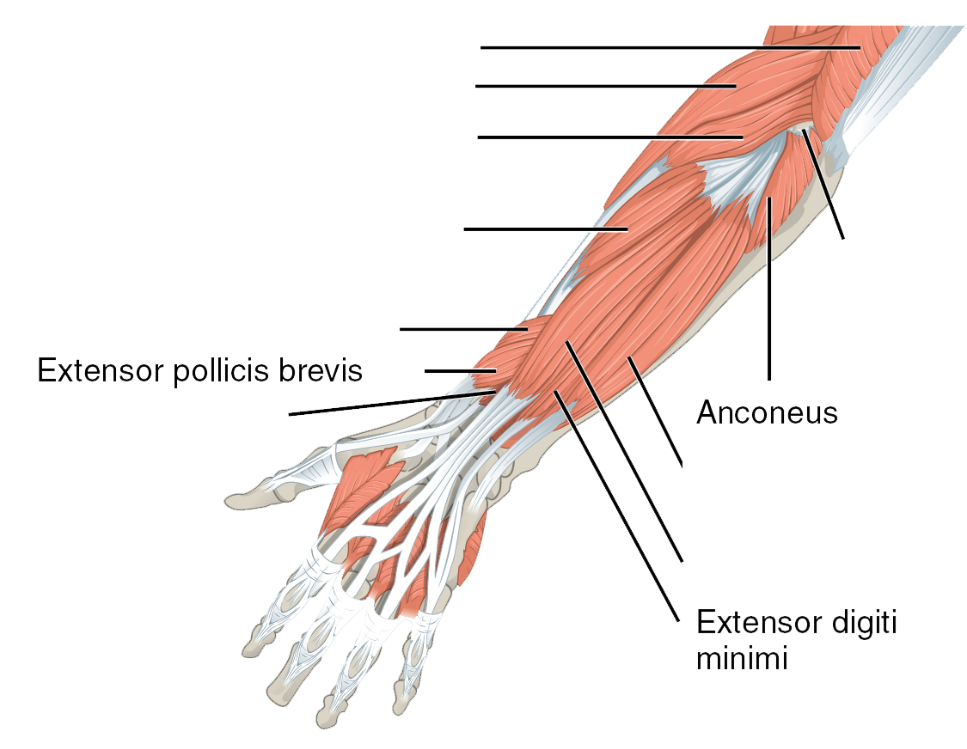
On the opposite side, the posterior compartment contains the extensor-supinator group. These muscles are the antagonists to the flexors. They originate primarily from the lateral epicondyle, the outer bump of your elbow, and run down the back of your forearm.
Their main jobs are to extend the wrist (lifting the back of your hand towards the ceiling) and supinate the forearm (rotating your palm to face upwards). Weak extensors relative to strong flexors can be a recipe for wrist pain and imbalances. Therefore, training this group with movements like reverse wrist curls is not just for aesthetics but for joint health and stability. The supinator muscle, which wraps around the upper part of the radius, is the prime mover for turning your palm up, a crucial action for movements like the final turn in a dumbbell curl.
Building Thickness
While flexors and extensors build the front-to-back depth of the forearm, two other key players are responsible for its width and thickness: the brachioradialis and the muscles involved in wrist deviation.
The Brachioradialis is a unique muscle. It originates on the humerus, far above the elbow, and inserts on the radius bone down near the wrist. Although it's a powerful elbow flexor, especially with the hand in a neutral or pronated grip (like in a hammer curl), its belly sits high on the lateral forearm, creating that coveted "Popeye" look. Because it doesn't cross the wrist joint, it doesn't flex or extend the wrist; its primary role is elbow flexion and stabilising the forearm during rapid movements.
The other dimension of growth comes from training the wrist's side-to-side movements: radial and ulnar deviations. Radial deviation is tilting your hand towards your thumb, and ulnar deviation is tilting it towards your little finger. These movements are controlled by muscles in both the anterior and posterior compartments, such as the flexor carpi radialis and extensor carpi ulnaris. Specifically targeting these movements with exercises like lever bar or cable deviations can add significant mass to the sides of the forearm, creating a thicker appearance from all angles.
So, a complete forearm routine must include:
- Flexion: Standard wrist curls to target the anterior compartment.
- Extension: Reverse wrist curls for the posterior compartment.
- Neutral-Grip Elbow Flexion: Hammer curls or reverse curls for the Brachioradialis.
- Deviation: Lever or cable work for radial and ulnar deviation to build width.
Let's test your understanding of forearm anatomy.
Most muscles in the anterior (flexor-pronator) compartment of the forearm originate from which bony landmark?
The posterior compartment of the forearm is primarily responsible for which two movements?
By understanding these distinct groups and their functions, you can move beyond generic exercises and start building your forearms with anatomical precision.