Hydroponic Tomato Mastery
Hydroponic Basics
Growing Without Soil
Imagine a tomato plant, vibrant and heavy with fruit, but with no soil in sight. Its roots dangle in a stream of water, getting everything they need to thrive. This is the core idea of hydroponics.
Hydroponics
noun
A method of growing plants in a water-based, nutrient-rich solution, without using soil.
Instead of roots searching through dirt for nutrients, hydroponics delivers a perfectly mixed cocktail of minerals directly to them. This gives growers incredible control over the plant's environment, leading to some impressive advantages over traditional farming.
By providing exactly what the plant needs, when it needs it, hydroponic systems can grow healthier plants faster, using far less water and space.
Common Hydroponic Systems
While the principle is simple, there are several ways to build a hydroponic system. Each has its own mechanics, but they all share the goal of efficiently delivering nutrients to the plant's roots. Let's look at three popular methods perfect for growing tomatoes.
For beginners, the Kratky method (passive hydroponics) or Deep Water Culture (DWC) are great starting points due to their simplicity.
First up is Deep Water Culture (DWC). This is one of the simplest systems. Plants are placed in net pots, and their roots are suspended directly in a reservoir filled with an oxygenated, nutrient-rich water solution. An air pump with an air stone, like you'd find in a fish tank, provides the oxygen the roots need to breathe.
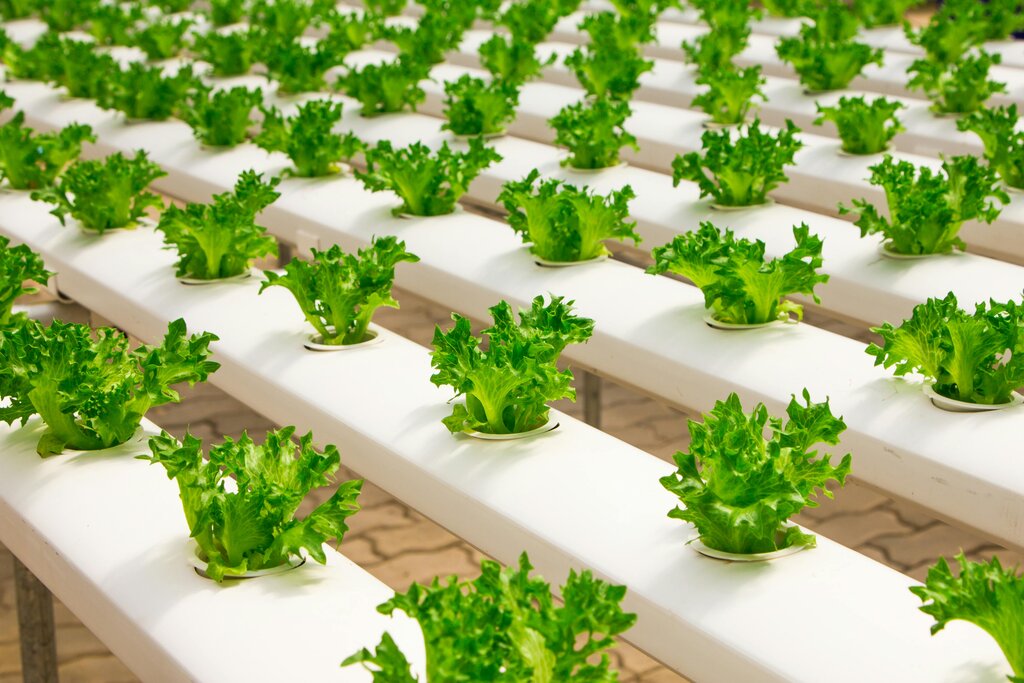
Next is the Nutrient Film Technique (NFT). In this system, plants are placed in a sloped, enclosed channel. A continuous, thin stream—or film—of nutrient solution flows down the channel, washing over the tips of the plant roots. The water is collected in a reservoir at the bottom and pumped back to the top to recirculate.
Finally, we have Ebb and Flow, also known as Flood and Drain. In this setup, plants sit in a grow tray filled with a growing medium like clay pebbles or perlite. The tray is periodically flooded with nutrient solution from a reservoir below. After a set time, the water drains back into the reservoir. This cycle repeats, allowing the roots to get nutrients and then air out.
Key Components of a Setup
Regardless of the system you choose, a few key components are universal for almost any hydroponic setup.
Reservoir: This is the container that holds your nutrient solution. It can be anything from a simple bucket for a DWC system to a larger tank for a more complex setup.
Pump: Most systems (except for passive ones like the Kratky method) need a pump. Submersible water pumps move the nutrient solution from the reservoir to the plants, while air pumps oxygenate the water in DWC systems.
Grow Trays or Channels: These are the structures that hold the plants and guide the flow of water. In Ebb and Flow, it's a tray; in NFT, it's a channel.
Lighting: If you're growing indoors, you'll need grow lights. Plants like tomatoes need plenty of strong, direct light to produce fruit. LED lights are a popular and energy-efficient choice for hydroponics.
With these basics in mind, you can begin to see how a soilless system can be tailored to fit almost any space, from a small apartment to a large commercial greenhouse.
What is the core principle of hydroponics?
Which hydroponic system is described as periodically flooding a grow tray with nutrient solution and then draining it away?