Hybrid Au–Ag Plasmonic Metasurfaces
Bimetallic Nanoplasmonics
Beyond a Single Metal
In plasmonics, we often deal with noble metals like gold and silver. Gold is incredibly stable and resists corrosion, making it reliable. Silver, on the other hand, boasts the sharpest and strongest plasmon resonances, but it tarnishes easily. What if we could get the best of both? This is where bimetallic nanostructures come in, combining gold (Au) and silver (Ag) to create materials with tailored optical properties.
To understand how these combinations work, we first need to look at their individual optical behaviour. The response of a metal to light is described by its complex dielectric function, . The real part, , tells us how much the material polarises in response to the light's electric field, while the imaginary part, , quantifies energy absorption or loss.
For plasmonic effects, we need the real part of the dielectric function to be negative, a condition met by noble metals at optical frequencies.
The behaviour of electrons in these metals can be approximated using the combined with terms for interband transitions. The Drude part describes the collective oscillation of free electrons, which is the heart of plasmon resonance. For a bimetallic system, this model gets a bit more complex. The effective dielectric function depends not just on the properties of Au and Ag, but on how they are mixed.
Alloys vs. Core-Shells
There are two main ways to combine gold and silver at the nanoscale: as an alloy or as a core-shell structure. In an alloy, the Au and Ag atoms are mixed together, often randomly. In a core-shell nanoparticle, a core of one metal is surrounded by a shell of the other.
These two configurations have distinctly different optical responses. For a random alloy, the dielectric function can be thought of as an average of the two metals, weighted by their relative amounts, or . Changing the ratio of gold to silver allows you to continuously tune the Localised Surface Plasmon Resonance (LSPR) frequency. The LSPR peak of an Au-Ag alloy nanoparticle lies somewhere between the peaks of pure Au and pure Ag nanoparticles.
Core-shell particles are different. Their resonance depends not only on the materials but also on the geometry, specifically the ratio of the core radius to the shell thickness. A thin gold shell on a silver core can protect the highly resonant silver from tarnishing while only slightly shifting its LSPR. Conversely, a silver shell on a gold core can enhance the brightness of the resonance compared to pure gold.
Tuning Resonance and Minimising Loss
The primary goal of creating bimetallic nanostructures is control. By adjusting the composition of an alloy, we can position the LSPR peak at a desired wavelength. This is crucial for applications like biosensing, where you want the resonance to perfectly match the wavelength of your laser source.
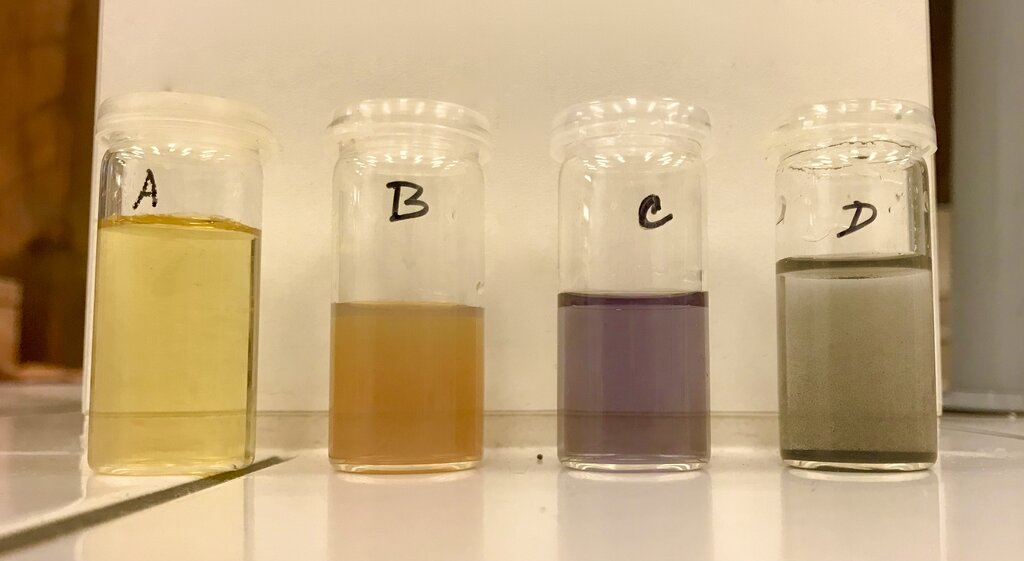
However, every resonance comes with a cost: energy loss. These ohmic losses are due to electrons scattering within the metal, which dampens the oscillation and converts some of the light energy into heat. This is represented by the imaginary part of the dielectric function, . Silver has lower ohmic losses than gold in the visible spectrum, which is why it has a sharper, higher-quality plasmon resonance.
The enhancement in the optical and photothermal properties of noble metal nanoparticles arises from resonant oscillation of their free electrons in the presence of light, also known as localized surface plasmon resonance (LSPR).
In bimetallic systems, a key challenge is to minimise these losses while achieving the desired resonance frequency and chemical stability. Core-shell nanoparticles offer a great solution. For example, a structure with a silver core and a very thin gold shell can maintain the low-loss properties of silver while being protected from the environment by the inert gold layer. This combines the high resonance quality of silver with the durability of gold, creating a nanostructure that is superior to what either metal could achieve on its own.
Understanding these material properties is the first step toward designing sophisticated metasurfaces. By choosing the right combination and configuration of gold and silver, we can create building blocks for devices that manipulate light in very specific ways.