Hungarian Fluency Foundations
Vowel Harmony Logic
The Sound of Harmony
Hungarian works like a set of magnetic building blocks. Instead of changing word order or adding lots of little words to show relationships, it snaps suffixes onto the end of root words. This is called agglutination, and the glue that makes it all stick together is vowel harmony.
At its heart, the rule is simple: the vowels within a word must belong to the same 'family.' This makes words flow more smoothly off the tongue. Hungarian divides its vowels into two main families based on where they are produced in your mouth.
Front vs. Back Vowels
The first group is back vowels (mély magánhangzók), which are formed at the back of the mouth. Think of the deep, open sounds.
deep/back vowels
The second group is front vowels (magas magánhangzók), formed at the front of the mouth. These are often higher-pitched.
high/front vowels
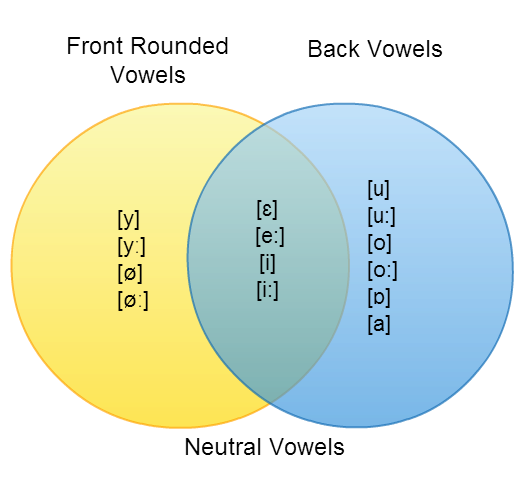
Some front vowels are also 'rounded,' meaning you round your lips to make the sound.
| Category | Vowels |
|---|---|
| Back (Mély) | a, á, o, ó, u, ú |
| Front Unrounded | e, é, i, í |
| Front Rounded | ö, ő, ü, ű |
The last vowel in a root word determines which family of suffix vowels you must use.
Harmony in Action
Let's see this in practice. The suffix for 'in' has two forms: -ban (with a back vowel) and -ben (with a front vowel). To say 'in the house,' you start with the word for house, ház. Since á is a back vowel, you use the back-vowel suffix: házban.
What about 'in the garden'? The word for garden is kert. The last vowel, e, is a front vowel. So, you use the front-vowel suffix: kertben. It's a phonetic chain reaction. The root word sets the rule, and the suffix follows.
The same logic applies to the dative case suffix -nak/-nek, which often translates to 'for' or 'to'.
- A lánynak (for the girl) — lány has a back vowel, so it takes -nak.
- A gyereknek (for the child) — gyerek has a front vowel, so it takes -nek.
This rule extends to making words plural. The plural suffix is -ok, -ek, or -ök.
- Ház (house) becomes házak (houses).
- Kert (garden) becomes kertek (gardens).
- Török (Turkish) becomes törökök (Turkish people). This form is used for words ending in a front rounded vowel.
Neutral Vowels and Exceptions
What about words with a mix of vowel types? This is where neutral vowels come in. The front unrounded vowels (e, é, i, í) are considered neutral. They can appear in words alongside back vowels.
When a word contains both back vowels and neutral vowels, the back vowels win. The word is treated as a back-vowel word. For example, the word papír (paper) has a back vowel (a) and a neutral front vowel (í). Since a back vowel is present, it takes back-vowel suffixes: papírnak (for the paper).
Words with only neutral vowels are treated as front-vowel words. The word víz (water) only has the neutral vowel í, so it takes a front suffix: vízben (in the water).
This system might seem complex, but it quickly becomes second nature. It's the underlying rhythm of the language, a principle that makes Hungarian surprisingly consistent once you understand the pattern. Many words borrowed from other languages are also an exception to the rule, often taking a front vowel suffix regardless of their own vowels, such as in the word sofőr (driver), which becomes sofőrnek.
Ready to test your understanding?
What is the core principle in Hungarian that governs which suffix form attaches to a root word?
The word for 'city' in Hungarian is város. The vowel á is a back vowel. Which of the following means 'in the city'?
Once you internalize the logic of vowel harmony, stringing together complex ideas in Hungarian becomes much more intuitive.