Human Physiological Control and Coordination
Neuron Membrane Dynamics
The Neuron's Electrical Charge
A neuron at rest isn't truly resting. It's maintaining a state of readiness, like a drawn bowstring, by holding a stable electrical charge across its cell membrane. This charge, known as the resting membrane potential, is typically about -70 millivolts (mV). The negative sign indicates that the inside of the neuron is more negative than the outside.
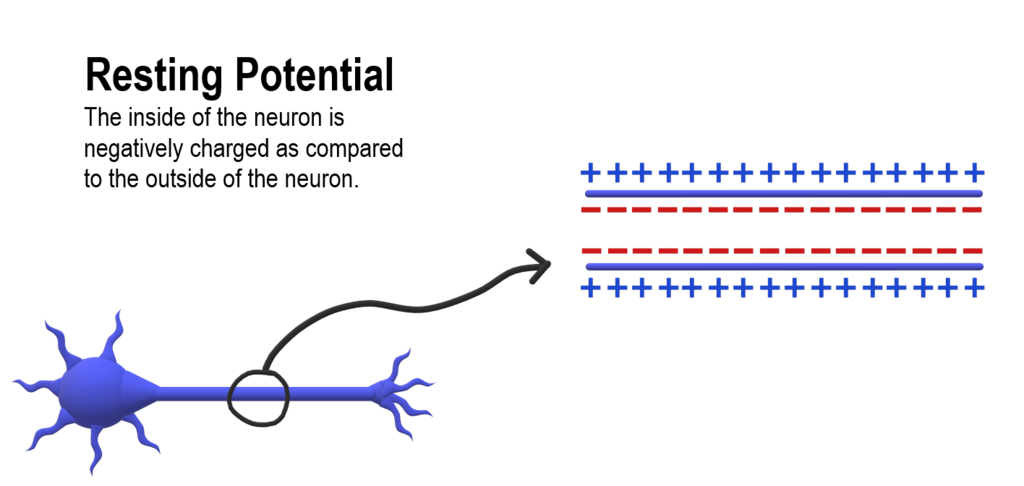
This potential difference is created and maintained by an uneven distribution of charged ions, primarily sodium (Na⁺) and potassium (K⁺), across the neuron's phospholipid bilayer. The environment outside the neuron is rich in Na⁺ ions, while the inside, the cytoplasm, has a higher concentration of K⁺ ions and negatively charged proteins.
This separation of ions creates two forces that are constantly in a delicate tug-of-war: the chemical gradient, which pushes ions from an area of high concentration to one of low concentration, and the electrical gradient, which pulls ions toward areas of opposite charge. Together, these form the electrochemical gradient, the driving force behind all neural signaling.
Maintaining the Balance
How does a neuron maintain this specific -70mV charge? The answer lies in two key features of its membrane: ion channels and a specialized protein pump.
The membrane is selectively permeable. It contains channels, which are proteins that form pores allowing specific ions to pass through. At rest, the membrane is much more permeable to K⁺ than to Na⁺ because it has many more "leak" channels for potassium. These channels are always open, allowing K⁺ to flow out of the cell, down its concentration gradient. As these positive ions leave, the inside of the cell becomes more negative.
The constant outflow of positive potassium ions is the primary reason the resting membrane potential is negative.
But if K⁺ ions are always leaking out, and a few Na⁺ ions are always leaking in, why don't the concentrations eventually even out? This is where the comes in. This protein is a marvel of cellular engineering, actively working to counteract the passive ion leaks.
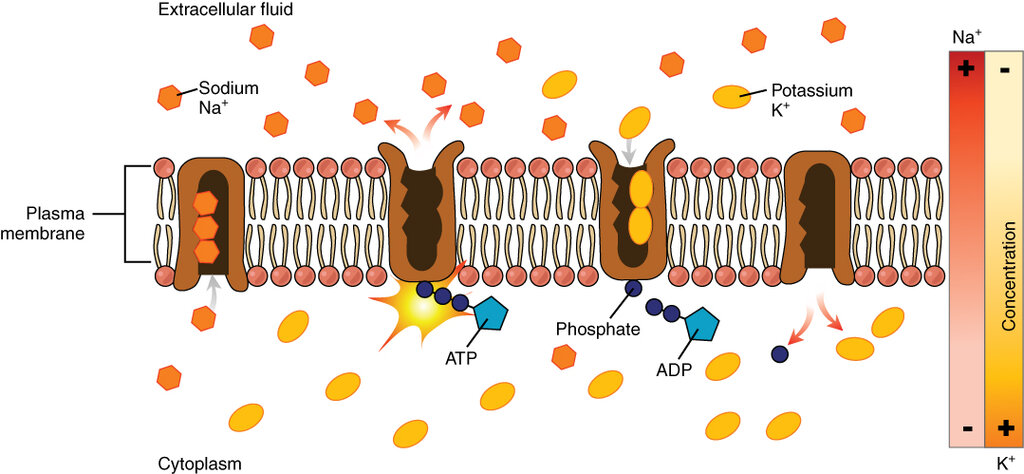
Using the energy from ATP (adenosine triphosphate), the pump actively transports three Na⁺ ions out of the neuron for every two K⁺ ions it brings in. This process moves both ions against their concentration gradients. Since it pumps out more positive charge than it brings in (3 Na⁺ out vs. 2 K⁺ in), the pump is electrogenic, meaning it contributes a small amount directly to the negative charge inside the cell.
Calculating Equilibrium
As potassium ions leak out of the cell, the interior becomes more negative. This growing negative charge starts to pull the positive K⁺ ions back in, opposing the chemical force pushing them out. Eventually, the electrical force pulling K⁺ in perfectly balances the chemical force pushing K⁺ out. The voltage at which this balance occurs is called the equilibrium potential for that ion.
Each ion has its own unique equilibrium potential, which can be calculated using the This equation considers the ion's charge and its concentration gradient across the membrane.
For potassium (K⁺) in a typical neuron, the equilibrium potential is around -90mV. For sodium (Na⁺), it's about +60mV. The neuron's resting membrane potential of -70mV is a weighted average of these equilibrium potentials, but it's much closer to K⁺'s potential because the membrane is far more permeable to potassium at rest.
This carefully maintained resting potential is the launchpad for every nerve impulse. It's a state of dynamic tension that allows the neuron to respond powerfully and rapidly to incoming signals, a topic we'll explore next.
What is the typical resting membrane potential of a neuron?
What is the primary role of the Sodium-Potassium ATPase pump?