Human Neuroscience
Systemic Integration
From Single Cells to Coherent Networks
You have already mastered the mechanics of individual neurons, but the brain is far more than a collection of isolated parts; it is a dynamic, interconnected powerhouse. This chapter bridges the gap between cellular activity and large-scale cognition by exploring how functional networks like the Default Mode and Central Executive systems coordinate your thoughts. By the end of this module, you will understand how these distributed architectures work in harmony to produce the coherent experience of consciousness.
The Syntax of Thought
To understand the brain at scale, we must move beyond the microscopic view of the single cell. You already understand the cellular mechanics of the nervous system—how an action potential surges down an axon and how synaptic transmission bridges the gap between neighbors. Think of these processes as the letters of an alphabet. Individually, an 'A' or a 'B' carries little information. They only gain meaning when arranged into words, sentences, and paragraphs. In the brain, those sentences are neural networks.
While a single neuron can signal an itch or a flash of light, it cannot plan a career or ponder a philosophical paradox. These higher-order feats require thousands of neurons in spatially separated regions to work in unison. This brings us to a critical distinction in modern neuroscience: the difference between the physical wiring and the actual conversation.
functional connectivity
noun
The temporal correlation or synchronization of neural activity between spatially distinct brain regions, regardless of whether they are directly connected by physical white matter fibers.
While provide the physical 'roads' (the white matter tracts), functional connectivity describes the 'traffic patterns.' It is entirely possible for two brain regions to be physically distant and not directly wired to each other, yet still oscillate in perfect synchrony. When regions fire together, they are effectively part of the same functional team.
Consider the metaphor of a grand orchestra. Each musician is an individual neuron, skilled and essential. But the music—the emergent phenomenon of consciousness and cognition—only happens when the musicians play in time with one another. If the violins and the cellos are out of sync, you have noise. When they harmonize, you have a symphony. In the brain, this harmony is achieved through large-scale networks that act as the 'sections' of the orchestra.
The Three Movements of the Mind
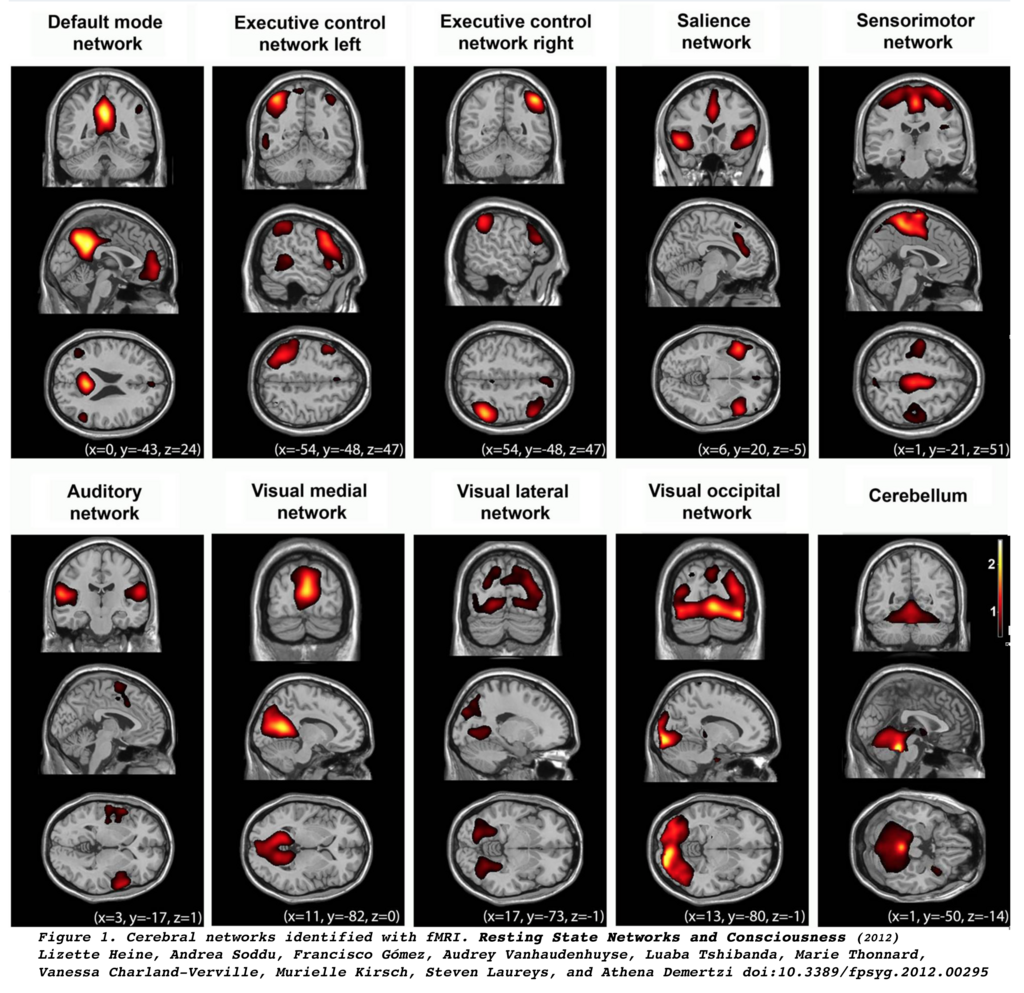
Neuroscientists have identified several primary networks that dominate our mental life. You can think of these as the three major 'movements' of the neural orchestra, each with a different tempo and purpose.
-
The Default Mode Network (DMN): This is the brain’s internal monologue. It activates when you are daydreaming, reflecting on the past, or imagining the future. It is the network of 'rest,' but it is incredibly active.
-
The Central Executive Network (CEN): This is the problem-solver. When you are focused on a difficult math problem or trying to follow complex instructions, the CEN takes the lead. It manages working memory and decision-making.
-
The Salience Network (SN): This is the conductor or the 'switch.' Its job is to monitor both internal and external environments to decide which of the other networks should be in control. If you are daydreaming (DMN) and a loud alarm goes off, the Salience Network abruptly shifts your brain's resources to the Central Executive Network to handle the threat.
Neuroscientists are learning that to understand brain function they need to look beyond functional segregation, or the localization of a particular function to a single area.
These networks are not static or rigid; they are profoundly dynamic. They constantly shift their activity levels based on your current needs. In a healthy brain, when the Central Executive Network ramps up, the Default Mode Network typically dials down—a relationship known as 'anti-correlation.' This fluid shifting allows us to transition from deep internal reflection to intense external focus in milliseconds. Understanding these large-scale architectures is the key to understanding how a three-pound organ creates the complexity of human behavior.
This orchestration of activity ensures that our cognitive resources are always deployed where they are needed most. In the following sections, we will take a closer look at each of these networks to see how their specific architectures support the unique functions of the human mind.
 How does the Salience Network actually decide what is important?
The Gatekeeper's Logic: How the Salience Network Judges Importance
If the Salience Network is the brain's conductor, it needs a way to listen to the entire orchestra at once. It doesn't just guess what is important; it relies on two primary biological hubs to make a judgment: the anterior insula and the anterior cingulate cortex (ACC).
Think of the as the brain's master sensor. It is uniquely positioned to monitor both your internal state (like your heart rate or hunger) and the external world (like a sudden movement in your peripheral vision). This dual monitoring is known as interoceptive and exteroceptive sensing. It gathers all this data to determine if something 'stands out' from the background noise of life.
Once the insula detects a noteworthy stimulus, it passes the baton to the (ACC). If the insula is the sensor, the ACC is the resource allocator. It is the region that decides how much cognitive muscle to flex in response to what the insula found. Together, they form a tight loop that 'tags' information as salient, signaling the rest of the brain to pay attention.
The Dispatcher and the Model
To visualize this process, imagine a high-stakes emergency dispatcher. The anterior insula is the phone line, constantly receiving calls about everything from a minor cat-in-a-tree to a major five-alarm fire. The dispatcher (ACC) must listen to these calls and decide which ones warrant sending out the fire trucks (cognitive resources). If you are sitting on your porch daydreaming, your 'fire trucks' are parked at the Default Mode Network station. But the moment the dispatcher hears 'fire,' they immediately signal the trucks to move to the Central Executive Network station to handle the crisis.
This decision-making process is driven by a concept called prediction error. Your brain is essentially a prediction machine; it constantly builds a model of what it expects to happen next. When you walk down a familiar hallway, your brain expects the floor to be solid and the walls to be where they always are.
If you suddenly trip on a loose rug, reality deviates from your internal model. This mismatch creates a 'prediction error' signal. The Salience Network is tuned specifically to these errors. It ignores the things that match your model (like the familiar walls) and 'tags' the unexpected rug as highly important. This trigger is what forces the brain to switch states, inhibiting the daydreaming of the DMN and activating the focus of the CEN.
Ultimately, the 'logic' of the Salience Network is rooted in survival and efficiency. By acting as a filter, it prevents us from being overwhelmed by every single heartbeat or background noise, while ensuring we never miss a threat or an opportunity. It is the biological switch that turns a passive observer into an active participant in the world.