Human Nervous System Integration
Electrochemical Signaling
Primed for Action
Every neuron in your body acts like a tiny, charged battery, holding a small amount of electrical potential across its membrane. This is called the resting membrane potential, typically sitting around -70 millivolts (mV). This negative charge inside the cell relative to the outside is not an accident; it's a carefully maintained state of readiness, crucial for sending signals.
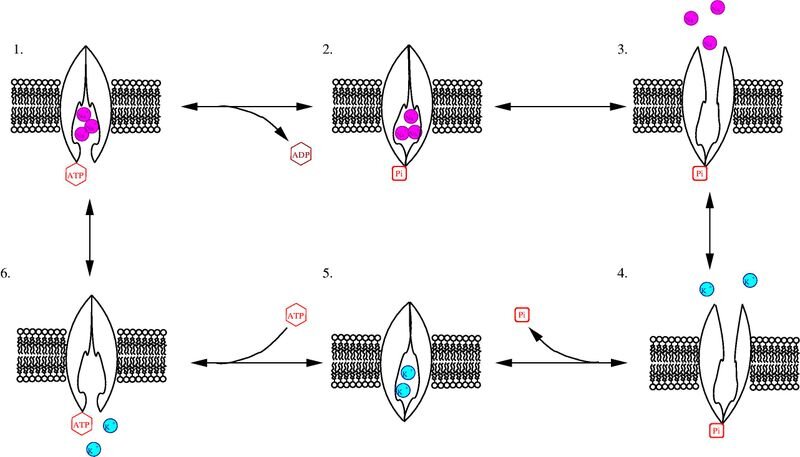
The key players in maintaining this balance are ions, specifically sodium (Na⁺) and potassium (K⁺), and the remarkable molecular machine known as the sodium-potassium pumps. These pumps are constantly at work, embedded in the neuron's membrane. For every cycle, they use energy to actively transport three sodium ions out of the cell for every two potassium ions they bring in. This creates two vital gradients: a concentration gradient (more Na⁺ outside, more K⁺ inside) and an electrical gradient (a net positive charge building up outside).
While the pumps set the stage, the resting potential is fine-tuned by leak channels. These are simple protein pores that are always open, allowing potassium ions to flow out of the cell down their concentration gradient. This outward leak of positive ions is what firmly establishes the negative charge inside the neuron, leaving it primed and waiting for a signal.
The All-or-None Signal
When a neuron receives a stimulus, it can cause a small, temporary change in membrane potential. But for a long-distance signal to be sent, a threshold must be reached—typically around -55 mV. Once this threshold is crossed, an unstoppable chain reaction called the action potential is triggered. It follows an all-or-none laws; it either fires with its full, consistent intensity, or it doesn't fire at all. There is no in-between.
The event begins with depolarization. Upon reaching the threshold, specialized voltage-gated channelss spring open. First, the fast-acting sodium channels open, allowing a flood of positive Na⁺ ions to rush into the cell. This influx of positive charge rapidly shoots the membrane potential up to about +30 mV.
This peak is short-lived. The depolarization itself triggers the inactivation of the sodium channels and the slower opening of voltage-gated potassium channels. Now, with the Na⁺ influx stopped and K⁺ ions rushing out of the cell, the positive charge inside decreases rapidly. This is repolarization, which brings the membrane potential back down toward its resting state.
Often, the potassium channels are a bit slow to close, leading to a brief overshoot called hyperpolarization, where the membrane becomes even more negative than its resting state. During this time, the sodium-potassium pump is working to restore the original ion concentrations. Immediately after the action potential, there is an absolute refractory period where the neuron cannot fire another signal, no matter how strong the stimulus. This is followed by a relative refractory period, where a stronger-than-usual stimulus is needed to trigger a new action potential.
Speeding Up the Signal
Once an action potential is generated, it needs to travel down the axon. In unmyelinated axons, this happens through continuous conduction. The action potential in one patch of membrane triggers a new one in the adjacent patch, propagating like a wave. It's reliable, but relatively slow.
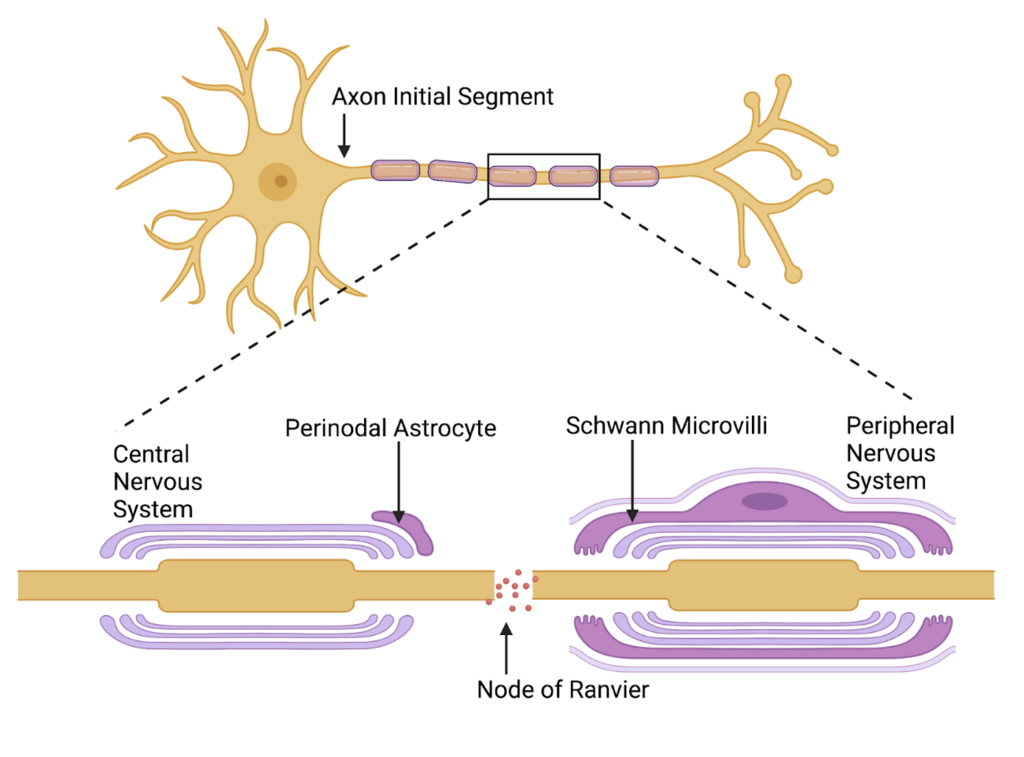
To increase speed, the nervous system evolved a clever solution: myelin. This is a fatty substance that wraps around the axon, acting as an electrical insulator. However, the myelin sheath is not continuous; it has small gaps called nodes of Ranvier. In myelinated axons, the ionic flux and regeneration of the action potential can only happen at these nodes.
The signal effectively "jumps" from one node to the next in a process called saltatory conductions. This is much faster and more energy-efficient than continuous conduction, as the pumps only need to restore ion balances at the nodes instead of along the entire length of the axon.
The trade-off is metabolic. Creating and maintaining myelin is a significant biological cost. This elegant system allows the human nervous system to transmit signals rapidly over long distances, ensuring the signal that tells your toe to move arrives almost instantly, without degrading along the way.
Now, let's review some of the key concepts we've covered.
Ready to test your knowledge? See if you can answer these questions about how neurons fire.
What is the primary role of the sodium-potassium pump in a neuron?
The principle that an action potential fires with its full, consistent intensity or not at all is known as the ______ law.
Understanding these electrochemical mechanics is fundamental to neuroscience, explaining not just how signals travel, but also how our nervous system processes information with such speed and reliability.