Human Digestive Physiology and Mechanics
GI Motility Coordination
The Gut's Own Brain
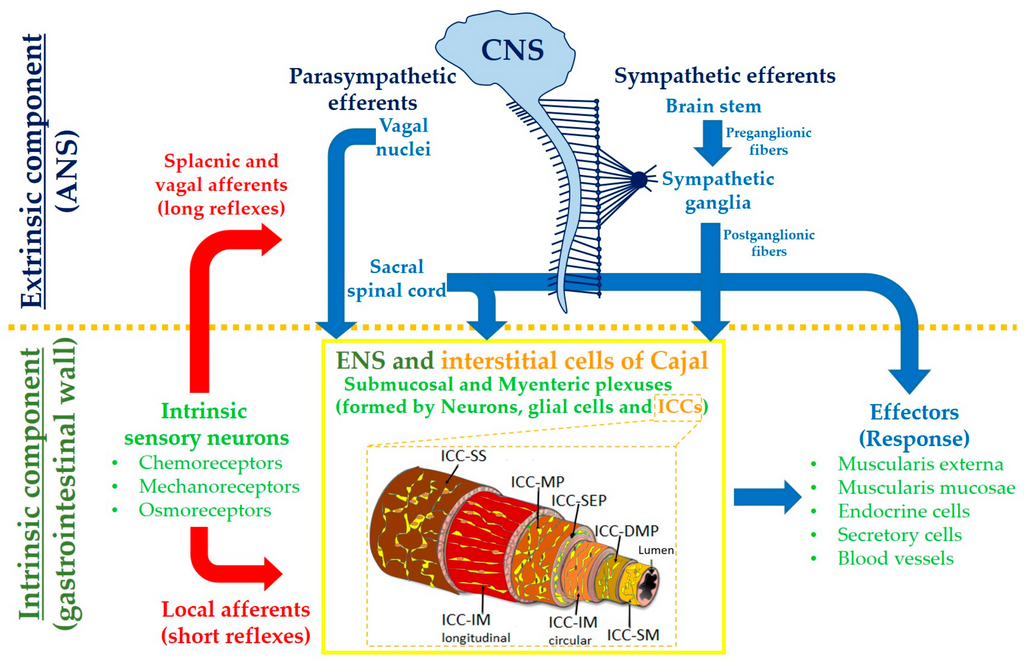
Your digestive tract operates with a surprising degree of autonomy, thanks to a complex network of neurons embedded in its walls. This network is the (ENS), often called the body's "second brain." It's so sophisticated that it can manage the intricate dance of digestion without any input from your actual brain.
The ENS is organised into two main layers, or plexuses. The myenteric plexus (also known as Auerbach's plexus) sits between the longitudinal and circular muscle layers of the gut wall. Its primary job is to control motility. The submucosal plexus (Meissner's plexus) is located in the submucosa and regulates functions like glandular secretion, absorption, and local blood flow. Together, they form an integrated circuit that directs the precise, rhythmic muscle contractions needed to move food along.
The Pacemakers of the Gut
Smooth muscle in the gut doesn't just contract on command from the ENS. It has its own intrinsic rhythm, a kind of electrical hum. This is generated by specialised cells called the (ICCs). Think of them as the gut's pacemakers, similar to the cells that set the pace for your heart.
ICCs generate rhythmic, spontaneous electrical depolarisations called "slow waves." These are not muscle contractions themselves, but they create a basal electrical rhythm. When the smooth muscle membrane potential reaches a certain threshold during a slow wave, an action potential is fired, triggering a contraction. The frequency of these slow waves varies along the GI tract, from about 3 per minute in the stomach to 12 per minute in the duodenum. The ENS modulates this activity, essentially deciding which slow waves will trigger a strong enough contraction to be effective.
Housekeeping and Mealtime
The gut's motility patterns change dramatically depending on whether you're eating or fasting. Between meals, the gut performs a cleaning routine. This is driven by the (MMC), a series of powerful, slow-moving peristaltic waves that sweep from the stomach down through the small intestine. Its purpose is to clear out undigested food, sloughed-off cells, and bacteria, preventing bacterial overgrowth.
The MMC has three distinct phases:
- Phase I: A quiet period with almost no contractions.
- Phase II: Intermittent, irregular contractions that don't propel content forward much.
- Phase III: A short burst of intense, regular, high-amplitude contractions that act as the intestinal broom.
When you eat a meal, the MMC stops, and the gut switches to a "fed state" pattern. This pattern involves two main types of contractions working together.
Peristalsis: These are the propulsive, wave-like contractions you're already familiar with, which push the chyme forward.
Segmentation: These are localised, ring-like contractions of the circular muscle. They don't push food forward but instead churn and mix the chyme with digestive enzymes, maximising contact with the absorptive surface of the intestinal wall.
Gatekeepers of the Tract
Movement through the GI tract is not a continuous free-for-all. It's carefully controlled by sphincters, rings of muscle that act as one-way gates. Their coordinated opening and closing ensure unidirectional flow and allow each organ enough time to do its job.
Swallowing, or deglutition, starts voluntarily but quickly becomes an involuntary reflex. As food moves down the oesophagus, the lower oesophageal sphincter (LOS) relaxes to let it pass into the stomach, then quickly closes to prevent acid reflux.
Once in the stomach, food is mixed into a semi-liquid paste called chyme. The pyloric sphincter carefully controls gastric emptying, releasing small amounts of chyme into the small intestine at a rate the intestine can handle. This rate is regulated by neural and hormonal feedback from the duodenum, based on the acidity, fat content, and osmolarity of the chyme.
Finally, the ileocaecal valve guards the junction between the small and large intestines. It prevents the bacteria-rich contents of the large intestine from flowing back into the sterile environment of the small intestine.
Now, let's test your understanding of how the gut coordinates its movements.
What is the primary function of the myenteric plexus (Auerbach's plexus) within the Enteric Nervous System?
The Interstitial cells of Cajal (ICCs) are best described as the gut's...
The intricate coordination between nerves, pacemaker cells, and muscles ensures your digestive system works efficiently, whether it's processing a meal or cleaning up between them.