Human Computer Interaction Essentials
Introduction to HCI
What is HCI?
Human-Computer Interaction, or HCI, is the study of how people design, implement, and use interactive computer systems. It's a field that sits at the crossroads of computer science, behavioral sciences, design, and several other fields of study.
A basic goal of HCI is to improve the interactions between users and computers by making computers more usable and receptive to the user’s needs.
Think about the apps you use every day. Some are a joy to use, while others are frustrating. The difference often comes down to good or bad HCI. The goal isn't just to make technology functional, but to make it usable, enjoyable, and effective for humans. It's about designing technology that fits into our lives seamlessly.
The Evolution of Interfaces
The way we interact with computers has changed dramatically over the decades. Early computers were complex machines operated by specialists who had to input commands line by line. There was no mouse, no icons, and no touchscreens. This was the era of the Command-Line Interface (CLI).
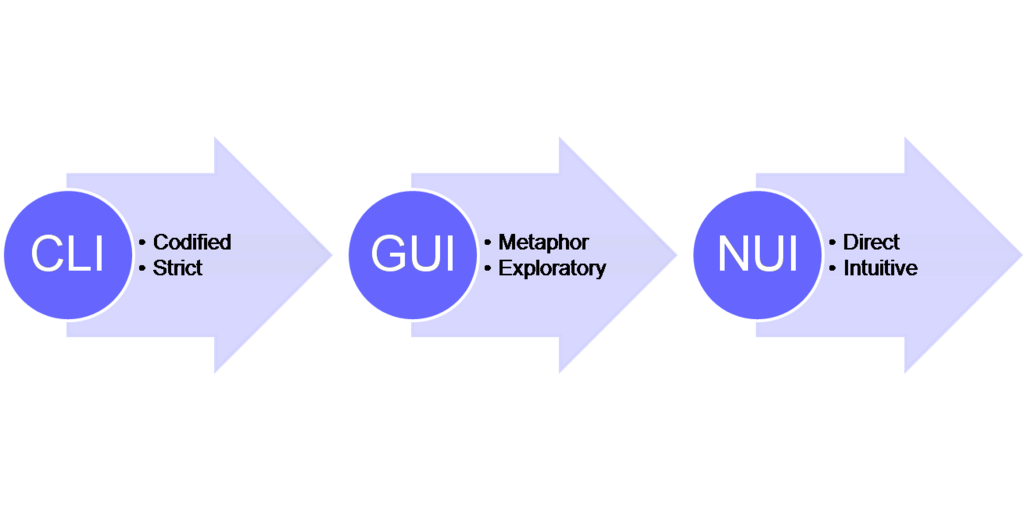
Then came the Graphical User Interface (GUI), which introduced visual elements like windows, icons, menus, and pointers (WIMP). This was a revolutionary shift. Suddenly, users could interact with computers by clicking, dragging, and dropping, using metaphors from the real world, like a desktop or a trash can. This made computers accessible to a much wider audience.
Today, we're in the era of Natural User Interfaces (NUI). We interact with devices by touching, swiping, and even speaking to them. These interfaces are designed to be so intuitive that they feel like an extension of our own actions.
A Cycle of Change
Technology doesn't just appear out of nowhere. It evolves in a cycle with the people who use it. This relationship is described by the task-artifact cycle.
The task-artifact cycle suggests that the tasks we perform influence the tools (artifacts) we create, and in turn, those new tools change the way we perform our tasks.
Think about writing. Originally, the task was to record information. The artifact was a pen and paper. When the computer and word processor were introduced, they were designed to make the existing task of writing easier. But these new artifacts changed the task itself. We started expecting to be able to edit text easily, check our spelling instantly, and share documents across the globe in seconds. This created new needs, which led to the development of even better tools, and so on. The tasks and the artifacts co-evolve.
Putting People First
At the heart of HCI is the concept of user-centered design (UCD). This philosophy pushes designers to focus on the users and their needs in every phase of the design process. Instead of building a product and then expecting people to adapt to it, UCD starts with understanding the people who will use it.
Why is this so important? Because technology that ignores its users often fails. It might be confusing, inefficient, or simply not solve the right problem. By involving users early and often—through research, interviews, and testing—designers can create products that are not only powerful but also intuitive and helpful.
This approach has a massive impact on technology and society. Well-designed systems can improve productivity in the workplace, make education more accessible, enhance healthcare, and connect people across the world. Conversely, poorly designed systems can lead to costly errors, frustration, and exclusion. HCI ensures that as technology becomes more integrated into our lives, it serves human needs first.
Now, let's test your understanding of these core concepts.
What is the central goal of Human-Computer Interaction (HCI)?
An interface that relies on visual elements like windows, icons, menus, and pointers (WIMP) is known as a...
HCI is a foundational field for anyone involved in creating technology. By understanding its history and core principles, we can better appreciate the thought and effort that goes into the devices and applications we use every day.